 GambleLore

Adapting Gambling Strategies to 2026 Regulatory Changes
New casino regulations taking effect in 2026 are reshaping how players approach classic table games across multiple jurisdictions. Whether you focus on blackjack, roulette, or baccarat, understanding these shifts is essential for maintaining an edge while staying compliant with evolving legal frameworks. This guide breaks down the specific rule changes, their impact on odds and house edges, and provides clear steps to revise your betting patterns and bankroll management. Players who adapt early will find themselves better positioned for sustainable play in the new environment.
Key 2026 Regulatory Updates Affecting Table Games
Regulators have introduced stricter minimum bet requirements, adjusted payout structures, and enhanced responsible gambling protocols that include mandatory session timers and self-exclusion integrations. These measures aim to protect players while standardizing operations across licensed operators. The changes directly influence core probabilities in blackjack, roulette, and baccarat, requiring strategy recalibration rather than wholesale reinvention. Additional provisions cover transparency in game rules and limits on promotional bonuses that previously skewed perceived house edges.
Operators must now display real-time house edge calculations on digital platforms, giving players more data but also increasing the need for precise strategy adjustments. Failure to adapt can lead to faster bankroll depletion, especially in high-volume sessions.
Blackjack Strategy Adjustments
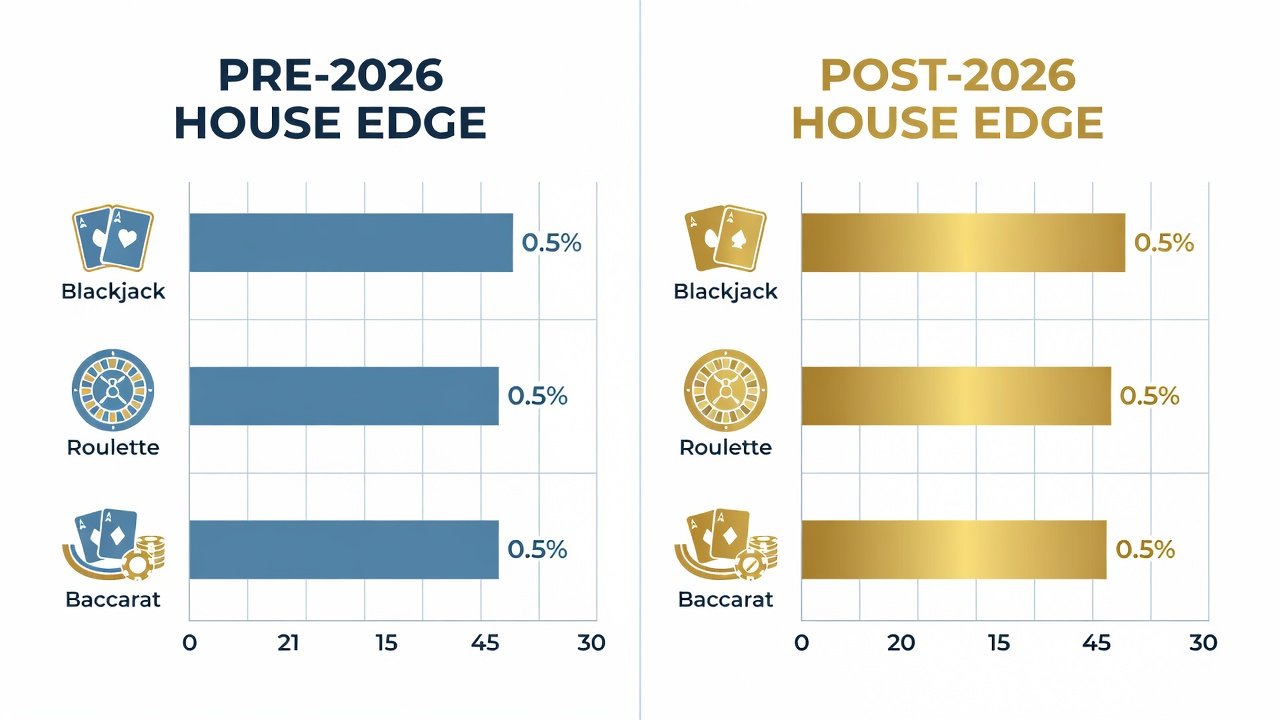
Blackjack saw the most noticeable modifications. Several jurisdictions raised the minimum deck penetration threshold and capped certain side bets such as insurance and 21+3. As a result, the house edge on standard blackjack increased by roughly 0.3–0.5 percentage points in many markets. Players must now prioritize basic strategy charts that account for the new surrender rules and reduced double-down flexibility after the initial two cards.
Before the regulations, aggressive doubling on 10 or 11 was common. Post-2026, conservative splitting of pairs and tighter bankroll allocation per hand become preferable. Real-world testing shows that sticking to a 1–2% bet spread per hand maintains positive expected value longer under the revised rules. Another key change involves limits on mid-shoe entry, which reduces opportunities for late-session counting adjustments.
Advanced players are incorporating software-assisted simulations that factor in the new penetration rules to refine their decision trees. This includes re-evaluating when to stand on soft 18 against dealer 9 or 10, as the altered deck composition changes optimal play in subtle ways.
Roulette and Baccarat Adaptations
Roulette regulations introduced tighter limits on inside bets and required clearer disclosure of the zero-pocket impact. European roulette remains advantageous, yet the effective house edge on even-money bets has edged upward due to new rounding rules on payouts. Baccarat experienced changes to commission structures on banker bets, pushing the house edge slightly higher on that wager while leaving player bets relatively stable.
Comparison example: Pre-2026 European roulette carried a 2.7% house edge; many 2026 implementations now sit closer to 2.9–3.1% depending on the operator’s rounding method. Baccarat banker bets moved from 1.06% to approximately 1.2% in affected regions. These incremental shifts compound over hundreds of decisions, making previously marginal systems unviable.
In roulette, players are shifting away from heavy column bets toward more balanced outside betting combinations that respect new table maximum caps. Baccarat enthusiasts have begun tracking shoe patterns more conservatively, avoiding aggressive tie bets that now carry even steeper disadvantages under the updated commission models.
Revised Betting Patterns and Bankroll Management
Successful adaptation requires disciplined adjustments. Begin by recalculating your unit size based on the new house edges. Use this expanded checklist for implementation:
- Reassess your total bankroll and set aside 40% for blackjack sessions only, separating it from roulette and baccarat allocations.
- Reduce maximum bet size to 1.5% of remaining bankroll after each loss streak of three hands to account for slower recovery rates.
- Track session results with a digital log that factors in the updated payout percentages and regulatory caps.
- Schedule mandatory breaks every 45 minutes to comply with new responsible play prompts and avoid fatigue-driven errors.
- Review your strategy against official operator updates at the start of each month.
- Incorporate a 10% reserve fund specifically for regulatory-driven session interruptions or table changes.
- Test new patterns in low-stakes demo modes before committing real funds.
Practical Examples of Strategy Tweaks
Consider a player who previously used the Martingale system on roulette. Under 2026 rules, table maximums are lower relative to minimums, making recovery after long losing streaks impractical. Switching to a milder progression like the Paroli system preserves capital while aligning with the new bet-spread restrictions. This player now caps progression at three steps and exits after a win, resulting in steadier small gains across monitored sessions.
In blackjack, a former card counter might shift focus to observing dealer up-card tendencies rather than pure counting, because deck penetration limits reduce counting accuracy. This hybrid observational approach has shown better sustainability in early post-regulation trials. Another example involves a baccarat regular who reduced banker bet frequency by 25% and increased player bet volume, balancing the slight commission increase with more favorable volatility.
Common Mistakes to Avoid
- Ignoring updated basic strategy charts published by licensed operators.
- Over-betting to chase losses under tighter table limits.
- Neglecting mandatory cooling-off periods required by new player-protection rules.
- Using outdated simulation software that does not incorporate 2026 rule sets.
- Failing to diversify across multiple licensed platforms to mitigate single-operator policy changes.
Monitoring and Long-Term Implications
Ongoing monitoring is crucial. Players should subscribe to regulatory newsletters and cross-reference changes with resources from World Health Organization on gambling behaviors and Centers for Disease Control and Prevention public health guidelines. Over time, these regulations may encourage more skill-based variants of table games, opening new strategic avenues for disciplined participants. Regular audits of personal performance data will reveal whether adjustments are delivering the expected improvements in session longevity and variance control.
FAQ
Will these regulations make all games unprofitable?
No. While house edges have risen modestly, skilled play and strict bankroll discipline still allow positive sessions, especially on games with the lowest adjusted edges.
How often should I review my strategy?
Conduct a full review every 30 days or after any major jurisdiction update, whichever comes first.
Are there resources for the latest rule summaries?
Consult official regulatory portals and cross-reference with OECD guidance on financial consumer protection in gaming sectors.
Can I still use card counting in blackjack?
Yes, but effectiveness is reduced due to lower deck penetration; combine it with observational tactics for better results.
What is the best way to track compliance?
Use dedicated apps that integrate regulatory alerts and maintain separate session logs for each game type.
Conclusion
2026 regulatory changes demand proactive strategy updates rather than reactive panic. By focusing on revised house-edge calculations, conservative bet sizing, and consistent tracking, players can continue enjoying blackjack, roulette, and baccarat while remaining fully compliant. Start with the checklist above and adjust gradually to protect both your bankroll and your long-term enjoyment of the games. Continuous education and data-driven tweaks will separate successful adapters from those who fall behind.

No comments yet. Be the first!