 GambleLore

Introduction: Why Blackjack vs Roulette Matters in 2026
In the ever-evolving world of online casinos, Blackjack and Roulette remain two of the most popular table games. As we head into 2026, advancements like VR casinos and AI-driven strategy tools are reshaping how players approach these classics. But which game offers better odds? Which strategies deliver real results? This showdown compares house edges, basic and advanced techniques, betting progressions like Martingale, and emerging trends. Whether you're a newbie or seasoned pro, we'll uncover hybrid tips to boost your long-term success.
Blackjack, a skill-based card game, pits you against the dealer with decisions impacting outcomes. Roulette, a game of pure chance, relies on where a ball lands on a spinning wheel. Understanding their differences is key to smart play. We'll break down math, strategies, risks, and future-proof advice.
House Edge Breakdown: The Casino's Built-in Advantage
The house edge is the casino's mathematical advantage over time. It's why casinos profit long-term, but savvy players can minimize it.
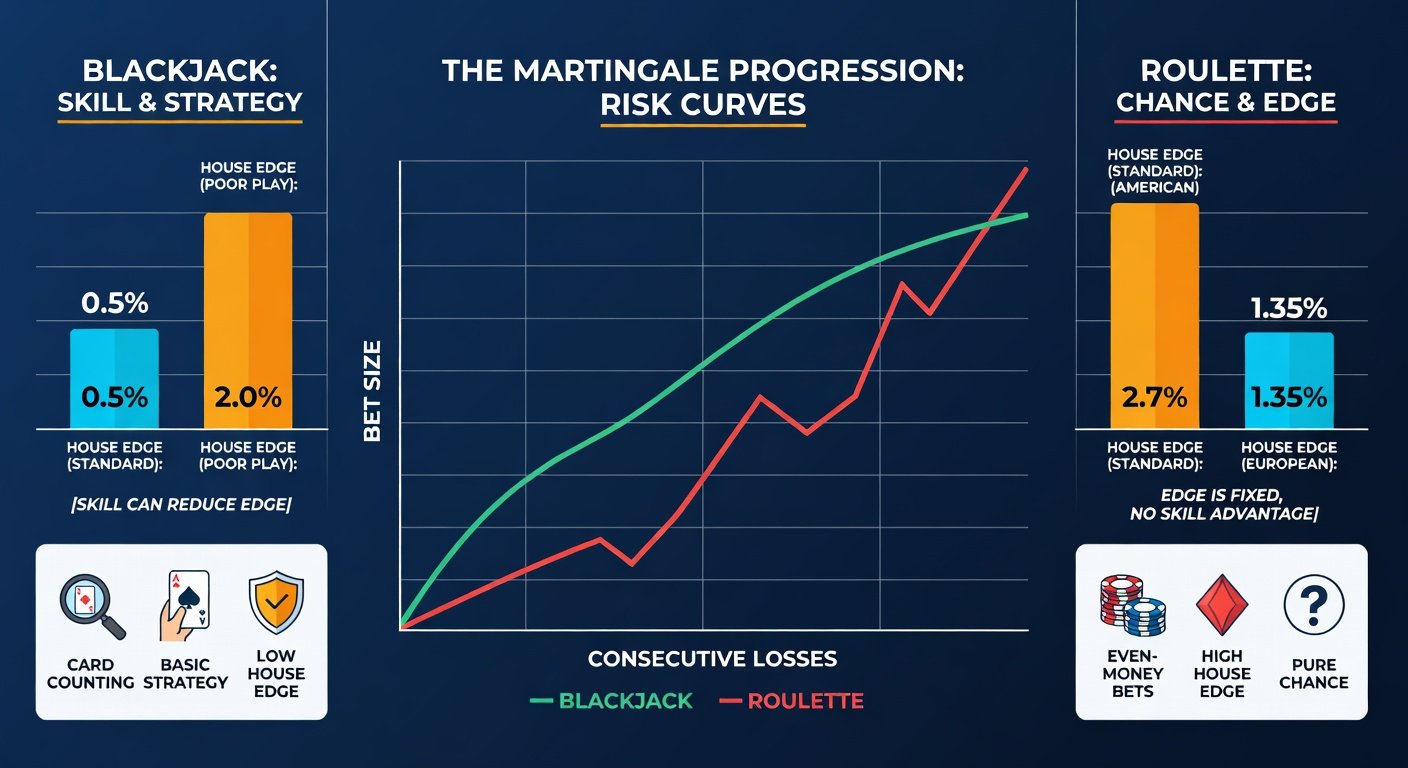
- Blackjack House Edge: As low as 0.5% with perfect basic strategy. Variants like single-deck can dip under 0.2%, but multi-deck games average 0.5-1%.
- Roulette House Edge: European (single zero) at 2.7%; American (double zero) at 5.26%. No skill reduces this—it's fixed.
Blackjack wins here for low-edge seekers. For context, slots often exceed 5-10%. Check detailed odds on authoritative sites like Wizard of Odds.
Quick Comparison Table
| Game | Best House Edge | Skill Influence |
|---|---|---|
| Blackjack | 0.5% | High |
| European Roulette | 2.7% | None |
| American Roulette | 5.26% | None |
This edge gap means Blackjack rewards strategy; Roulette favors luck.
Basic Strategies: Foundations for Every Player
Start simple to build confidence.
Blackjack Basics
Memorize a basic strategy chart: Hit on 16 vs. dealer 10? No—stand on hard 17+. Key rules:
- Always split Aces and 8s.
- Double down on 11 vs. dealer 2-10.
- Stand on soft 18 vs. dealer 2,7,8.
Apps and charts are free online. Practice reduces edge from 2% to 0.5% instantly.
Roulette Basics
Bet outside: Red/Black, Odd/Even (1:1 payout, 2.7% edge). Avoid American wheels. Skip single numbers (35:1, 2.7% edge but high variance).
Basic tip: Stick to even-money bets for steady play.
Advanced Techniques: Elevate Your Game
Go beyond basics for edges.
Blackjack Advanced
Card counting (Hi-Lo system): Track high/low cards. +2 deck = bet more. Legal but casinos counter with shuffles. Expect 1-2% player edge in perfect conditions. Use simulations; real casinos ban counters.
Side bets like Perfect Pairs add fun but hike edge to 6%—avoid unless recreational.
Roulette Advanced
No true "advanced" due to independence of spins (gambler's fallacy beware). Sector slicing or visual ballistics (predicting ball deceleration) works in live dealer but edges are tiny (1-2%) and require practice. Physics-based, not magic.
Pro tip: Online RNG roulette? Pure math—no prediction.
Betting Progressions: Martingale and Beyond
Progressions manage losses but risk ruin.
Martingale System
Double after loss: Bet $10, lose → $20, lose → $40, win → profit $10. Works short-term on even-money bets.
- Blackjack Fit: Volatile; blackjacks disrupt. Table limits cap at 8-10 doubles ($5000+ bets).
- Roulette Fit: Perfect for red/black, but 9-loss streak = bankruptcy risk.
2026 twist: AI bots simulate millions of spins, showing 99% ruin rate long-term due to house edge.
Alternatives
- Paroli (Reverse Martingale): Double after wins. Positive progression, lower risk.
- D'Alembert: +1 unit after loss, -1 after win. Safer for Roulette.
- 1-3-2-6: Fixed sequence for Blackjack even-monies.
Never chase losses—set stop-losses.
2026 Trends: VR, AI, and Online Evolution
Online casinos hit $100B+ by 2026. Key shifts:
- VR Casinos: Immersive tables in Meta Quest-style. Blackjack with haptic feedback; Roulette with 360° wheel views. Lowers edge via live dealers (0.4% Blackjack).
- AI Strategy Coaches: Real-time basic strategy nudges. Apps like those from Blackjack Wikipedia evolve to VR overlays.
- Crypto & Provably Fair: Blockchain verifies RNG. Roulette edges transparent.
Trend: Hybrid VR/live streams cut latency, boosting mobile play. Expect 20% VR adoption per industry forecasts.
Risk-Reward Analysis: Real-Win Examples
Math meets reality.
Session Simulations
1000 hands/spins, $10 units:
| Strategy | Blackjack EV | Roulette EV | Bankroll Risk |
|---|---|---|---|
| Basic | -$50 | -$270 | Low |
| Martingale | -$100 | -$500 | High (Ruin 40%) |
| Counting/Physics | +$200 | +$50 | Medium |
Example: Player A (Blackjack basic, $1000 bankroll) ends +$150 after 500 hands. Player B (Roulette Martingale) hits limit, down $800. Real win: Pro counter nets $5k/night pre-ban.
Risk: Variance. Blackjack standard deviation ~1.15 units/hand; Roulette 2.0 for even bets.
Hybrid Tips: Switching Between Games for Success
Maximize by blending:
- Bankroll Split: 60% Blackjack (skill), 40% Roulette (fun).
- Session Rotation: 1hr Blackjack strategy grind → 30min Roulette progression unwind.
- Martingale Hybrid: Use D'Alembert on Roulette, flat-bet Blackjack.
- VR Switch: Practice counting in VR Blackjack, relax in Roulette lounges.
- Track & Adjust: Log sessions; if variance kills, go conservative.
Avoid: Alcohol, tilt-chasing. Set 5% bankroll/session limit. Promote responsibility via UK Gambling Commission.
Common Mistakes to Dodge
- Insurance in Blackjack (5.5% edge—always no).
- American Roulette (double zero killer).
- Infinite Martingale belief (tables cap bets).
Conclusion: Your 2026 Winning Playbook
Blackjack edges out Roulette for serious players (0.5% vs 2.7%), but both thrive with discipline. Master basics, dip into advanced, use progressions wisely, embrace VR trends, and hybridize for balance. Long-term? Favorable play + bankroll management = sustained fun and profits. Ready for the showdown? Hit the tables responsibly.
For more, explore Roulette details on Wikipedia.


No comments yet. Be the first!