 GambleLore

Understanding Variance in Modern Gambling Strategies
Variance measures the natural ups and downs in gambling outcomes, influencing how much your bankroll can swing even when using solid strategies. For intermediate players targeting 2026 results, grasping variance helps refine approaches in blackjack strategy, roulette strategy, and baccarat tips. This concept separates short-term luck from long-term edge, enabling better decisions across casino games. Without a clear grasp of variance, even experienced players may misinterpret losing streaks as poor strategy rather than statistical fluctuation.
In 2026, online platforms and physical casinos continue to emphasize data-driven play. Variance acts as the bridge between theoretical house edges and real-session results, making it essential for anyone serious about refining their edge.
Real-World Examples from 2026 Casino Play
In 2026, players at major online and land-based casinos experience variance daily. Consider a blackjack session where basic strategy yields a 0.5% house edge, yet a player might lose 20 hands in a row due to high variance before recovering. Roulette strategies like the Martingale system amplify variance, leading to dramatic bankroll swings during extended sessions. Baccarat tips often involve betting on banker or player, where low variance paths emerge from consistent small bets rather than aggressive patterns.
Another example involves a roulette player employing a progressive betting system over 300 spins. Even with a slight edge in even-money bets, variance caused a 40% drawdown before recovery. Baccarat players using pattern-tracking methods in 2026 often encounter streaks that test emotional control, illustrating how variance manifests differently across table games.
Calculating Variance Step by Step
To calculate variance, start with expected value and standard deviation for each game. For blackjack, use the formula for variance as the average of squared differences from the mean return. Players can apply online calculators or spreadsheets: input bet amounts, win probabilities, and outcomes to derive a variance number. High variance games like certain roulette bets show larger numbers, indicating bigger swings.
Practical guidance includes tracking at least 100 hands or spins for reliable estimates. Break down calculations by game variant—for instance, European roulette versus American roulette changes variance due to the extra zero. Use software tools to simulate thousands of trials, then adjust for real-time factors like table limits and rule variations common in 2026 casinos.
Adjusting Bet Sizes Based on Variance
Effective bankroll management requires scaling bets to variance levels. In low-variance scenarios, increase bet sizes gradually after wins. For high-variance games, reduce bets to 1-2% of your total bankroll per hand to weather swings. Step-by-step: 1. Assess game variance through historical data. 2. Set a session bankroll limit of at least 50 times the base bet. 3. Apply percentage-based sizing that decreases during downswings. 4. Re-evaluate after every 50 plays and adjust dynamically.
This method prevents ruin during inevitable downswings common in 2026 play. Players who ignore variance-adjusted sizing often deplete funds prematurely, while those who adapt maintain longer sessions and better overall results.
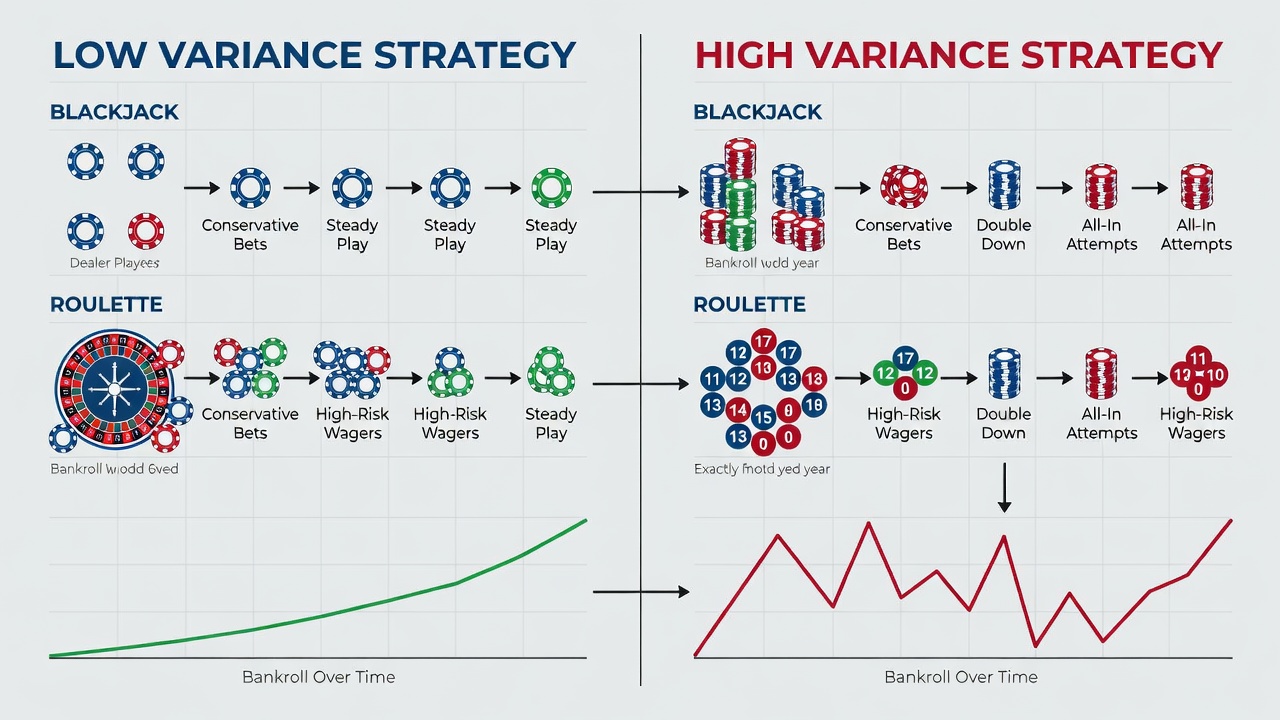
Comparing Low vs High Variance Approaches
- Low variance: Steady small wins in baccarat tips or even-money roulette bets; ideal for longer sessions with controlled risk and slower bankroll erosion.
- High variance: Aggressive blackjack doubling or single-number roulette; offers bigger payouts but requires deeper bankrolls and higher emotional resilience.
Choose based on your risk tolerance and goals. Intermediate players often blend both for balanced 2026 strategies. Low-variance methods suit conservative bankrolls, while high-variance approaches work best when combined with strict stop-loss rules.
Bankroll Management Across Games
Integrate variance into overall bankroll plans by dividing funds into session, daily, and monthly portions. For roulette strategy, allocate more to low-variance options to extend playtime. Blackjack players benefit from variance buffers for card-counting fluctuations, often setting aside extra reserves for counting deviations. Always maintain at least 50 times the average bet size as a minimum reserve, and review allocations weekly to account for changing game conditions.
Additional tactics include using separate accounts for different variance levels and tracking results in spreadsheets. This layered approach ensures sustainability across blackjack, roulette, and baccarat throughout 2026.
Practical Tips and Player Scenarios
Scenario 1: A player using baccarat tips hits a high-variance streak of banker wins followed by losses—solution is to pause, review variance metrics, and reassess bet sizing before continuing. Scenario 2: Blackjack variance leads to early losses in a card-counting session—stick to pre-set limits and switch tables rather than increasing bets to recover. Scenario 3: A roulette player applying the Labouchere system encounters extreme variance—reduce unit size immediately and log outcomes for later analysis.
Tips include reviewing session data weekly, avoiding emotional bets after losses, and using variance-aware tools like probability simulators available on reputable sites. These practices help intermediate players achieve more consistent results over time.
Common Mistakes to Avoid
Many players mistake variance for a flaw in their strategy and abandon proven methods too quickly. Others fail to adjust bet sizes when moving between low- and high-variance games, leading to unnecessary risk. Avoid chasing losses by increasing bets without regard to variance calculations, and never ignore session limits even during winning streaks.
Frequently Asked Questions
What is the difference between variance and house edge?
House edge is the long-term casino advantage, while variance describes short-term fluctuations around that edge.
How does variance affect roulette strategy?
High-variance bets like single numbers create larger swings, demanding stricter bankroll controls than even-money options.
Can variance be eliminated in blackjack strategy?
No, but it can be managed through bet adjustments and game selection for more consistent results.
Is low variance always better for beginners?
Low variance offers steadier play but limits upside potential; intermediate players should match variance to their risk tolerance and bankroll size.
How often should variance be recalculated?
Recalculate every 100-200 hands or when switching game variants to maintain accurate bankroll guidelines.
Conclusion
Mastering variance empowers players to navigate 2026 gambling with confidence. By calculating it, adjusting bets, and comparing approaches, you build resilient strategies for blackjack, roulette, and baccarat. Apply these insights to achieve steadier wins while enjoying responsible play. For further reading, explore resources at UK Gambling Commission and BeGambleAware.


No comments yet. Be the first!