 GambleLore

Introduction to Winning Poker Strategies in 2026 Casinos
Texas Hold'em remains the dominant poker variant in casinos worldwide. Success in 2026 requires disciplined fundamentals, smart position play, and precise calculations rather than luck alone. This guide delivers actionable steps for beginners and intermediates seeking consistent results at live and online tables. Whether you are playing in a bustling Las Vegas casino or logging into an online platform from home, mastering these elements can shift the odds in your favor over time. The strategies outlined here focus exclusively on game mechanics, betting decisions, and opponent observation techniques that translate directly to the felt.
Texas Hold'em Core Fundamentals
Every strong strategy starts with understanding hand rankings, betting rounds, and community cards. Players receive two hole cards and combine them with five community cards to make the best five-card hand. The four betting rounds—pre-flop, flop, turn, and river—create opportunities to build pots or fold weak holdings. Hand rankings follow standard poker hierarchy from royal flush down to high card. Betting actions include fold, check, call, bet, and raise, each serving a specific purpose depending on the round and board texture. Understanding these basics allows players to avoid common errors such as overvaluing marginal hands or misreading board strength.
Hand Selection Charts for Pre-Flop Play
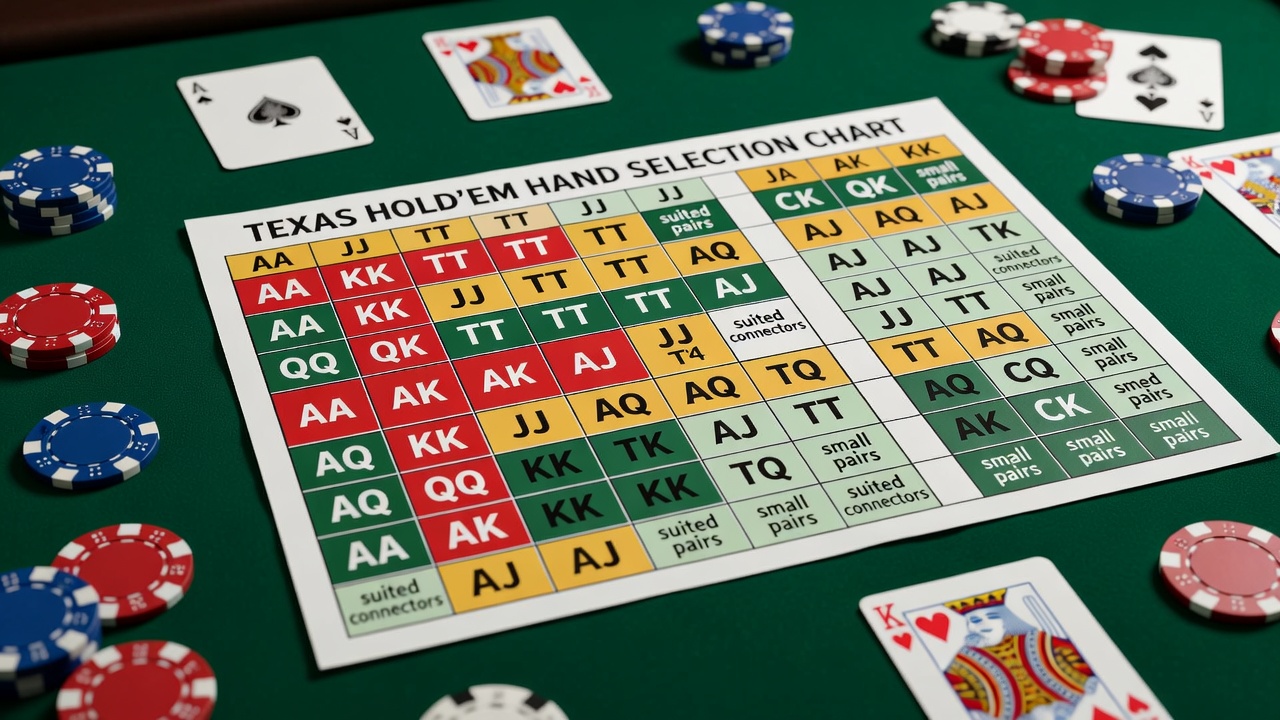
Use tight-aggressive hand charts to filter starting hands. From early position, play only premium holdings such as AA, KK, QQ, AK suited, and AQ suited. Middle position expands to include JJ, TT, AJ suited, and KQ suited. Late position allows a wider range including suited connectors like 98s and small pairs for set-mining. Print or memorize these ranges and stick to them until table dynamics justify adjustments. For instance, in a 9-handed game with 100 big blind stacks, early position ranges should remain under 12% of hands to maintain profitability. Adjust charts slightly when facing loose opponents by tightening further or when short-stacked by prioritizing high-card strength over speculative hands.
Position-Based Betting Tactics
Position is power. Acting last provides maximum information. In late position, raise more frequently with a wider range to steal blinds and build pots with strong hands. From early position, raise only premium hands and play cautiously post-flop. When out of position, check-raise selectively with strong made hands or draws to balance your range. Consider a scenario where you hold AJ suited on the button: a standard open raise of 2.5 times the big blind often takes down the blinds uncontested or builds a pot for post-flop play. In contrast, the same hand from under the gun warrants a raise only if the table is tight, otherwise folding preserves chips for better spots.
Reading Opponents Through Betting Patterns
Observe betting patterns to gain an edge without relying on physical tells alone. Players who bet quickly with strong hands may slow down on later streets, while hesitant bettors often hold marginal strength. Track continuation bet frequency on the flop and note when opponents check-raise. In a typical hand, if an opponent who rarely bluffs suddenly overbets on the river, their range likely contains value hands. Use this information to narrow their possible holdings and adjust your calling or folding decisions accordingly during the same session.
Calculating Pot Odds Accurately
Before calling a bet, compare the pot size to the call amount. If the pot offers 4-to-1 odds and your draw needs 5-to-1, fold. Convert outs to percentages: multiply outs by 2 on the flop or 4 on the turn for quick equity estimates. For example, with a flush draw on the flop (9 outs), you have roughly 35% equity—call only if pot odds exceed this threshold. Another case involves an open-ended straight draw on the turn with 8 outs, giving approximately 32% equity. Always factor in implied odds when facing aggressive opponents who may pay off big on later streets if you hit.
Bluffing Examples with Real Scenarios
Bluff on dry boards where opponents miss draws. Example one: You raise pre-flop with 76 suited from the button. Flop comes A-9-2 rainbow. Continuation bet 60% of the pot; most players fold weak aces or missed hands. Example two: On a coordinated board like 8-7-6 after raising with AK, check back instead of bluffing into strong ranges that connect well. Example three: In a multi-way pot on a K-2-2 flop with a missed draw, a small probe bet can fold out unpaired hands while maintaining fold equity. Always select spots where your story remains believable based on prior action.
Pre-Flop and Post-Flop Decision Trees
Pre-flop: Assess position, stack sizes, and opponent tendencies. Raise or fold—limping invites multi-way pots. Flop: Continuation bet 60-70% of the time with range advantage. Check strong hands on wet boards to protect checking range. Turn: Barrel with value hands and semi-bluffs that improve or retain equity. Fold marginal hands facing aggression. River: Value bet thin with top pair or better; bluff only when blockers and story align. Expand this framework by tracking board texture categories such as dry, wet, or paired, and adjust aggression levels accordingly. For instance, on paired boards, reduce continuation bet frequency because opponents connect more often with trips.
Live Casino vs Online Poker Dynamics
Live games feature slower pace, physical tells, and social pressure. Online play offers faster hands, HUD stats, and anonymous tables. Adjust by tightening live ranges against recreational players and using timing tells online. Many 2026 casinos now offer hybrid tables with digital elements, blending both experiences. Live sessions allow direct observation of chip handling and posture, while online requires focus on bet sizing patterns and reaction times. Players switching between formats should practice each separately to avoid costly leaks from mismatched strategies.
FAQ: Common Pitfalls to Avoid
How often should I bluff? Target 2-3 bluffs per session in position against observant opponents. Should I chase draws every time? Only when pot odds justify the call; otherwise fold to preserve chips. What if opponents notice my patterns? Mix bet sizing and occasionally check strong hands to stay unpredictable. Is online poker easier in 2026? Rake structures remain competitive; focus on volume and study rather than assuming softness. How do I handle aggressive 3-bets pre-flop? Narrow your calling range to premium hands and consider 4-betting with blockers when in position.
Conclusion
Apply these position tactics, pot odds calculations, and decision trees immediately at the tables. Consistent execution of fundamentals separates winning players from the field in 2026 casinos. Review hands after each session and refine ranges based on observed tendencies for long-term results. For further reading, visit PokerNews, WSOP, and Card Player.


No comments yet. Be the first!