 GambleLore

Introduction to Advanced Blackjack Strategies in 2026
Intermediate players looking to move beyond basic blackjack rules can benefit from proven 2026 techniques that adapt to modern online environments. This guide focuses on actionable advice for card counting in RNG and live dealer games, optimal betting progressions, and avoiding common pitfalls while promoting responsible gambling practices. Blackjack remains one of the most skill-influenced casino games when players apply mathematical edges. In 2026, online platforms continue to evolve with enhanced RNG systems and live dealer options, requiring updated approaches to maintain an advantage over the house. Whether you play on desktop or mobile, understanding these advanced methods helps maximize session efficiency without relying on luck alone.
Many players start with basic strategy but plateau quickly. Advanced tactics involve tracking card flow, adjusting bets dynamically, and recognizing when to deviate from standard charts. This tutorial provides concrete examples, decision trees, and session management frameworks tailored for both random number generator tables and live dealer streams. Always remember that long-term success depends on discipline and bankroll control rather than chasing short-term wins.
Card Counting Adaptations for Online RNG and Live Dealer Games
Traditional card counting works best in physical casinos with multiple decks, but online versions demand modifications. For RNG-based games, tracking is less effective due to continuous shuffling, so focus on pattern recognition in session data instead. Live dealer environments allow more traditional Hi-Lo counting since decks are finite between shuffles. Begin by selecting tables with favorable rules such as dealer stands on soft 17 and double after split permitted. In RNG games, simulate counting by reviewing historical hand data from demo modes to identify loose patterns. For live dealer, maintain a running count by noting every visible card dealt from the shoe.
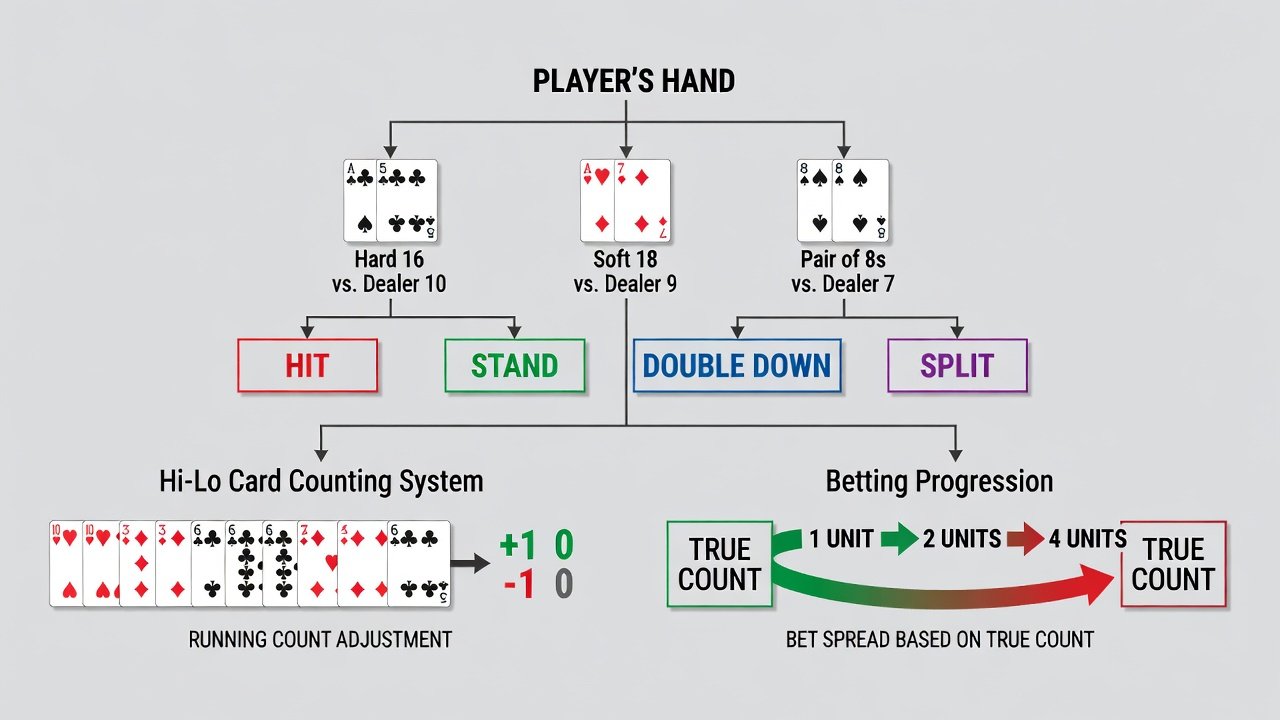
Step-by-step adaptation process: First, learn the Hi-Lo values where cards 2-6 receive +1, 7-9 receive 0, and 10-A receive -1. Second, practice converting running count to true count by dividing by remaining decks. Third, apply bet spreads only when true count exceeds +2. In live streams, use mental tallying or discreet notes if allowed. Always verify platform terms to avoid violations, as some operators monitor for advantage play. These adaptations can shift the house edge by 0.5 to 1.5 percent when executed consistently.
Optimal Betting Progressions and Bankroll Allocation
Betting progressions help manage risk during sessions. The Paroli system doubles bets after wins for up to three hands, capping exposure. Combine this with fixed bankroll rules: allocate no more than 1-2 percent of your total bankroll per hand to weather variance. Another popular method is the 1-3-2-6 progression, which resets after four wins or any loss. These systems do not overcome the house edge but structure your play to capitalize on winning streaks.
Real-world example: With a moderate bankroll, start at a base unit. After two consecutive wins, increase to double the unit, then revert on any loss. Track every outcome in a simple spreadsheet to review performance after 100 hands. This approach protects capital during losing streaks common in online play. Learn more about responsible bankroll management from Begambleaware.
Session allocation should include a stop-loss limit at 20-30 percent of daily bankroll and a win goal at 50 percent. Divide your overall funds into 20-30 session units so no single bad run wipes you out. Reassess allocation monthly based on win rate data collected from your play logs.
Step-by-Step Strategy Charts and Hand Decision Examples
Basic strategy charts remain foundational but advanced players layer in deviations based on count. For hard 16 versus dealer 10, stand only if count is +4 or higher in Hi-Lo. For soft 18 versus dealer 9, double only when true count is +1 or better. These adjustments require memorization through repeated practice with flash cards or apps.
Example hand one: Player holds 10-6 totaling 16, dealer shows 10. Basic play is hit, but with positive count above +4, stand to leverage dealer bust probability. Example hand two: Player has ace-7 (soft 18) against dealer 3. Always double in this spot unless count is extremely negative. Example hand three: Pair of 8s against dealer 10. Split only if true count exceeds +3. Print or screenshot customized charts for quick reference during sessions and drill 50 hands daily until decisions become automatic.
Comparing Popular Systems: Hi-Lo versus KO
- Hi-Lo: Balanced system assigning +1 to low cards, -1 to high. Requires true count conversion, ideal for multi-deck online tables with slower shoe penetration.
- KO: Unbalanced, simpler for beginners as it skips true count calculation. Slightly less accurate but faster for live dealer streams where speed matters.
- Omega II: More complex level-two system that offers higher precision for dedicated players willing to invest extra study time.
Hi-Lo offers a measurable edge with perfect execution, while KO suits shorter sessions. Test both via demo modes to find your fit. Many 2026 players combine elements of both for hybrid counting tailored to specific table speeds.
Common Pitfalls to Avoid
Many players chase losses by increasing bets irrationally or ignore table limits. Another mistake is neglecting game selection—always prioritize low-house-edge variants with 3:2 blackjack payouts. Detection risks in live dealer games include erratic betting patterns; stay consistent to minimize flags. Avoid alcohol during sessions as it impairs count accuracy. Finally, never play when tired or distracted, as mental errors compound quickly in advanced play.
FAQs on Legality and Detection Risks
Is card counting legal online? Yes in most jurisdictions, but casinos may restrict accounts for suspected advantage play. Check the UK Gambling Commission for regional rules. Detection usually occurs through bet spread analysis rather than software alone.
How to minimize detection? Vary bets naturally and avoid extreme spreads. Use multiple accounts sparingly and focus on enjoyment over profit. Visit the National Council on Problem Gambling for support resources.
Conclusion
Mastering 2026 advanced blackjack strategies requires practice, discipline, and a commitment to responsible play. Apply these techniques gradually, track your results, and remember that no system guarantees wins. For further guidance, explore official resources on safe gambling and continue refining your skills through deliberate practice.


No comments yet. Be the first!