 GambleLore

Introduction to Final Table Adjustments
Reaching the final table in a Texas Hold'em tournament represents a major strategic turning point. The field has shrunk dramatically, blinds are rising, and every decision carries heightened consequences because of the payout structure. Players who thrived on loose-aggressive play earlier must now refine their approach to account for stack sizes, opponent tendencies, and Independent Chip Model (ICM) implications. This comprehensive guide breaks down the essential adjustments required, providing step-by-step examples, checklists, and comparisons between formats so you can navigate final tables with confidence and precision.
Understanding Stack Size Dynamics in Depth
Effective stack sizes determine the tools available to you at the final table. When you hold more than 40 big blinds, you retain post-flop flexibility and can apply pressure through continuation betting and barreling. Mid-stack situations (15-30 big blinds) reward pre-flop initiative but limit your ability to play multiple streets without commitment. Short stacks below 15 big blinds reduce your game to push-fold mathematics. Consider a common scenario: you hold 22 big blinds in the cutoff with pocket sevens. If the button and blinds are all shorter than you, raising and folding to a three-bet preserves your stack for better spots, whereas calling off against a bigger stack risks missing the pay jump. Always calculate effective stacks rather than your own stack in isolation to avoid overplaying marginal hands.
Opponent Profiling at the Final Table
With fewer players, profiling becomes both easier and more critical. Categorize opponents into four archetypes based on the first orbit: tight-passive players who only enter pots with premium holdings, loose-passive callers who defend wide but rarely raise, tight-aggressive regulars who balance their ranges, and loose-aggressive gamblers who apply constant pressure. Track voluntary put-ins, three-bet frequency, and showdown hands. For instance, if a player has defended the big blind three times in the last orbit but folded to a continuation bet each time, you can exploit them by firing second barrels on favorable boards. Adjust your own ranges dynamically once you gather this data rather than relying on pre-tournament assumptions.
Selective Aggression Strategies with Examples
Selective aggression means targeting high-equity spots instead of indiscriminate raising. Use position to attack the blinds when short stacks are under 12 big blinds and likely to fold. A practical example: at a nine-handed final table with 18 big blinds in the small blind, you hold ace-five suited on the button. A standard open-raise exploits the short stack's desperation while maintaining fold equity against the blinds. Balance this by three-betting light against players who open 25%+ of hands but fold to resistance 60% of the time. Avoid over-aggression by checking back medium-strength hands on dry boards to control pot size when ICM pressure is high.
ICM-Aware Decision Making
ICM fundamentally alters equity calculations near pay jumps. Chips lost have greater value than chips gained because busting eliminates future payout opportunities. With 12 players remaining and a large pay increase at tenth place, folding a hand like king-queen suited against a big-stack shove can be correct even if it is ahead of their range. Another scenario involves a pay jump from 18th to 9th place: you should tighten your calling range by approximately 8-10% of hands to secure the higher payout. Software tools and mental models help quantify these decisions, but the core principle remains protecting your stack until the money bubble bursts. 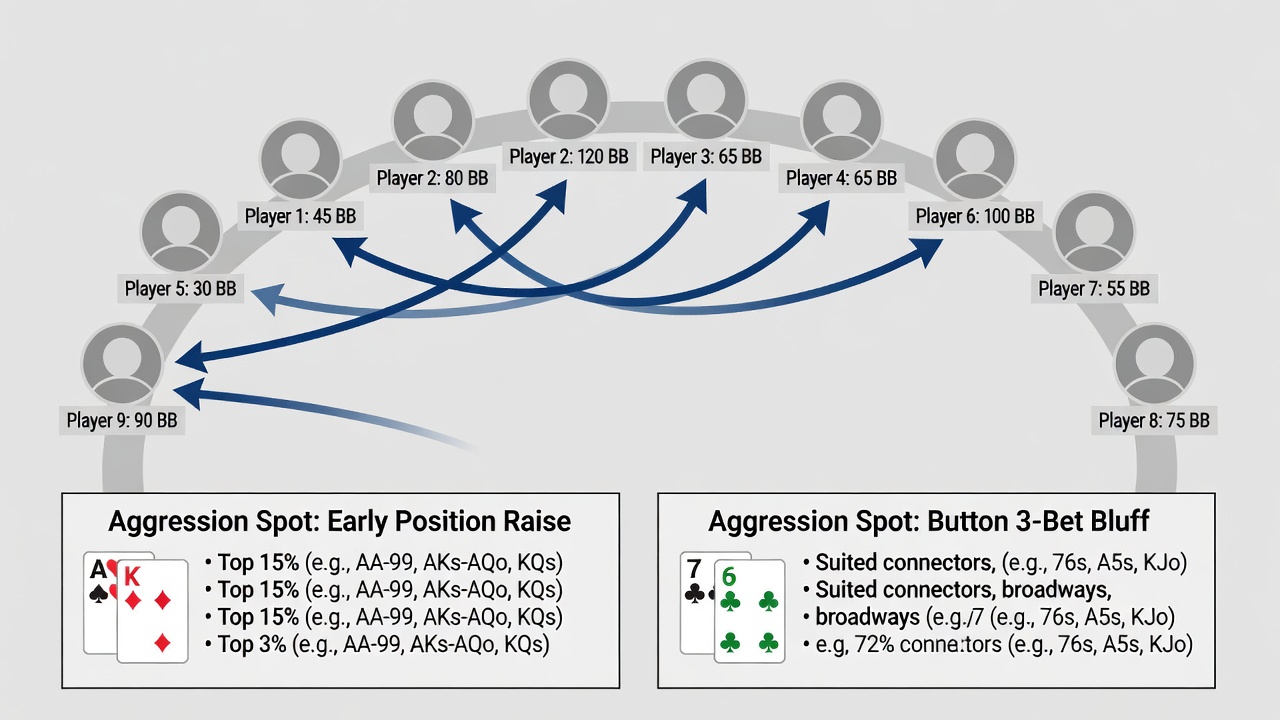
Exploiting Short-Stack Tendencies
Short stacks frequently shove wider than optimal to avoid blinding out. Counter this by widening your big-blind defending range and tightening early-position opens. Step-by-step example: a player with 11 big blinds shoves from the button. Their range is approximately 22% of hands. From the big blind with 25 big blinds you can profitably call with hands like pocket fours through tens, ace-ten suited, and suited connectors that perform well against that range while accounting for ICM. Avoid over-calling from the small blind where you risk a bigger confrontation with the big blind still to act.
Online Versus Live Final Table Play
Online final tables provide HUD statistics, timing tells, and rapid decision cycles that favor data-driven adjustments. You can instantly see a player's three-bet percentage and adjust three-bet calling ranges accordingly. Live final tables introduce physical tells, slower pacing, and the absence of tracking software, requiring greater reliance on memory and observation. Online players can maintain wider stealing ranges because of speed, while live players benefit from reading discomfort during large bets. Hybrid players often prepare by reviewing both formats to switch seamlessly between them.
Checklist for Adjusting Opening Ranges
- Under 20 big blinds: Reduce early-position opens to the top 12-15% of hands and increase button steals to 35%.
- Multiple short stacks behind you: Tighten raises by an additional 5% to avoid difficult post-flop decisions.
- Approaching a major pay jump: Shrink all stealing ranges by 6-8% and avoid marginal three-bets.
- In position against loose opens: Maintain wider calling ranges but increase three-bet frequency with suited connectors and small pairs.
- Heads-up or near heads-up: Open at least 70% of hands from the button regardless of stack depth.
Transitioning to Heads-Up Play
Heads-up play demands the widest ranges and constant pressure. Adjust by raising any two cards from the button when stacks are under 30 big blinds and defending at least half of hands from the big blind. Practice common confrontations such as blind-versus-blind all-ins and continuation-bet frequencies on paired boards. A key adjustment is reducing bet sizes to 40-50% of the pot to maintain aggression without over-committing. Review heads-up hand histories to identify leaks in your button versus big-blind dynamics.
Common Pitfalls to Avoid
Many players over-fold to ICM pressure and become passive, missing value opportunities. Others ignore effective stack sizes and call off with dominated hands. A frequent mistake is failing to adjust opening ranges when short stacks are present, leading to unnecessary variance. Combat these issues by reviewing every final-table hand immediately after the tournament and maintaining a written checklist of adjustments for each stack depth. Regular analysis prevents repeating errors in high-pressure situations.
FAQ
How does payout pressure affect risk management?
Payout pressure encourages tighter play near pay jumps to secure higher cashes rather than risking elimination for a larger score. Always weigh the equity of a call against the value of locking up the next payout tier.
What is the best way to profile opponents quickly?
Observe pre-flop actions and showdowns over the first 20-30 hands while noting bet-sizing patterns and positional tendencies to categorize players accurately.
Should opening ranges change between online and live?
Yes. Online ranges can be wider due to HUD information, while live ranges benefit from physical tells and slower decision times that reward careful observation.
How should you adjust when multiple short stacks remain?
Focus on stealing from late position and avoid marginal confrontations that risk your own stack against players who are already committed to pushing all-in.
Conclusion
Final table success in Texas Hold'em requires disciplined adjustments across stack dynamics, ICM considerations, opponent exploitation, and format-specific tactics. Apply the checklists, examples, and strategic frameworks outlined above to improve your results. For additional resources, consult PokerNews, WSOP, and Card Player.
Review more poker and casino tactics in our complete gambling strategies guide.


No comments yet. Be the first!