 GambleLore
Introduction to Converting Betting Odds to Probabilities
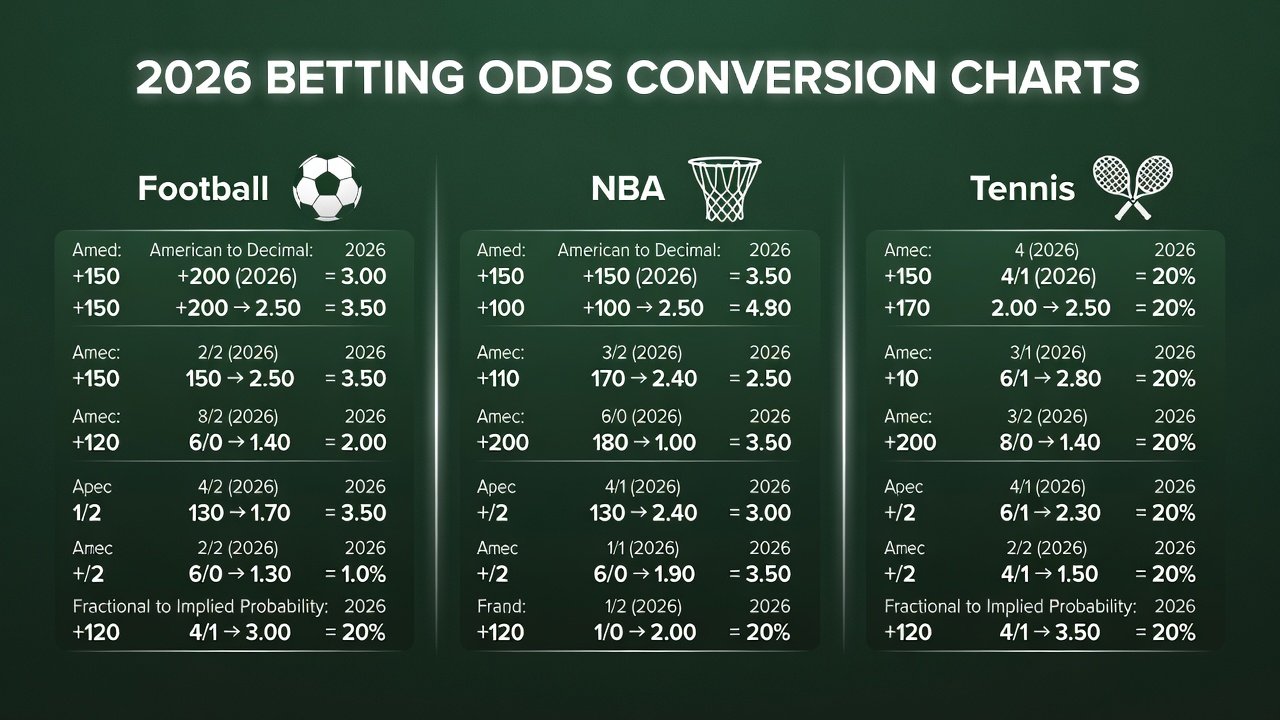
Understanding how to convert betting odds into implied probabilities is essential for bettors seeking value in football, NBA, and tennis markets during the 2026 season. This comprehensive guide walks through the three main odds formats with practical formulas and real-world examples from major leagues. By mastering these calculations, you can identify when bookmakers' lines offer positive expected value and avoid common errors that erode bankrolls over time. Whether you are analyzing Premier League matches, NBA playoff series, or Grand Slam tennis encounters, converting odds helps you compare your own assessments against the market and make informed decisions.
American Odds Conversion Formula with Detailed Examples
American odds, common in the United States, use positive and negative numbers to indicate underdogs and favorites. For negative odds, divide 100 by the absolute value of the odds and multiply by 100 to get the probability. For positive odds, divide 100 by the odds plus 100, then multiply by 100. Example: -150 odds convert to (100 / 150) * 100 = 66.67% implied probability. In 2026 NBA playoffs, a -130 favorite on a top team might imply around 56.5% chance, helping you compare against your own analysis of team performance and injuries. Another example from football involves a -200 line on a strong Premier League side, which calculates to 66.67% probability. Bettors should always verify these figures against multiple sportsbooks to ensure accuracy before placing wagers.
Decimal Odds to Probability Step-by-Step
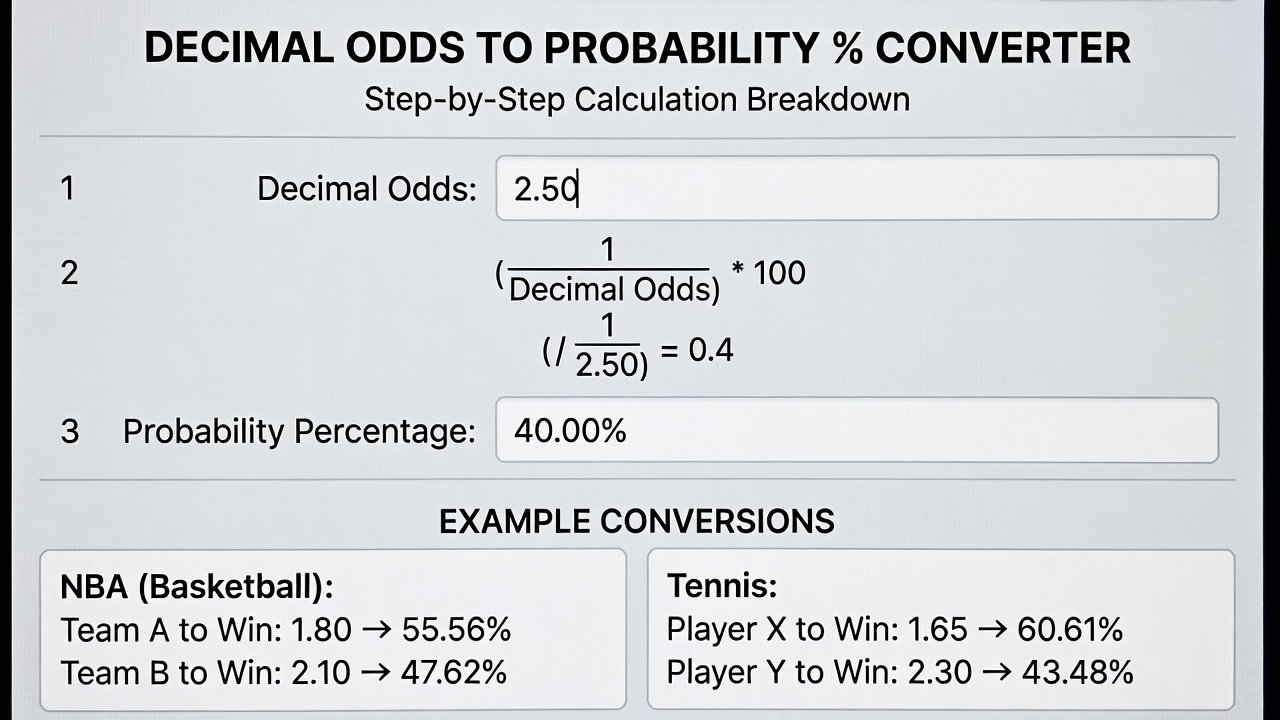
Decimal odds are popular internationally and straightforward: probability equals 1 divided by the decimal odds, multiplied by 100. A 2.50 decimal line gives 1 / 2.50 * 100 = 40% implied chance. This format shines in European football leagues where 1.85 odds on a home win convert to roughly 54% probability. Consider a 2026 UEFA Champions League match with decimal odds of 3.20 on an underdog; the implied probability is 31.25%. Walk through the math slowly: 1 divided by 3.20 equals 0.3125, then multiply by 100 for the percentage. This method allows quick comparisons across different events and helps spot discrepancies in how bookmakers price similar situations in NBA or tennis.
Fractional Odds Explained with Practical Applications
Fractional odds like 5/2 mean you win 5 units for every 2 staked. Convert by adding the numerator and denominator, then divide the denominator by that sum and multiply by 100. 5/2 becomes 2 / 7 * 100 ≈ 28.57%. Tennis bettors often see fractional odds on underdogs in Grand Slams. For instance, 6/4 odds on a rising star in a 2026 Wimbledon match imply (4 / 10) * 100 = 40% probability. These conversions become especially useful when scanning multiple bookmakers that display varying formats, allowing you to standardize everything into percentages for direct comparison.
2026 Football League Examples and Analysis
Consider a Premier League match where decimal odds of 1.75 on the home side imply 57.1% probability. Cross-check against team form, key player availability, and historical head-to-head records for value. In UEFA competitions, American odds of +180 on an away win translate to 35.7% chance, useful when comparing across bookmakers. Expand this by calculating for both teams plus the draw option, then sum the probabilities to reveal the bookmaker margin. If the total exceeds 100% by a significant amount, the margin is high and value may be limited. Practical tip: create a simple spreadsheet with these formulas to test dozens of matches quickly during the 2026 season.
NBA 2026 Season Calculations and Value Spotting
NBA totals often use decimal odds. A 1.91 line on over 225.5 points equals about 52.4% implied probability. Use this to evaluate whether a team's pace stats, defensive efficiency, and recent scoring trends support the line. American odds of -200 on a conference favorite convert to 66.7%, highlighting how margins affect perceived value. For player props, convert odds on points scored by stars to see if your projection exceeds the implied probability. This approach helps in identifying spots where the market undervalues certain outcomes based on advanced analytics available in 2026.
Tennis Betting Probability Walkthrough and Surface Considerations
Tennis matches frequently feature fractional odds. 4/6 on a top seed implies (6 / 10) * 100 = 60% probability. Compare this with surface-specific stats for clay or hard courts in 2026 ATP events to spot discrepancies. In best-of-five set matches, adjust your probability estimates for fatigue factors that bookmakers may not fully price. Convert live odds during a match when a player wins the first set to decide whether to bet on a comeback or the favorite to close it out. This real-time application separates successful bettors from casual ones.
Comparing Odds Across Football, NBA and Tennis
- Football lines often carry higher margins due to many markets and the three-way outcome structure.
- NBA spreads use American odds with vig around 4-5% typically, making totals and moneylines competitive for value hunters.
- Tennis moneyline bets can offer lower margins on popular matches, especially in early rounds of major tournaments.
- Cross-sport comparison reveals that NBA games tend to have more predictable scoring, while football and tennis introduce higher variance from single events.
Spotting Bookmaker Margins and Reducing Their Impact
Calculate overround by summing implied probabilities of all outcomes. If the total exceeds 100%, the excess is the margin. Aim for books where combined probabilities stay under 105% for better value opportunities. In 2026, shop around multiple platforms before committing to a bet. For example, if one site shows a football match with a 4.2% margin and another shows 2.8%, the lower margin site preserves more of your edge when your probability estimate is accurate.
Practical Calculator Walkthrough and Worksheet Ideas
Start with your chosen odds format, apply the relevant formula, then compare against your estimated true probability. Adjust for live factors like player fatigue in tennis or pace in NBA games. Test with multiple sports to build intuition. Create a personal worksheet with columns for sport, match, odds format, converted probability, your estimated probability, and edge calculation. Repeat this process daily during peak seasons to refine your skills and track long-term results.
Common Calculation Errors to Avoid
Always convert to the same format before comparing. Forgetting to add the stake in decimal conversions or mishandling negative American odds leads to incorrect probabilities. Double-check arithmetic, especially under live betting pressure. Another frequent mistake is ignoring the draw option in football, which can skew your overall assessment of value in three-way markets.
Applying Skills to Live Betting Scenarios
FAQ
How do I adjust for live odds changes? Recalculate probabilities after each shift and compare to evolving game state, such as remaining time or sets in tennis.
Which sport benefits most from probability conversion? NBA totals often show clear value when your pace model differs from the implied line, especially in high-paced 2026 matchups.
Can I use these methods for in-play tennis? Yes, convert updated odds quickly to decide on set or match bets while accounting for momentum shifts.
What tools help automate these conversions? Many betting apps include built-in probability displays, but learning manual calculation ensures you understand the underlying math during fast-moving live scenarios.
Conclusion
Converting 2026 betting odds to probabilities empowers smarter decisions across football, NBA, and tennis. Practice the formulas regularly and always factor in bookmaker margins to maximize long-term results. For more on responsible practices, visit NBA.com, UEFA.com, and ATP Tour.
No comments yet. Be the first!