 GambleLore

Accumulator betting remains one of the most popular ways to chase substantial returns from modest stakes, especially with major 2026 events like the FIFA World Cup and premier horse racing meets on the calendar. This comprehensive guide breaks down proven accumulator betting strategies to help you build winning multis while maintaining discipline and focusing on long-term sustainability. Whether you are new to multi-bet structures or looking to refine your approach, understanding the mechanics, selection processes, and risk controls is essential for success in today’s dynamic betting landscape.
Understanding Accumulator Mechanics in Detail
An accumulator, often called an acca, combines multiple individual selections into a single wager. All legs must succeed for the bet to pay out, and the odds from each selection multiply together. This structure creates the potential for exponential growth in returns compared to placing the same selections as separate single bets. In 2026, with expanded tournament schedules across football, tennis, and thoroughbred racing, accumulators offer fresh opportunities for bettors who can identify value across multiple markets. The key lies in balancing the number of legs with realistic probability assessments rather than simply adding more selections for bigger multipliers.
Why 2026 Presents Unique Accumulator Opportunities
The calendar for 2026 features several high-profile events that lend themselves to accumulator strategies. International football tournaments provide numerous matches with varying odds levels, while major horse racing festivals offer daily opportunities across different race types. Bettors who monitor form guides, travel schedules, and weather impacts can construct multis that capitalise on these periods. Official tournament information from FIFA helps verify schedules and team news, ensuring selections are based on accurate data rather than speculation.
Key Bet Selection Criteria for 2026
Successful accumulator construction starts with rigorous selection criteria. Prioritise value over short odds favourites. Examine recent form, head-to-head statistics, player availability, and market movements. For horse racing accumulators, evaluate track conditions, trainer and jockey statistics, and pace maps. Avoid selections solely because they shorten the overall price; instead, seek outcomes where the implied probability underestimates true chances. Cross-reference multiple data sources and maintain a consistent process for every leg added to your slip.
Risk Management Techniques That Protect Your Bankroll
Effective risk management separates profitable strategies from those that deplete funds quickly. Limit most accumulators to between four and six legs to maintain reasonable strike rates while still achieving attractive multipliers. Allocate no more than one to two percent of your total betting bankroll to any single accumulator. Diversify across unrelated sports or markets to minimise the impact of correlated outcomes, such as multiple selections from the same football match. Set clear stop-loss rules and review performance weekly to adjust stake sizes or selection filters as needed.
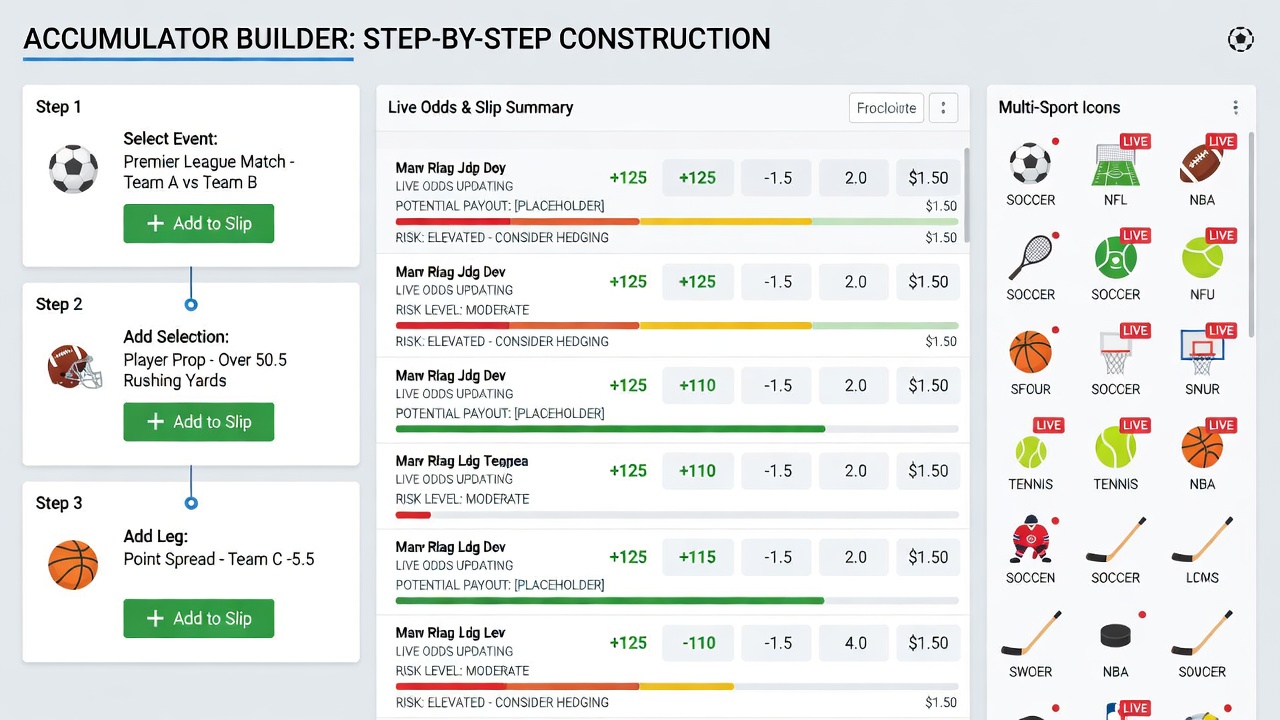
Step-by-Step Construction Examples Using Real Odds Principles
Consider a four-leg football accumulator built around 2026 World Cup qualifiers. Start with a home favourite at 1.60, add an away win at 2.40, include an over 2.5 goals selection at 1.90, and finish with a draw no bet market at 1.75. The combined decimal odds reach approximately 12.7, turning a ten-unit stake into over 127 units if successful. For horse racing, construct a treble from a major summer festival: select a well-fancied runner in the feature race at 2.20, pair it with a each-way bet converted to win-only at 3.50, and add a later race selection at 2.80. The resulting multiplier demonstrates how careful leg choice amplifies returns without excessive risk. These examples illustrate the multiplication effect while emphasising the need for independent analysis of each component.
Accumulator vs Single Bets Comparison for Different Bankroll Sizes
Single bets deliver more consistent results and are better suited to smaller bankrolls or conservative bettors seeking steady growth. Accumulators introduce higher variance but can accelerate bankroll expansion when hit rates align with value selections. Bettors with larger funds may allocate a portion to accumulators while keeping the majority in singles. The decision ultimately depends on risk tolerance, time horizon, and personal goals rather than chasing the biggest possible payout on every bet.
Practical Checklist for Building Accumulators
- Confirm each selection offers positive expected value based on your research
- Verify latest team news, injury reports, and non-runner information
- Compare odds across multiple licensed bookmakers for the best prices
- Establish strict stop-loss and profit-taking limits before placing the bet
- Record every accumulator in a dedicated journal with reasoning and outcome
- Review past results monthly to identify patterns in successful and unsuccessful multis
- Adjust leg count and stake size according to current form and market conditions
Common Mistakes to Avoid When Building Accumulators
Many bettors add extra legs to chase bigger returns without sufficient value, dramatically lowering overall probability. Others ignore correlated outcomes, such as selecting both a team to win and over goals in the same match. Chasing losses by increasing stakes or leg numbers after a losing run compounds problems quickly. Failing to shop for the best odds or neglecting to check for late changes also erodes potential profits over time. Discipline and process adherence remain the most reliable paths to long-term improvement.
Short FAQ on Avoiding Common Accumulator Errors
Q: How many legs deliver the best balance? A: Four to six legs typically provide an effective compromise between payout size and realistic hit rate for most bettors. Q: Should heavy favourites be included? A: Only when they represent genuine value; adding them purely to reduce overall odds often leads to lower returns than carefully chosen underdogs. Q: Is it better to stick to one sport? A: Diversifying across unrelated events reduces risk, though deep knowledge in one sport can also be advantageous. Q: How important is record keeping? A: Essential for identifying strengths and weaknesses in your selection process over multiple months.
Responsible betting practices underpin every successful strategy. Consult resources from the Gambling Commission and British Horseracing Authority for guidance on safe participation. Apply these accumulator betting strategies with consistency and patience throughout 2026 to pursue sustainable results rather than short-term gains.


No comments yet. Be the first!