 GambleLore

Introduction to Arbitrage Betting in 2026
Arbitrage betting offers a structured way to secure profits by exploiting differences in odds across multiple bookmakers. Unlike traditional betting that relies on predictions, this approach focuses on mathematical certainty when odds create an opportunity for guaranteed returns regardless of outcome. In 2026, with more bookmakers and faster odds updates, the strategy remains viable for disciplined users targeting sports betting and horse racing markets. This method appeals to those seeking consistent, low-risk returns rather than high-variance gambling. By identifying mismatches where the combined implied probabilities fall below 100 percent, bettors can allocate stakes proportionally to lock in a profit margin, often between one and five percent per opportunity. This guide covers the mechanics, detection processes, recommended tools, real examples, risks, and comparisons to help you implement it effectively while maintaining bankroll discipline. Success depends on speed, accuracy, and careful account management across platforms.
Understanding the Core Mechanics
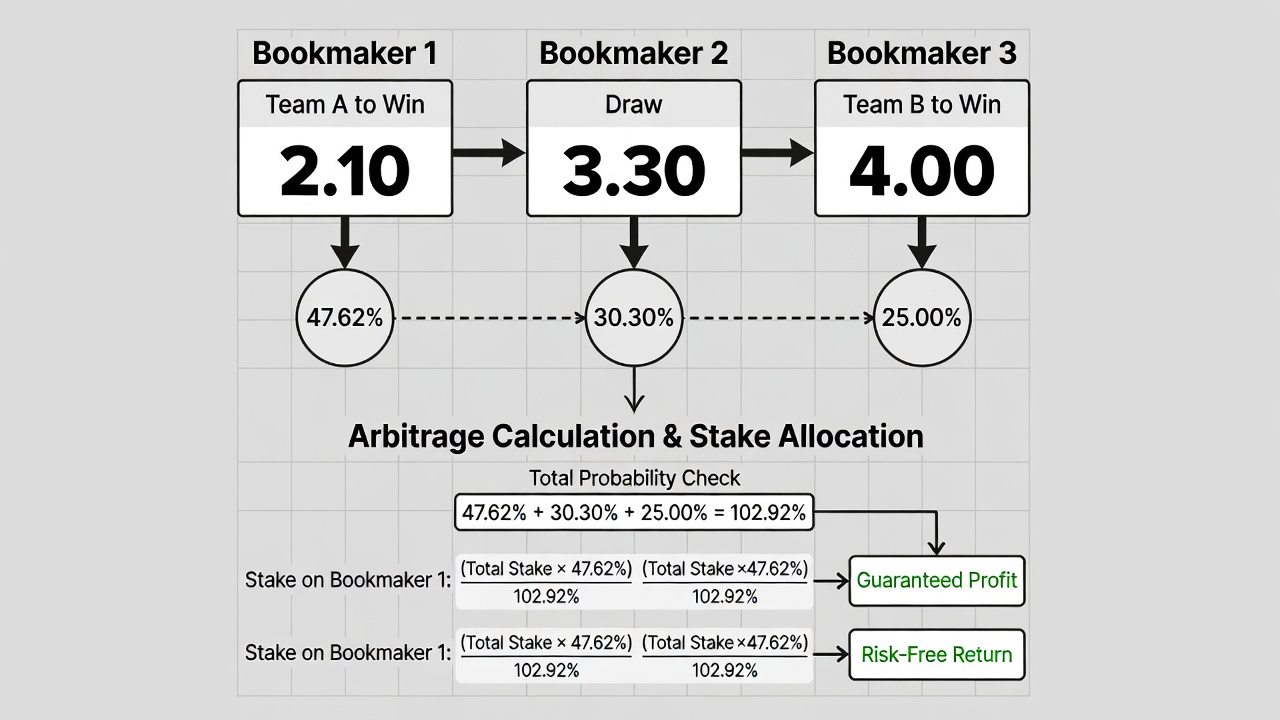
Arbitrage betting, often called arb betting, occurs when the combined implied probabilities from different bookmakers' odds fall below 100%. This mismatch allows you to place bets on all possible outcomes and lock in a profit. The math involves calculating the sum of (1 divided by each decimal odd) across outcomes. If the total is less than 1, an arbitrage opportunity exists. For instance, in a two-outcome event, if one bookmaker offers 2.10 on Team A and another offers 2.05 on Team B, the implied probabilities may create a small edge. To calculate potential profit, divide your total stake by the sum of the reciprocals and subtract the total stake. This process works across three-way markets in football or win markets in horse racing, where differing opinions among bookmakers create the necessary discrepancies. Understanding decimal, fractional, and American odds conversions is essential, as most scanners default to decimal format for precision. In 2026, real-time data feeds make these calculations faster, but manual verification remains important to confirm no changes have occurred mid-process.
Step-by-Step Detection Methods
Follow these steps to identify opportunities reliably:
- Monitor multiple bookmakers simultaneously for the same event using both manual checks and automated alerts.
- Convert all odds to decimal format for consistent calculations across sites.
- Calculate implied probabilities for each outcome by dividing one by the decimal odd.
- Sum the probabilities; if under 100%, calculate stake distribution for equal profit on every possible result.
- Place bets quickly before odds adjust, starting with the largest stake to minimize timing risks.
- Double-check event details, start times, and rules such as overtime inclusion to prevent mismatches.
Always verify the event details match exactly across sites to avoid errors. Advanced users often set custom filters for minimum profit margins and specific leagues to streamline the search process.
Recommended Tools and Scanners for 2026
Specialized scanners help track odds in real time. Popular options include dedicated arbitrage software that aggregates data from dozens of bookmakers. Users often combine these with browser extensions for quick comparisons. Focus on tools that cover major football leagues and horse racing tracks, updating frequently to capture fleeting opportunities. Look for features like mobile alerts, historical odds tracking, and customizable profit thresholds. Integration with multiple exchanges improves coverage, especially during busy racing festivals or football weekends. Many 2026 platforms also offer API access for users building personal dashboards. When selecting a scanner, prioritize those with strong data accuracy and low latency to stay ahead of market corrections.
Real-World Examples from Football and Racing Markets
Consider a Premier League match where Bookmaker A offers 1.95 on the home win and Bookmaker B offers 4.20 on the draw with Bookmaker C at 5.50 on the away win. Calculating the implied probabilities reveals a potential 2-4% profit margin if stakes are allocated proportionally. For a total stake of 1000 units, the distribution might be 513 units on the home win, 238 on the draw, and 182 on the away win, securing a locked return irrespective of the result. In horse racing, similar mismatches appear in win markets at major events, where multiple exchanges and traditional bookmakers differ on favorites. A six-horse race might show odds creating a 3% arb across four different platforms when one operator undervalues an outsider. These examples highlight the importance of acting within minutes of detection. Events covered by FIFA often produce reliable data points for football arbs due to high liquidity, while British Horseracing Authority regulated meetings provide structured opportunities in racing. Scaling these examples requires maintaining separate accounts and rotating bookmakers to avoid patterns that trigger reviews.
Risk Factors Including Account Limitations
Bookmakers actively monitor for arbitrage activity and may limit or close accounts showing consistent low-risk patterns. Other risks include odds changes after partial placement, event postponements, and withdrawal restrictions. Mitigate these by using multiple accounts, varying bet sizes, and avoiding repeated patterns on the same markets. Additional considerations involve currency conversion fees when crossing borders and potential tax implications depending on your location. Account limitations often begin with stake caps on specific events, progressing to full restrictions if activity appears automated. To reduce detection, space out bets, mix in occasional non-arb wagers, and maintain natural betting rhythms. Event cancellations or rule changes can also void opportunities, so always confirm official sources before finalizing stakes. Responsible management includes setting strict daily exposure limits and reviewing account terms regularly.
Comparison to Matched Betting
Matched betting uses free bet promotions and relies on laying off bets on exchanges for near-certain returns. Arbitrage betting differs by depending solely on odds discrepancies without needing bonuses. While matched betting often yields higher volumes through promotions, arbitrage provides steadier but typically smaller margins across standard odds. Both require careful record-keeping and bankroll allocation. Matched betting suits users with access to frequent sign-up offers, whereas arbitrage excels in stable markets with ongoing discrepancies. A hybrid approach combining both can diversify returns, but each demands separate tracking systems. Arbitrage generally involves lower promotional dependency, making it more sustainable during periods when bookmakers reduce bonus availability.
Practical Checklist for Success
- Maintain separate accounts at 8-12 reputable bookmakers covering diverse markets.
- Set daily time limits for monitoring to avoid burnout and maintain focus.
- Calculate stakes precisely using an arbitrage calculator before betting.
- Track all transactions in a dedicated spreadsheet with timestamps and margins.
- Withdraw profits regularly to protect capital and prevent large balances that attract attention.
- Start with small stakes to test processes and refine timing.
- Review bookmaker terms weekly for any policy updates affecting arb activity.
- Combine scanner alerts with manual cross-checks for highest accuracy.
Common Pitfalls to Avoid
Beginners often overlook currency conversion fees when using international bookmakers or fail to confirm event start times. Another frequent error is chasing larger arbs that carry higher detection risk. Always prioritize smaller, frequent opportunities over high-margin ones that may vanish quickly. Additional mistakes include neglecting to factor in commission on exchanges or placing bets in the wrong order, which can leave one outcome uncovered. Over-reliance on a single scanner without backup verification also leads to missed adjustments. Keeping detailed logs helps identify recurring issues and improve future performance.
Frequently Asked Questions
Is arbitrage betting legal?
Yes, it is legal in most jurisdictions where sports betting is permitted, though bookmakers may restrict accounts. Always check local regulations to ensure compliance.
How much bankroll do I need?
Start with an amount that allows multiple bets without exceeding 5% exposure per opportunity. This provides flexibility while limiting risk during the learning phase.
Can I use this for horse racing?
Absolutely, many successful arbs appear in racing win and place markets due to varying bookmaker opinions on form and conditions.
What are the best times to find arbs?
Peak opportunities often occur shortly before events when bookmakers adjust lines independently, especially during major football weekends or racing festivals.
How do I handle account restrictions?
Rotate usage across accounts, vary stake sizes, and include occasional non-arbitrage bets to maintain natural activity patterns.
Conclusion
Arbitrage betting provides a methodical path to consistent returns when executed with precision and discipline. By mastering detection, using reliable scanners, and managing risks, you can build a sustainable approach in 2026 sports and racing markets. Always prioritize responsible bankroll management and stay updated on bookmaker policies for long-term success.


No comments yet. Be the first!