 GambleLore

Introduction to Hedging in Betting
Hedging is an advanced risk-management strategy that allows bettors to lock in profits or minimize losses by placing additional wagers on opposite outcomes. In 2026, with evolving odds and live betting markets, hedging remains essential for both sports enthusiasts and horse racing fans seeking consistent returns rather than relying solely on luck. This approach transforms betting from pure speculation into a more controlled process where outcomes can be partially secured even when initial predictions face uncertainty.
This comprehensive guide covers the fundamentals of hedging, practical applications during live events and pre-race scenarios, and detailed step-by-step examples tailored to accumulators and each-way bets. Readers will also discover how hedging differs from arbitrage and matched betting, along with calculation tips using current odds from major events. By the end, you will have actionable knowledge to apply these techniques responsibly throughout the year.
Core Principles of Hedging
At its heart, hedging involves balancing your original bet with a counter-bet to guarantee a positive outcome regardless of the final result. The key is understanding implied probabilities from odds and calculating the exact stake needed for the hedge. For instance, if you have a multi-leg accumulator with strong early wins, hedging the remaining legs can secure gains before the final outcome is decided. This principle relies on the mathematical relationship between decimal odds and probability, where the sum of probabilities across all outcomes exceeds 100 percent due to bookmaker margins.
Always factor in bookmaker margins and potential odds fluctuations. Successful hedgers monitor markets closely and act when value appears in the opposing side. Another core idea is risk tolerance: some bettors aim for guaranteed small profits while others use partial hedges to reduce exposure without eliminating all upside potential. Understanding your personal goals helps determine the appropriate hedge size and timing.
When to Apply Hedging: Pre-Event vs Live Scenarios
Hedging can be executed before an event starts or during live play. Pre-event hedging suits situations where initial odds offer high value but later shifts create opportunities for balance. This is common in horse racing when ante-post bets are placed months ahead and market movements occur closer to race day. Live hedging shines in dynamic sports like NFL games or horse racing, where momentum changes rapidly and in-play odds adjust in real time.
For horse racing, consider hedging after the first few furlongs if your selection pulls ahead significantly, as this often signals a strong position that can be protected. In sports, hedge during halftime if your team leads by a wide margin but you want to protect against a comeback. Timing is critical: hedging too early may leave potential profits on the table, while waiting too long can result in poor odds on the hedge bet itself.
Step-by-Step Examples: Locking Profits on Accumulators
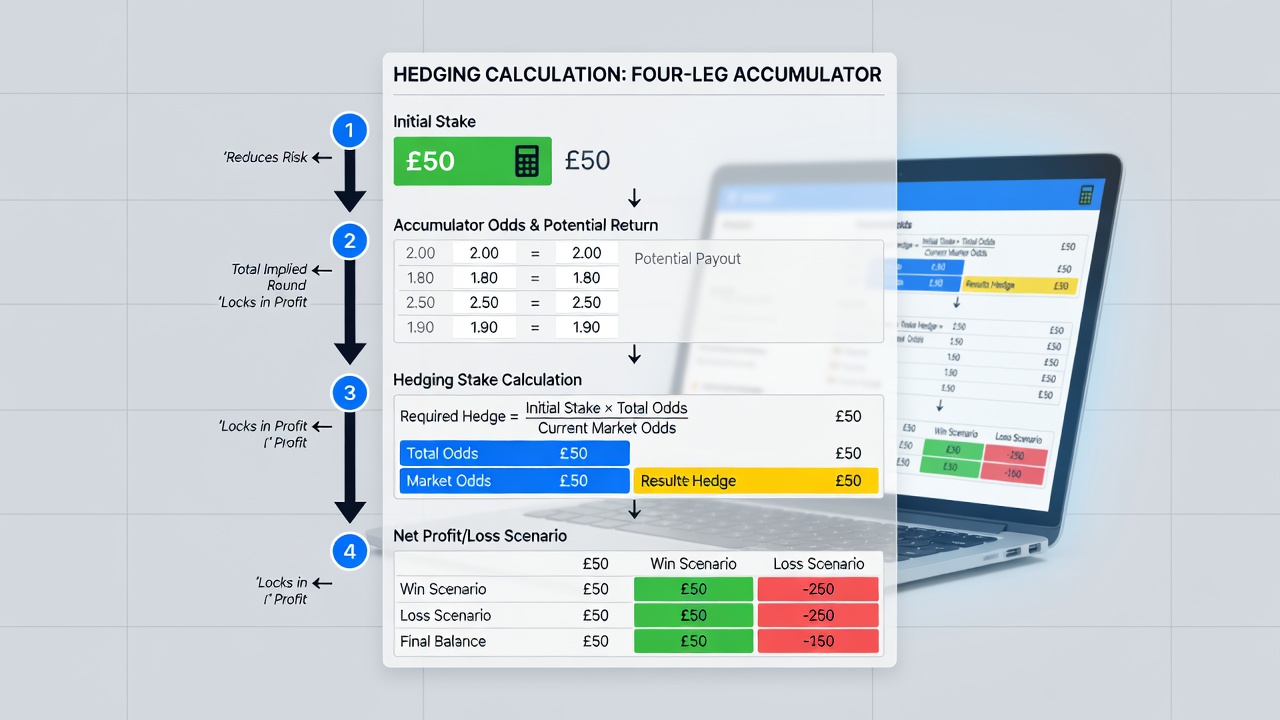
Imagine a four-leg NFL playoff accumulator placed at the start of the postseason with combined odds of 12.5. After three legs win, the final leg offers a massive potential payout of several thousand dollars on a modest stake. To hedge, convert the remaining odds to decimal format and calculate the exact counter-stake required. Divide your potential accumulator return by the sum of both outcomes decimal odds to determine the hedge amount, ensuring the result locks in a fixed profit regardless of the outcome.
For each-way bets in horse racing, hedge the win portion while leaving the place bet active, or vice versa depending on market movements. Suppose you backed a horse each-way at 10/1 with a £50 stake. If the horse is leading at the final fence, placing a hedge bet on the favorite to win can secure a portion of the profit while the place return remains intact. This approach reduces variance while preserving some upside if your original selection holds on.
Comparisons: Hedging vs Arbitrage and Matched Betting
Hedging differs from arbitrage, which exploits price differences across bookmakers for risk-free profit, because hedging accepts a smaller guaranteed return to eliminate downside. Arbitrage requires multiple accounts and perfect synchronization, whereas hedging works seamlessly within a single platform. Matched betting uses free bet promotions to create similar outcomes but often requires specific bonus terms and can be limited by bookmaker restrictions. Hedging works well within a single bookmaker account and adapts better to in-play markets where odds change constantly.
Many bettors combine elements of all three for optimal bankroll management. Learn more about responsible practices from the UK Gambling Commission. Each method has trade-offs in complexity, required capital, and regulatory considerations that should be evaluated before implementation.
Practical Tips for Calculating Hedge Stakes
- Convert all odds to decimal format for easy math and accurate probability assessment.
- Determine your desired locked profit or maximum loss tolerance before placing the hedge.
- Use the formula: Hedge Stake = (Original Potential Profit) / (Hedge Odds - 1) to find the precise amount.
- Account for commission on betting exchanges where applicable, as this affects net returns.
- Reassess after every significant market move to ensure the hedge remains optimal.
- Keep detailed records of each hedge to review performance and refine future decisions.
- Start with smaller stakes when learning to build confidence without risking large portions of your bankroll.
Practice with paper trades before committing real funds. Tools like odds calculators help refine accuracy during fast-moving events such as live NFL games or the final stages of a horse race.
Real-World Scenarios for 2026 Major Events
At the Cheltenham Festival in March 2026, a punter backing a longshot each-way in the Gold Cup could hedge after the first circuit if the horse jumps prominently and shortens in the betting. This protects against late errors while still allowing a return if the horse maintains its lead. Similarly, during NFL playoffs in January 2026, hedging a parlay after conference championships allows securing returns before the Super Bowl by balancing the final game outcome.
These scenarios highlight the importance of timing and staying informed on team news, track conditions, and weather factors that influence live odds. Monitoring multiple bookmakers simultaneously can reveal the best hedge prices and maximize locked profit.
Common Mistakes to Avoid
One frequent error is over-hedging too early in an event, which reduces potential returns unnecessarily. Another is ignoring bookmaker betting limits that may prevent placing the full hedge stake. Emotional reactions after a strong performance by your selection can also lead to poor calculations. Always double-check math and consider partial hedges if full protection is not required.
Tax Implications and Responsible Use
Tax rules vary by jurisdiction and winnings may need to be reported depending on your location and total profits. Consult official resources such as IRS guidelines for US bettors or UK government pages for accurate reporting requirements. Responsible hedging includes setting strict bankroll limits and viewing it as a protective tool rather than a guaranteed income source.
Conclusion
Hedging empowers bettors to navigate uncertainty with greater control. By mastering these techniques for sports and horse racing, you can protect profits and reduce emotional decision-making throughout 2026. Consistent practice and disciplined application will yield the best long-term results.
FAQ
What are common hedging mistakes?
Over-hedging too early or ignoring bookmaker limits can erode value. Always calculate precisely and avoid emotional reactions to live events.
How do tax implications work?
Tax rules vary by jurisdiction. Consult official resources such as IRS guidelines for US bettors or local authorities for accurate reporting of winnings.
Can hedging be used on every bet?
No, it is most effective on accumulators and multi-leg bets where partial wins create opportunities. Single bets rarely benefit from hedging due to limited upside after the counter wager.
Is hedging legal everywhere?
Hedging itself is simply a betting strategy, but local laws on gambling activities must be followed. Always verify regulations in your region before participating.


No comments yet. Be the first!