 GambleLore

Introduction to Favorites and Longshots in Modern Betting
Betting on favorites versus longshots remains one of the most debated topics among punters in 2026. Favorites offer higher win probabilities but lower payouts, while longshots promise bigger returns at greater risk. Understanding when each delivers value is essential for building sustainable strategies across sports betting and horse racing markets. This comparison-style guide explores statistical probabilities, risk-reward profiles, and actionable 2026 approaches to help bettors make informed decisions. Whether you are new to wagering or an experienced handicapper seeking refined tactics, grasping the nuances between these two betting categories can dramatically improve your long-term profitability and enjoyment of the process.
In today's data-rich environment, bettors have access to advanced analytics that were unavailable even a few years ago. This allows for deeper evaluation of implied probabilities versus actual historical outcomes. The goal is never simply to pick winners but to identify situations where the odds offered exceed the true likelihood of an outcome, creating positive expected value over time.
Statistical Probabilities Behind Favorites and Longshots
Favorites typically win 30-50% of the time in major sports leagues, depending on the sport and market efficiency. In contrast, longshots (odds of +300 or higher) succeed far less often, often below 15%. Bettors must weigh implied probabilities against actual outcomes to identify value. Historical data shows that in horse racing, favorites win around 33% of races, yet longshots can provide positive expected value when odds exceed true probabilities by a sufficient margin. Across major football leagues, strong favorites at odds shorter than 1.50 win approximately 65% of matches, while longshots above +400 win roughly 8-12% but can yield higher returns when correctly identified.
Understanding variance is crucial. Even a favorite with a 70% implied win rate will lose 30% of the time, creating sequences of unexpected results that test any bettor's discipline. Longshots, meanwhile, produce extended losing runs that require substantial bankroll reserves and psychological resilience.
Risk-Reward Profiles Compared
Favorites deliver steady but modest profits, suiting conservative bankrolls. Longshots carry high variance, leading to long losing streaks but occasional large payouts. The key is matching your risk tolerance to the chosen approach. A balanced portfolio often mixes both to smooth equity curves while still capturing upside potential.
Key Factors Influencing Risk
- Market liquidity and odds movement before race or match start
- Team or horse form, including recent injuries and training reports
- Weather or track conditions in racing that can disproportionately affect certain runners
- Public bias inflating favorite odds and creating overlays on longshots
- Betting exchange liquidity for laying favorites or backing outsiders
Identifying Strong Favorites
Look for favorites with consistent recent performance, strong head-to-head records, and favorable conditions. Avoid betting heavy favorites at short odds unless additional value exists through accumulators or specific markets. Strong favorites often emerge in matches where one side dominates possession, has superior defensive structure, or benefits from home advantage. In horse racing, favorites that have won at the distance or track surface previously tend to outperform random selections. Always cross-check trainer and jockey statistics, as these can elevate an otherwise moderate favorite into a high-confidence selection.
Spotting Profitable Longshots with Data
Use advanced analytics to find longshots. Focus on horses or teams with improving form, trainer patterns, or overlooked statistics. Tools that compare public odds to model predictions help uncover mispriced opportunities. In 2026, many professional bettors rely on pace analysis, sectional timing, and machine-learning projections to isolate longshots that the market has undervalued. For instance, a horse dropping in class after competing against stronger rivals may offer excellent value at expanded odds. Similarly, in team sports, an underdog facing a favorite that is resting key players can present a profitable angle.
BBC Sport provides detailed previews that often highlight value in underdogs through expert analysis and statistical breakdowns.
Bankroll Allocation Examples
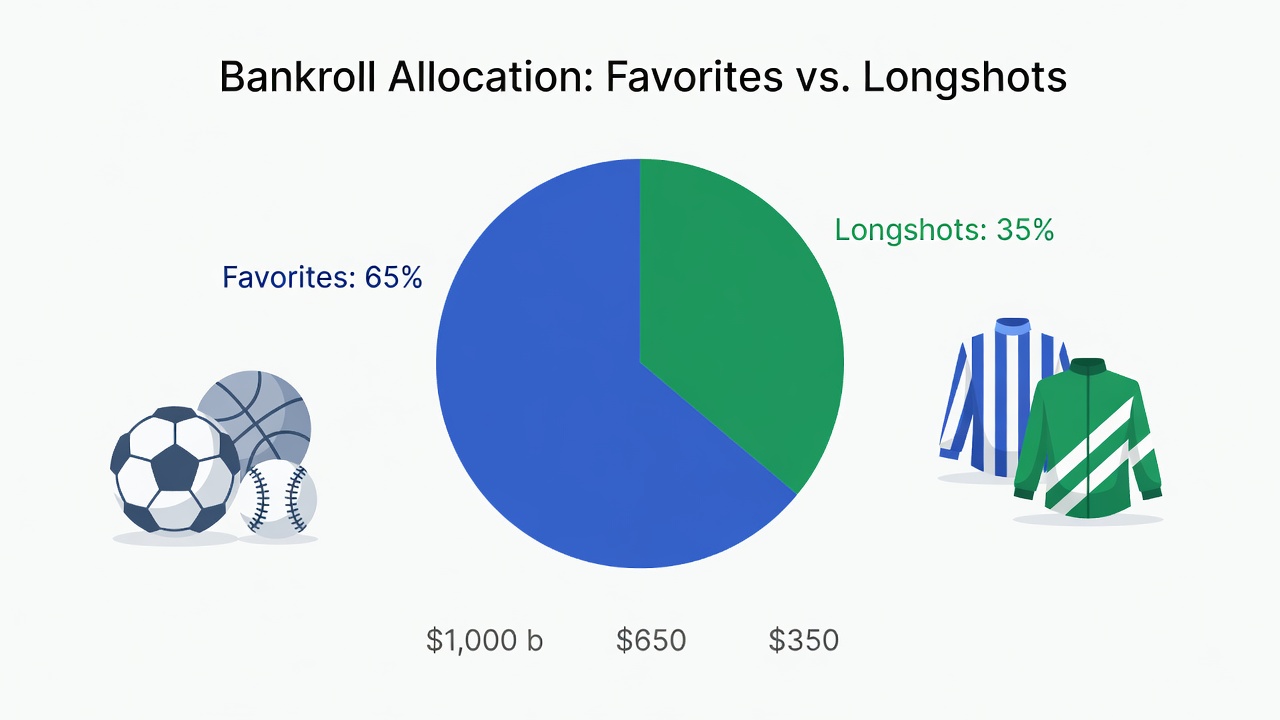
Divide your bankroll strategically. Allocate 60-70% to favorites for stability and 30-40% to longshots for growth. For a $1,000 bankroll, this means roughly $650 on favorites and $350 on longshots per cycle, adjusting based on results. Consider a tiered approach where high-confidence favorites receive 3-5% stakes while speculative longshots receive 1-2% stakes. This method protects the bankroll during inevitable downswings while allowing compounding when longshots hit. Track performance monthly and rebalance allocations if one category consistently outperforms the other.
Practical Steps for Evaluating Odds
- Compare multiple bookmakers for the best lines to maximize potential returns on both favorites and longshots.
- Calculate implied probability from odds and compare it against your own assessed probability derived from data models.
- Cross-reference with independent models that incorporate pace, form, and situational factors.
- Track closing odds versus opening odds to detect sharp money movement that may indicate value.
- Record all bets for performance review, including stake size, odds, and outcome notes for future refinement.
- Factor in commission rates on exchanges and any promotional boosts that can tip marginal bets into positive value territory.
Real-World Case Studies from Major Events
In the 2025 Kentucky Derby, several longshots at +800 delivered strong returns when favorites underperformed due to pace scenarios and traffic issues. Bettors who identified horses with strong late closing speeds profited handsomely. Similarly, in Premier League matches during the 2025-2026 season, underdogs with positive expected value outperformed public perception in key fixtures where the favorite showed signs of fatigue from European commitments. Another example comes from the 2026 Australian Open tennis, where a longshot qualifier at +1200 upset a top seed after detailed analysis revealed superior recent form on the surface.
Common Mistakes to Avoid
Chasing losses by over-betting longshots, ignoring bankroll limits, and failing to shop for odds are frequent errors. Additional pitfalls include overvaluing recent results without context, neglecting to account for track bias in racing, and placing emotional bets on popular favorites without checking value. Always maintain discipline and review historical data before placing wagers. Another common mistake is failing to diversify across different bet types, such as mixing win bets with each-way or place options in racing to reduce variance.
FAQ on Staking Plans and Market Differences
What staking plan works best for mixing favorites and longshots?
Flat staking or percentage-based methods provide consistency. Adjust percentages according to confidence levels derived from data analysis. Kelly Criterion variants can optimize growth but require accurate probability estimates.
How do sports betting markets differ from horse racing?
Sports often feature more variables like injuries and weather, while horse racing emphasizes pace and track bias. Both require careful odds evaluation and understanding of market dynamics.
Should beginners focus on favorites?
Yes, starting with favorites builds experience before venturing into higher-risk longshots. This approach teaches bankroll management and odds reading in lower-variance environments.
Are there regional differences in how longshots perform?
Yes, markets in Europe tend to be more efficient than some US racing circuits, making longshot identification slightly easier in less liquid pools.
How important is live betting when backing longshots?
Live betting can rescue or enhance longshot positions if early pace develops favorably, but it requires fast decision-making and disciplined exit strategies.
Conclusion
Balancing favorites and longshots with data-driven 2026 strategies improves long-term results. Focus on value, manage your bankroll wisely, and continually refine your approach using reliable sources such as World Health Organization for responsible practices and ESPN for live insights. Consistent application of these principles separates recreational bettors from those who achieve sustainable success.

No comments yet. Be the first!