 GambleLore

In 2026, artificial intelligence is reshaping how serious players approach table games in casinos worldwide. This comprehensive guide explores practical methods for incorporating AI-driven tools into core strategies for blackjack and roulette, helping users make data-informed decisions that go far beyond traditional counting systems or intuition. Whether you are a recreational player or someone seeking consistent edges, understanding these technologies can elevate your gameplay while emphasizing responsible habits.
Understanding AI in Modern Casino Play
Artificial intelligence excels at processing enormous volumes of historical and real-time data, including card distributions, wheel biases, and probability matrices. In blackjack, AI models can simulate millions of hands to refine basic strategy charts dynamically based on remaining deck composition. For roulette, machine learning algorithms detect subtle patterns in spin outcomes or dealer signatures that human observation might miss. These capabilities stem from advances in neural networks and predictive analytics, allowing tools to adapt to specific casino environments such as single-deck versus multi-deck tables or European versus American roulette variants. Players benefit from reduced cognitive load, as the AI handles complex calculations instantly, freeing mental energy for bankroll management and table selection.
Top AI Apps for Odds Analysis
Leading applications in 2026 leverage cloud-based processing and on-device machine learning to deliver accurate odds assessments. Tools often feature live camera integration for scanning cards or tracking ball trajectories, combined with customizable risk profiles that adjust recommendations according to user bankroll size and session goals. For example, certain platforms provide heat maps of favorable betting zones in roulette or real-time deviation alerts in blackjack when the count shifts dramatically. Users should prioritize apps with transparent algorithms and regular updates to maintain compatibility with evolving casino surveillance technologies. Cross-referencing multiple apps can further validate signals before committing to a bet.
Step-by-Step Setup Guide
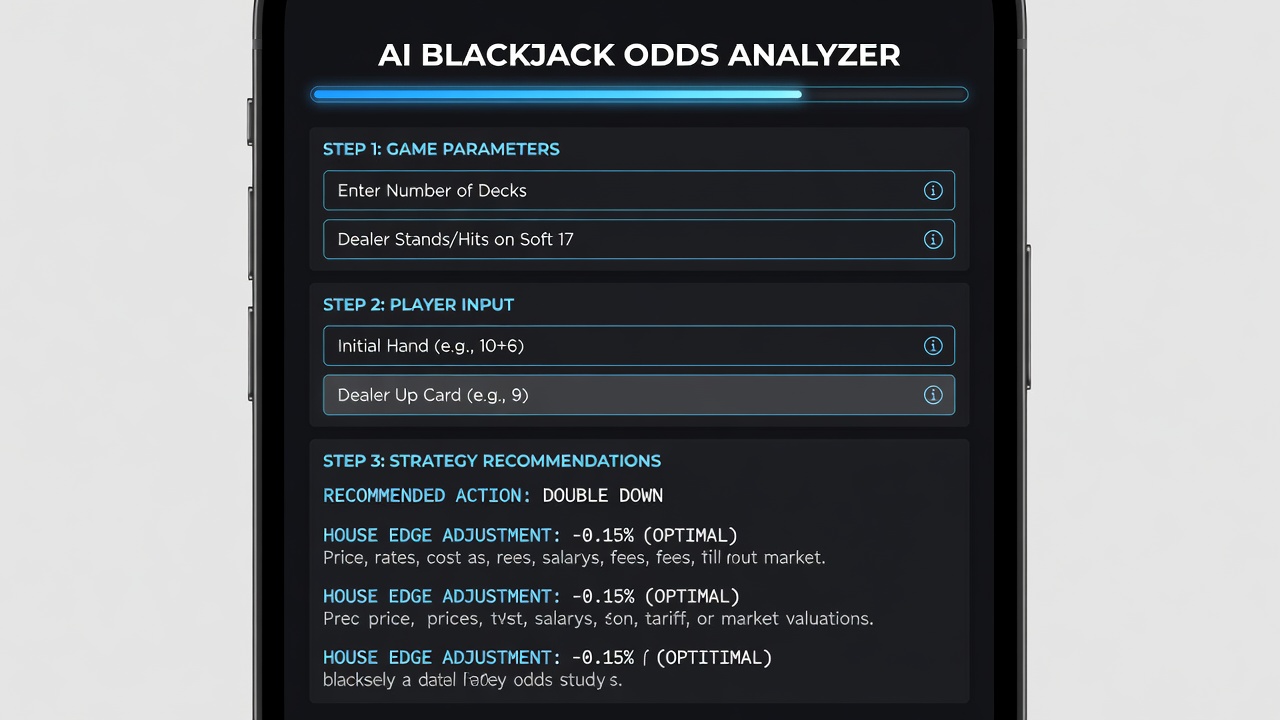
Integrating an AI tool begins with careful preparation to ensure seamless operation during live sessions. First, select and download an app from verified app stores while reviewing recent user feedback for reliability. Next, enable necessary permissions such as camera access for table scanning or microphone for voice input of outcomes. Configure core settings by selecting your preferred game rules, including blackjack payout ratios or roulette wheel type, then import any personal historical data if the app supports it. Calibration follows, involving several practice rounds where you compare AI suggestions against known optimal plays to fine-tune sensitivity levels. Finally, establish session parameters like stop-loss thresholds and review the dashboard analytics before entering the casino floor. Testing the full workflow in a low-stakes environment helps identify any interface quirks early.
Real-World Examples and Sample Sessions
Imagine a three-hour blackjack session at a busy 2026 Las Vegas property where the player uses an AI app to monitor a six-deck shoe. After the first twenty hands, the tool identifies a positive count and recommends increasing bets on hands with favorable player options, resulting in a net gain despite several dealer blackjacks. In another scenario involving roulette at an Atlantic City casino, the AI tracks twenty consecutive spins and highlights a slight bias toward high numbers, prompting the player to place combination bets on the third column while maintaining strict unit sizing. These examples illustrate how AI augments rather than replaces player judgment, especially when combined with real-time observation of dealer habits or table pace.
Risk Comparisons to Manual Play
Compared with purely manual approaches, AI-assisted play significantly lowers the incidence of emotional decision-making such as chasing losses or deviating from strategy under pressure. Manual players frequently overlook subtle statistical shifts during long sessions, whereas AI maintains consistent analysis regardless of fatigue. However, both methods face the same fundamental house edges, and overconfidence in technology can lead to larger bets without adequate safeguards. AI users also gain advantages in record-keeping, as apps log every decision for post-session review, enabling iterative improvement that manual note-taking rarely achieves at the same depth.
Addressing Data Privacy and Costs
Privacy remains a primary concern when using connected AI applications. Reputable providers implement end-to-end encryption and anonymized data handling to protect user activity. Players are encouraged to read terms carefully and consider offline-capable tools when possible. Subscription and usage models vary widely across providers, so evaluating free trial periods offers the best way to assess value without commitment. For broader guidance on digital well-being, refer to established health authorities.
Common Mistakes to Avoid
- Relying exclusively on AI outputs without mastering foundational game rules and basic strategy first.
- Using electronic devices in jurisdictions or venues where they are explicitly prohibited, risking confiscation or ejection.
- Neglecting to set strict time and money limits even when the tool suggests favorable conditions.
- Failing to update the application regularly, which can result in outdated probability models.
- Sharing login credentials or sensitive session data across unsecured networks.
FAQ
Is using AI legal in casinos?
Legality varies by location and individual casino policy. Many properties ban electronic assistance, so always confirm house rules in advance.
How accurate are these tools in live environments?
Accuracy depends on input quality and game conditions, often exceeding 90 percent in controlled simulations but requiring user verification during actual play.
Can AI guarantee consistent wins?
No system can overcome the built-in house advantage over the long term; AI improves decision quality but does not ensure profits.
What data does an AI app typically collect?
Most apps gather game statistics and device information while employing strong encryption; review each provider’s privacy policy for specifics.
Are there alternatives to paid AI tools?
Free open-source probability calculators exist, though they lack the advanced real-time features of commercial applications.
Explore responsible gambling frameworks through the World Health Organization. For insights into ethical AI development, consult resources from Microsoft and IBM.
Conclusion
By thoughtfully integrating AI tools into blackjack and roulette strategies, players in 2026 can access deeper analytical support that complements traditional skills. Success ultimately hinges on disciplined execution, ongoing education, and a clear focus on entertainment rather than guaranteed returns. Approach every session with preparation and restraint to maximize both enjoyment and long-term sustainability.


No comments yet. Be the first!