 GambleLore

Introduction to Risk Management in Modern Casinos
Effective risk management forms the foundation for any player pursuing sustainable success in 2026 casino environments. Blackjack, roulette, and baccarat each present unique challenges due to their differing house edges and volatility levels. Protecting capital while extending play sessions demands more than intuition; it requires structured protocols that adapt to real-time performance. This comprehensive guide examines dynamic loss limits, stop-win protocols, and variance-based position sizing with detailed implementation steps, comparisons between conservative and aggressive styles, and multiple real-world examples. Players frequently encounter the trap of chasing losses during inevitable downswings, which accelerates bankroll erosion. Structured techniques counteract this by enforcing objective exit points and allocation rules. These methods scale across skill levels and remain relevant whether playing at physical tables or regulated online platforms.
Setting Dynamic Loss Limits
Dynamic loss limits differ from static daily caps by recalibrating based on session metrics and overall bankroll health. Begin by establishing your total playing capital and dividing it into session allocations, typically no more than 20 percent per outing. For a $1,000 bankroll, this yields $200 per session. The dynamic element involves tightening thresholds mid-session if early results indicate higher variance than anticipated. Step-by-step: first calculate a base threshold at 20 percent of the session allocation; second, review results every 20 to 30 minutes and reduce the remaining limit by 5 percent if losses reach half the threshold; third, log every bet outcome in a simple spreadsheet or dedicated app to enable accurate adjustments. Conservative players prefer thresholds between 10 and 15 percent with immediate session termination, while aggressive players extend to 25 percent but incorporate mandatory 48-hour cooling periods afterward. Real-world example: a roulette player with a $300 session allocation hits the dynamic 18 percent mark after 40 minutes of even-money bets and exits, preserving the majority of funds for later sessions instead of attempting recovery on the same table.
Implementing Stop-Win Protocols
Stop-win protocols protect accumulated profits by mandating cessation once predefined targets are met. This prevents the common error of continuing play after gains, thereby exposing winnings to further variance. Targets should reflect game volatility—set at 30 percent above starting capital for blackjack and closer to 25 percent for roulette. Implementation requires pre-session definition of both the profit target and a mandatory break duration, such as 24 hours before returning. Conservative approaches trigger at +25 percent with full session shutdown, whereas aggressive versions permit +40 percent but enforce strict re-entry rules and reduced bet sizing on the subsequent outing. Both styles outperform unstructured play by minimizing emotional overrides. Example in baccarat: a player starts with $250, reaches the +35 percent target at $337.50, and departs immediately, locking in the gain irrespective of later dealer streaks.
Position Sizing Based on Variance
Variance quantifies outcome fluctuation and directly influences safe bet sizing. Higher-variance games such as roulette necessitate smaller percentages of bankroll per wager compared with lower-variance blackjack. Begin by estimating game-specific variance through standard deviation calculations or published charts; then apply a conservative fraction of the Kelly Criterion, typically half-Kelly, to determine bet size. For blackjack, maintain bets at 1 to 2 percent of total bankroll; for roulette, reduce to 0.5 to 1 percent. Reassess sizing after every 10 completed sessions using recorded results. Conservative sizing never exceeds 1 percent regardless of streak, while aggressive sizing temporarily increases to 2 to 3 percent during confirmed positive trends but includes automatic reduction triggers. 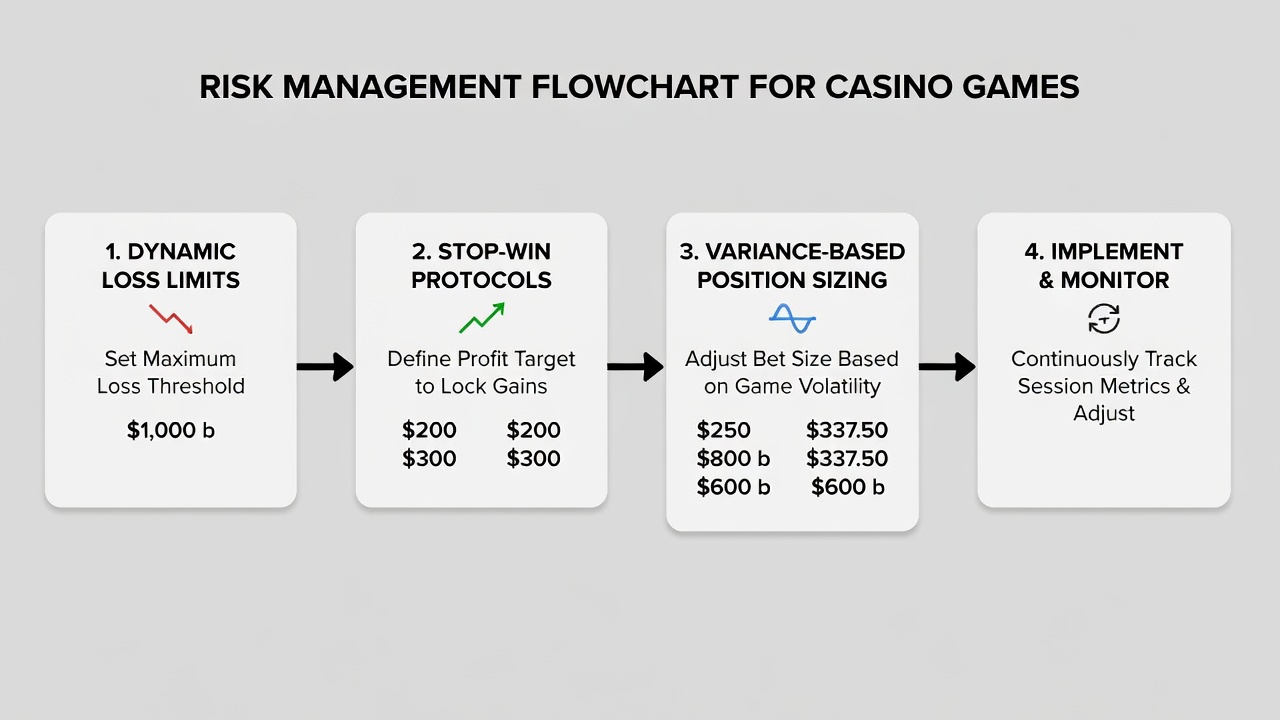
Real-World Examples Across Games
Blackjack illustration: a disciplined player allocates 1.5 percent position sizing on a $800 bankroll and pairs it with a dynamic 15 percent loss limit. After 92 hands the session reaches the +32 percent stop-win target, allowing departure with locked profits and no exposure to subsequent variance. Roulette scenario: variance analysis dictates 0.75 percent bets on a $600 bankroll. The player applies a +28 percent stop-win and exits during a prolonged cold streak, sidestepping the frequent error of progressive betting after losses. Baccarat case study: combining dynamic limits at 18 percent with variance-adjusted sizing produces average session lengths 2.5 hours longer than unstructured approaches while maintaining positive expectancy over 50 documented outings.
Common Pitfalls to Avoid
- Ignoring game-specific variance, which leads to oversized bets in roulette and rapid drawdowns.
- Failing to adjust limits mid-session when fatigue or emotional tilt appears.
- Over-relying on aggressive sizing without maintaining a written plan and review process.
- Skipping weekly performance reviews that reveal recurring patterns requiring threshold refinement.
- Applying identical rules across all games without accounting for house edge differences.
Consistent record-keeping and periodic evaluation prevent these issues from undermining long-term results. Authoritative guidance from organizations such as the National Council on Problem Gambling reinforces the value of documented strategies.
Tracking and Reviewing Performance
Maintain a detailed log that captures bet size, outcome, cumulative bankroll, and emotional state after each session. Review entries weekly to identify whether actual variance matches projections and whether limits require recalibration. This feedback loop transforms static rules into adaptive systems that improve with experience. Conservative players emphasize qualitative notes on decision quality, while aggressive players focus on quantitative metrics such as return on allocated capital.
FAQ: Adapting Techniques Across Game Types
How do I adjust loss limits for blackjack versus roulette?
Blackjack permits modestly higher limits because of reduced variance; begin at 20 percent and validate adjustments across at least 15 sessions. Roulette demands tighter caps around 15 percent to accommodate greater outcome swings.
Can stop-win protocols work in baccarat tournaments?
Yes, but scale targets to tournament progression—consider 25 percent gains before locking profits to offset escalating structure and entry considerations.
What if variance calculations appear overly complex?
Employ simplified percentages: 1 percent for low-variance games and 0.5 percent for high-variance games. Validate effectiveness by tracking outcomes over 20 consecutive sessions before further refinement.
Are these techniques suitable for online casinos in 2026?
Yes—apply identical bankroll rules while treating any platform bonuses as separate mini-bankrolls subject to their own limits and expiration dates. Additional support resources are available at BeGambleAware.
How often should position sizing be recalculated?
Recalculate after every 10 sessions or following any bankroll change exceeding 10 percent to maintain alignment with current variance and capital levels.
Consistent application of these risk management techniques supports extended, controlled play across blackjack, roulette, and baccarat throughout 2026 while preserving capital for future opportunities.


No comments yet. Be the first!