 GambleLore

Introduction to Online Gambling Taxes in 2026
Online gambling continues to expand rapidly worldwide, bringing both excitement and important financial responsibilities for players. Understanding tax obligations is essential to avoid penalties, audits, or legal complications in 2026. This comprehensive guide examines how winnings from online casinos, poker rooms, and sportsbooks are treated in major jurisdictions. It provides detailed compliance strategies, documentation requirements, and real-world calculation examples to help players report income accurately and legally. Recreational players and professionals alike benefit from clear knowledge of thresholds, forms, and deduction opportunities that differ by location and activity level.
Tax authorities generally classify gambling winnings as taxable income, though treatment differs significantly by country and player status. Recreational players face simpler rules than professionals who treat gambling as a business. Staying informed helps maintain compliance while maximizing legitimate deductions where available. Failure to report can lead to interest, fines, or even criminal charges in severe cases across multiple regions.
US Tax Rules for Online Gambling Winnings
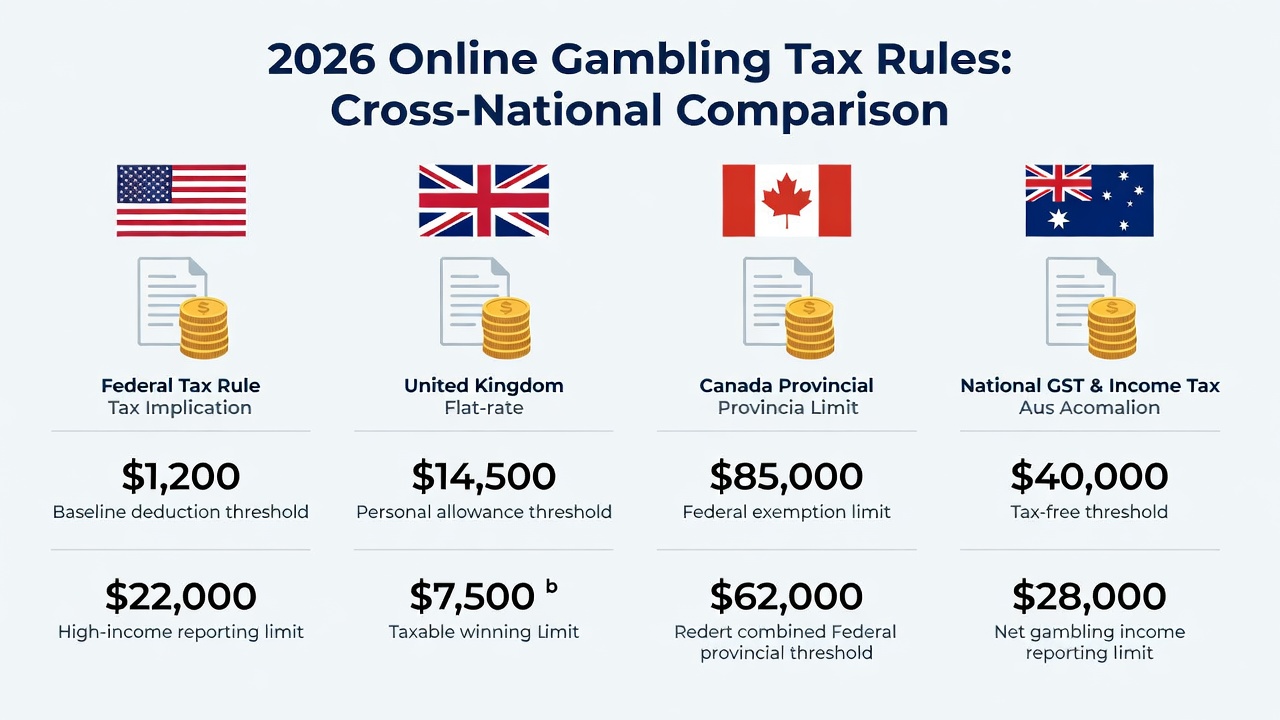
The Internal Revenue Service treats all gambling winnings as ordinary income. Players must report every win, regardless of amount, on their federal tax return. Online platforms may issue Form W-2G for jackpots meeting specific thresholds, such as $1,200 or more for slot machines. Even without this form, self-reporting remains mandatory. State taxes may also apply depending on residency, adding another layer of complexity for cross-border players. Some states like Nevada have no income tax while others such as New York impose additional layers on top of federal obligations.
Professional gamblers can deduct ordinary business expenses, but recreational players are limited to loss offsets. Detailed records become critical during audits. Visit the official IRS site for forms and guidance: IRS.gov.
Tax Treatment in the UK, EU, and Other Regions
The United Kingdom maintains a player-friendly stance where gambling winnings remain tax-free for individuals. HM Revenue and Customs focuses taxation on operators rather than players. This contrasts with several EU nations. Germany imposes a 5% tax on stakes for certain games, while France applies withholding on larger poker winnings. Canada generally exempts casual gambling income but may tax professional activity as business revenue. Australia follows a similar exemption pattern unless the activity qualifies as a trade or profession under specific tests.
Check official UK government resources here: GOV.UK. Players in other regions should review local revenue authority websites for the most current guidance each tax year.
Documentation Required for Filings
Comprehensive record-keeping forms the foundation of compliant reporting. Essential documents include platform transaction histories, deposit and withdrawal statements, and session logs showing dates, times, and bet amounts. Many licensed operators provide downloadable CSV or PDF reports that satisfy IRS or equivalent requirements. Bank records and credit card statements serve as supporting evidence. Digital apps designed for gamblers can help organize data by tax year, reducing preparation time during filing season. Maintaining separate accounts for gambling activity further strengthens audit defense by creating clear audit trails.
Common Deductions and Losses
US taxpayers may deduct gambling losses up to the total of reported winnings, provided they itemize deductions. Acceptable proof includes casino-issued win/loss statements, personal diaries noting each session, and receipts for entry fees or tournament buy-ins. Professional players often qualify for additional deductions such as software subscriptions, internet costs, and travel directly related to their activity. Always separate personal and gambling finances to strengthen your position during potential reviews. Accurate categorization prevents disputes over what qualifies as a legitimate business expense versus a personal hobby cost.
Step-by-Step Reporting Process
Follow this structured approach to ensure accurate filings:
- Gather all platform statements and bank records from the previous tax year, organizing them by month and game type for easy reference during preparation.
- Calculate gross winnings and subtract documented losses to determine net taxable income, double-checking totals against multiple sources.
- Complete Schedule 1 or relevant forms and attach supporting documentation if required by your filing status or income level.
- Review state-specific obligations and file any additional returns by applicable deadlines to avoid late penalties.
- Retain copies of all submissions and records for at least seven years in case of audit or amendment needs.
Regional Comparisons of Tax Rules
- United States: Winnings fully taxable; losses deductible with detailed records; Form W-2G possible for larger jackpots.
- United Kingdom: No tax on player winnings; operator duties apply instead with no player-level reporting required.
- Canada: Generally tax-free for casual players; professional income may be taxable as business revenue.
- Australia: Winnings usually exempt unless classified as business activity under ATO guidelines.
- Germany: Stake-based taxes may apply depending on game type and licensed platform location.
Real-World Tax Calculation Examples
Imagine a recreational player who wins $22,000 from online slots and records $14,500 in verified losses across the year. In the US, the net $7,500 becomes the taxable amount when itemizing on Schedule A. Another example involves a poker professional earning $85,000 in tournament winnings offset by $62,000 in travel, software, and entry fees, resulting in significantly lower taxable income after proper deductions. A third scenario features an international player with $40,000 in mixed casino wins and $28,000 in losses who must reconcile currency conversions and foreign platform reports for US filing purposes.
Common Mistakes to Avoid
Players frequently underestimate the importance of consistent record-keeping or assume small wins do not require reporting. Mixing personal and gambling funds complicates audits and can lead to disallowed deductions. Failing to track international play can also create issues for US citizens who must declare worldwide income. Overlooking state filing requirements adds another common error. Consulting a tax advisor familiar with gambling regulations prevents costly errors and ensures all forms are completed correctly.
Frequently Asked Questions
Do I need to report winnings under $1,000?
Yes, all winnings must be reported even if they fall below Form W-2G issuance thresholds or state minimums.
Can I deduct travel expenses to casinos?
Only professional gamblers meeting IRS criteria typically qualify for such deductions after proving profit intent.
What if I play on international platforms?
US taxpayers must still report all worldwide gambling income regardless of operator location or licensing jurisdiction.
How long should I keep gambling records?
Retain documents for at least seven years to cover potential audit periods and amendment windows.
Are cryptocurrency winnings taxed differently?
They follow the same rules as fiat winnings but require additional tracking of fair market value at receipt date.
Do bonuses and free spins count as taxable winnings?
Yes, any converted bonus amounts or free spin prizes are considered taxable income upon withdrawal or play-through completion.
Conclusion
Navigating 2026 online gambling tax obligations requires diligence, accurate records, and awareness of jurisdiction-specific rules. By understanding reporting requirements, utilizing legitimate deductions, and avoiding common pitfalls, players can fulfill their legal responsibilities while protecting their finances. When situations grow complex, professional tax guidance ensures full compliance and peace of mind throughout the filing process.


No comments yet. Be the first!