 GambleLore

Introduction to 3-Bet Mastery in Texas Hold'em Tournaments
In the high-stakes world of Texas Hold'em tournaments, especially online in 2026, aggression is the key to separating winners from the pack. For intermediate players, mastering the 3-bet—one of poker's most powerful weapons—can transform your game from passive to predatory. A 3-bet occurs when you re-raise after an initial raise, signaling strength or bluffing to exploit opponents' weaknesses.
This guide dives deep into 3-bet fundamentals, optimal sizing, position-based ranges, and tournament-specific adjustments. We'll cover light 3-betting from late position, value 3-bets from early seats, defenses against 4-bets, and comparisons between polarized and linear strategies. With real hand examples, step-by-step guides, practical charts, and common pitfalls to avoid, you'll gain the tools to boost your aggression and stack sizes. Whether you're grinding online MTTs or deep runs, these 2026 strategies are tailored for the evolving meta.
3-Bet Fundamentals: Building a Solid Foundation
Understanding 3-bets starts with context. In tournaments, players open-raise preflop (2-bet), and you respond with a 3-bet to apply pressure. The goal? Fold out better hands, build pots with premium holdings, or steal dead money.
Key concepts:
- Frequency: Aim for 8-12% overall 3-bet frequency in tournaments, adjusting by position.
- Polarization: Mix value hands (QQ+, AK) with bluffs (suited connectors, Ax suited).
- Exploitation: Target loose openers who fold too much to 3-bets.
According to experts at Upswing Poker, balanced 3-betting prevents exploitation while maximizing folds.
Optimal 3-Bet Sizing for 2026 Tournaments
Sizing is crucial in online poker where speeds are fast and stacks vary. Standard tournament sizing:
- Early/Mid Stack (20-50BB): 3x the open raise.
- Short Stack (<20BB): 2.2-2.5x for value, larger for bluffs.
- Deep Stack (100BB+): 3.5-4x to punish loose opens.
In 2026's solver-influenced meta, use smaller sizes (2.5-3x) in position against calling stations, but bump to 4x out of position. Always consider ICM pressure in late stages—smaller 3-bets preserve fold equity without risking tournament life.
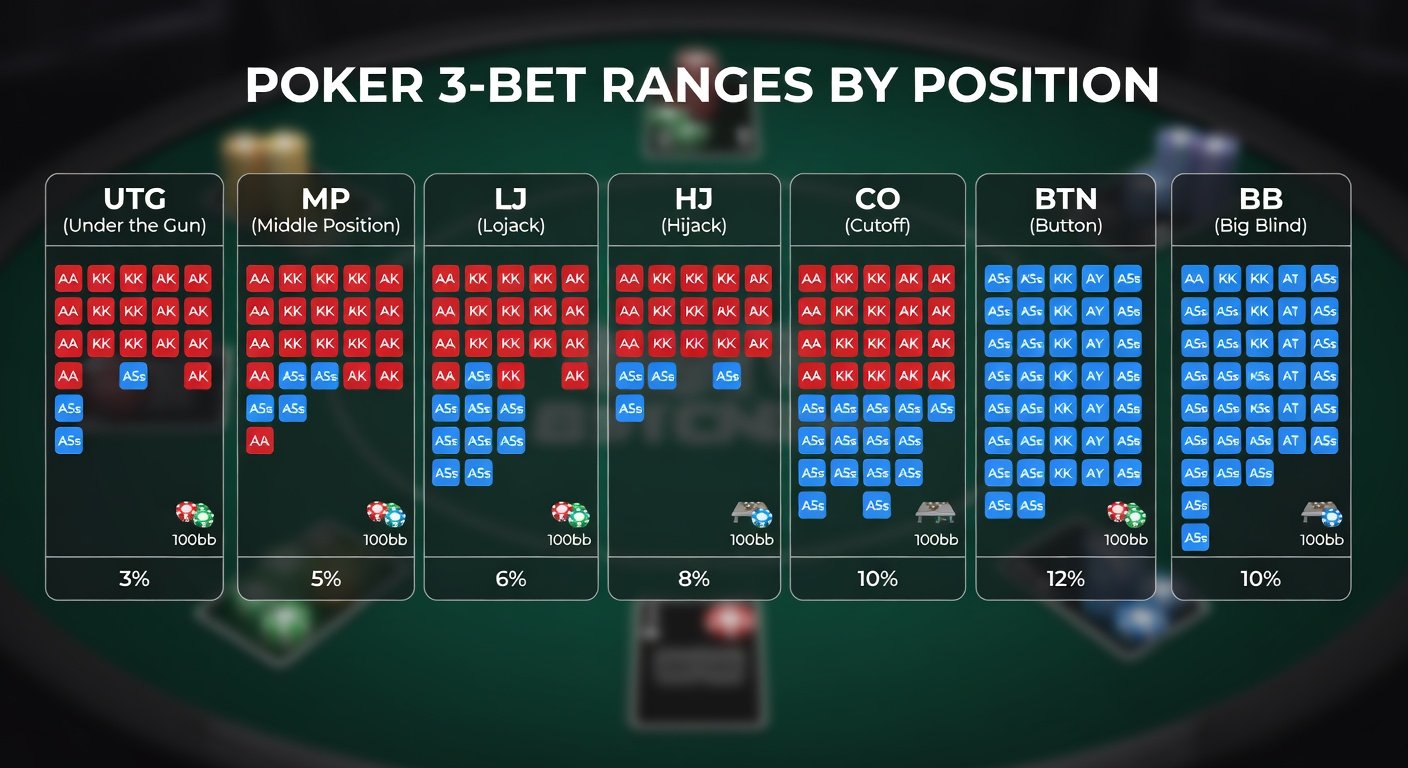
Position-Based 3-Bet Ranges
Position dictates your range. Here's a breakdown:
| Position | Value Hands | Bluff Hands | 3-Bet Freq |
|---|---|---|---|
| UTG/Early | QQ+, AK | A5s-A2s, KQs | 4-6% |
| Middle | JJ+, AQ+ | A4s+, suited connectors | 6-8% |
| Button/CO | 88+, AJs+, KQs, AQo+ | A2s+, suited wheels, broadways | 12-15% |
| Blinds | TT+, AQs+, AKo | Any Ax suited, suited gaps | 10-12% |
These ranges are starting points; use HUD stats to adjust. For more on range construction, check PokerNews.
Step-by-Step Guide: Light 3-Betting from Late Position
Light 3-betting shines on the button or cutoff against loose opens. Here's how:
- Identify Targets: Open-raise VPIP >30%, fold-to-3bet >60%.
- Select Hands: Bluffs like A5s (block AA/AK, plays well postflop), 76s (multi-way potential).
- Size Up: 2.8-3.2x in position.
- Postflop Plan: C-bet 60% on dry boards, check-raise draws.
Example Hand: Button vs MP open. You hold JTs. 3-bet to 3x. Villain folds 65%—instant equity.
Value 3-Bets from Early Position
From UTG, stick to nuts. QQ+ crushes loose opens.
- Range Tight: QQ+, AKs, AKo.
- Size Large: 3.5-4x OOP.
- Barrel Strong: Continue aggression on ace-high boards.
Example: UTG open to you with KK. 3-bet 4x. Villain shoves? Snap call if stacks <25BB.
Tournament Stage Adjustments
Adapt to phases:
- Early: Wider 3-bets to build stacks.
- Mid: ICM-aware, tighten vs pros.
- Late/Bubble: Exploit short stacks, avoid vs big stacks.
- Final Table: Polarize heavily; 3-bet shove ranges explode.
In 2026 online MTTs, ante structures (12-16%) demand more 3-bets to counter dead money.
Polarized vs Linear 3-Bet Strategies: Which to Use?
Polarized: Top 10% + bottom 30% (QQ+/bluffs). Pros: Unexploitable, high fold equity. Cons: Tough postflop.
Linear: Medium-strength hands (88-JJ, AJo). Pros: Easier postflop. Cons: Capped range readable.
Polarized wins in fast online tournaments; linear for live deeper stacks. Compare via equity calculators—polarized folds out 88-TT profitably.
Defending Against 4-Bets
When facing 4-bets, fold marginals, jam premiums. Ranges:
- 4-Bet Bluff Defense: Call QQ-JJ light, 4-bet shove AK.
- Value 4-Bet: Hero-fold JJ if villain's range is QQ+.
Example: You 3-bet AKo BTN, villain 4-bets. With 25BB, shove—equity vs AA/KK is 30%+.
Common Pitfalls: Over-Bluffing and More
Avoid these mistakes:
- Over-Bluffing: >50% bluffs unbalances you.
- Ignoring HUDs: No stats? Default tight.
- Static Ranges: Adjust live.
- Postflop Neglect: Plan beyond preflop.
Track with PokerTracker; aim for balanced frequencies.
Practical 3-Bet Frequency Chart
| Stack Depth | Vs Loose Open | Vs Tight Open | Recommended Freq |
|---|---|---|---|
| 10-20BB | 15% | 8% | Push/Fold Charts |
| 20-40BB | 12% | 6% | 9-10% |
| 40BB+ | 10% | 5% | 7-9% |
FAQ: Online vs Live 3-Betting Adaptations
Q: How does online differ from live?
A: Online: Faster, HUDs mandatory, wider ranges. Live: Sizing larger (4x+), read physical tells.
Q: Best software for ranges?
A: PioSolver or GTO Wizard for training.
Q: When to 3-bet call?
A: Rarely; prefer fold/jam OOP.
Q: 3-bet shoving thresholds?
A: 15BB: TT+, AQs+; 10BB: 22+, A2s+.
Conclusion: Implement and Dominate
Mastering 3-bets in 2026 Texas Hold'em tournaments demands practice, but the edge is massive. Review hands, track stats, and exploit relentlessly. Start applying these strategies in low-stakes MTTs, scale up, and watch your results soar. Stay aggressive, stay balanced, and claim those final tables.

No comments yet. Be the first!