 GambleLore

Introduction to Continuation Betting in Modern Tournaments
Continuation betting, or c-betting, remains one of the most powerful tools in Texas Hold'em tournament play. In the evolving 2026 online meta, where solvers and tracking software shape strategies, mastering c-bets separates winning players from the field. This guide delivers practical advice on frequencies, board textures, and range balancing tailored for tournament formats. Effective c-betting starts with understanding why you bet the flop after raising preflop. The goal is to apply pressure on opponents' weak holdings while protecting your own equity. As stack depths shrink in tournaments, adjustments become critical compared to cash games. Players who ignore these nuances often bleed chips through predictable patterns that solvers easily exploit.
The 2026 Online Poker Meta and Solver Influence
The 2026 online environment features advanced solver integrations in most major platforms, leading to more balanced play from regulars. However, recreational players still make exploitable mistakes. C-betting must account for this mix. Tools like PioSolver and GTO+ have raised baseline frequencies, but human tendencies allow for profitable deviations. Understanding this meta helps you decide when to deviate from pure GTO lines toward exploitative ones that maximize expected value against specific opponents.
Optimal C-Bet Frequencies by Board Texture
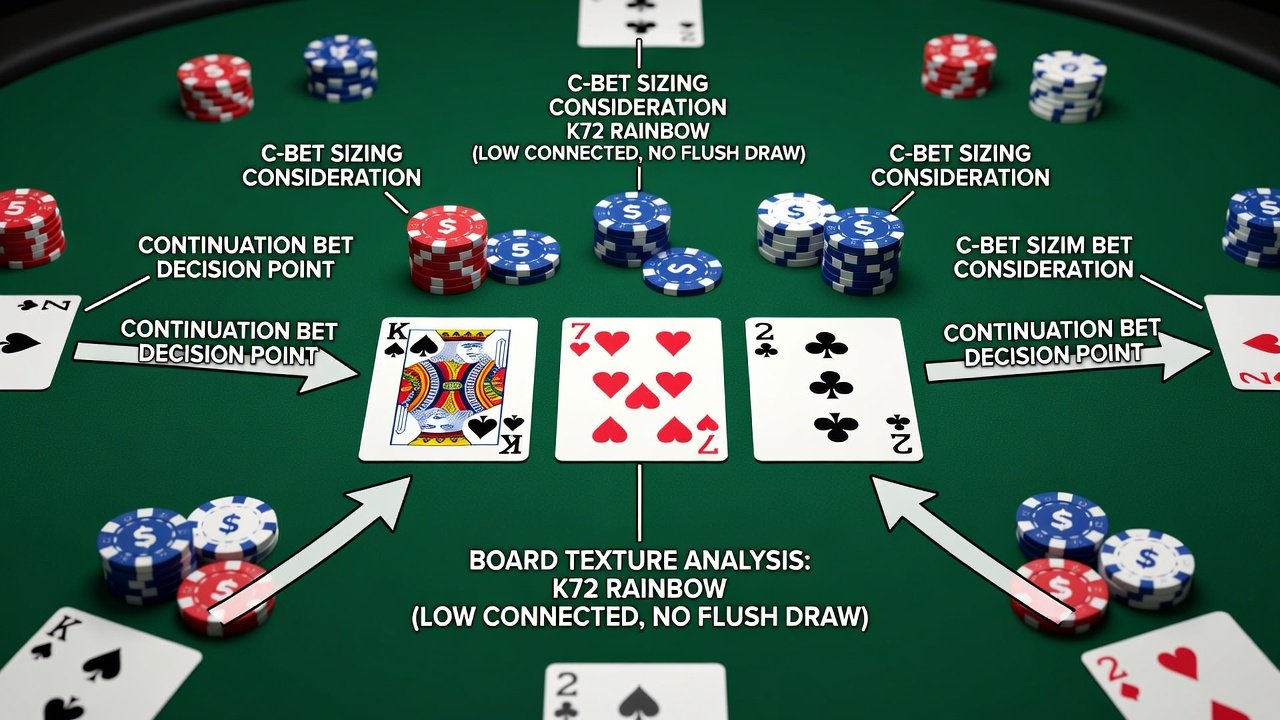
Board texture dictates c-bet frequency more than any other factor. On dry boards like K72 rainbow, GTO baselines suggest c-betting 60-70% of the time in position. Wet boards such as 987 with two flush draws demand lower frequencies around 40-50% to avoid over-bluffing. Monotone boards require even more caution, with frequencies dropping to 35% or lower because flush draws hit ranges hard. In position from the button or cutoff, increase c-bet rates by 10-15% compared to early position because you close the action more often. Stack depth further refines this: with 20-30 big blinds, lean toward smaller bet sizes on dry boards to preserve fold equity while avoiding commitment with marginal hands.
Position and Stack Depth Interactions
Position amplifies or reduces the power of your c-bets. Late position allows wider c-betting because you face fewer players behind. Early position demands tighter ranges since multiple opponents can float or raise. Stack depth changes everything: at 15 big blinds or less, shift toward all-in or check-fold strategies rather than standard c-bets. Deeper stacks of 50+ big blinds permit larger bet sizings and more complex multi-street plans. Always calculate pot odds and implied odds before deciding on bet size in these scenarios.
Flop Selection Criteria and Range Balancing
Choosing which hands to c-bet requires balancing your range. Include value hands like top pair and strong draws while mixing in bluffs such as gutshots and backdoor flush draws. Avoid c-betting every made hand, as this makes your range predictable. Against loose callers, tighten your c-betting range to include more value. In the 2026 meta, many players over-fold to flop bets, allowing exploitative increases in bluff frequency on dry textures. Use blocker effects to select bluffs that remove key parts of opponents' continuing ranges.
Turn and River Barreling Decisions
Barreling on later streets builds on flop decisions. On the turn, continue betting when the card improves your range or weakens opponents'. For example, a brick turn on a dry flop often warrants a second barrel with air or medium strength hands. River play focuses on blocker effects and pot odds. Check back some strong hands to protect your checking range, especially in multi-way pots common in tournaments. Always consider how your range looks to the opponent after each street.
Real Hand Examples from Online Sessions
Consider a hand from a 2026 online MTT: You raise KQo from the cutoff to 2.2 big blinds and face a call from the big blind. The flop comes K72 rainbow. A 60% pot c-bet works well here, as your range hits this board frequently. In another example, you hold 98 suited on a 765 flop after raising from the button. Checking back balances your range against aggressive opponents who float wide. A third scenario involves ATo on an A92 board with two clubs. Here, a smaller 40% pot c-bet extracts value while denying equity to draws. Review these patterns in your own database to spot recurring spots.
GTO Baselines Versus Exploitative Adjustments
GTO solvers provide solid baselines, but tournaments reward exploitative play. Against tight players who over-fold, raise c-bet frequency to 80% on dry boards. Versus loose-aggressive types, reduce bluffs and focus on value betting. Common player types in 2026 online fields include recreational players who call too wide and regulars who adjust to solver outputs. Track opponent tendencies using HUD stats to fine-tune your approach. Small adjustments compound over hundreds of hands.
Step-by-Step Checklist for Implementation
- Review preflop ranges before each session to ensure balanced opening hands.
- Assess flop texture and assign a c-bet frequency based on position and stack depth.
- Balance value and bluffs using blockers and equity realization.
- Plan turn and river barrels in advance during flop decision-making.
- Adjust frequencies against specific player types using observed tendencies.
- Review sessions with tracking software to identify leaks in your c-betting strategy.
- Simulate hands with solvers weekly to stay sharp on evolving meta trends.
Adjustments for Varying Tournament Stages
Early stages allow wider c-betting as stacks are deep and survival is not yet critical. In the middle stages with 25-40 big blinds, tighten ranges and prefer smaller sizing to avoid variance. Near the bubble or final table, exploit ICM pressure by c-betting more aggressively against short stacks who cannot afford to defend wide. Pay close attention to payout jumps and adjust bluff frequencies accordingly.
Common Mistakes to Avoid
Many players c-bet too often on coordinated boards, leading to difficult spots on later streets. Another error is failing to check back enough strong hands, which makes checking ranges weak and exploitable. Ignoring stack-to-pot ratios when sizing bets also costs equity over time. Always review your hand histories to catch these patterns early.
FAQs on Common Mistakes
What is the biggest mistake in continuation betting?
Over-c-betting without regard for board texture leads to predictable play and easy exploitation by observant opponents.
How do stack depths affect c-bet sizing?
Shallow stacks favor smaller bets to maintain fold equity, while deeper stacks allow larger sizes for value extraction.
Should I always c-bet in position?
No. Even in position, check back some medium-strength hands to balance your range and induce bluffs on later streets.
How should I adjust c-bets near the money bubble?
Increase aggression against short stacks while tightening against big stacks who can apply ICM pressure back at you.
For further reading on poker fundamentals, visit PokerNews, Card Player, and WSOP.
Conclusion
Mastering continuation bets in Texas Hold'em tournaments requires blending GTO principles with real-time adjustments. By focusing on board texture, position, stack depth, and opponent tendencies, you can build a robust strategy that thrives in the 2026 online environment. Practice these concepts consistently through hand review and simulation to see measurable improvements in your tournament results over time.


No comments yet. Be the first!