 GambleLore

Introduction: Finding Your Perfect Tournament Fit in 2026
Texas Hold'em tournament players in 2026 face more format choices than ever before. Multi-table tournaments (MTTs) and sit-and-go (SNG) events each reward different skills and mindsets, making the decision between them highly personal. This comprehensive guide includes a practical style match quiz plus deep comparisons on payout structures, Independent Chip Model (ICM) pressure, variance effects, and evolving push-fold thresholds. Whether you prefer long grinding sessions or quick high-pressure decisions, selecting the right format maximizes both enjoyment and long-term results. Many players waste time switching formats randomly instead of matching their natural tendencies to the structure that suits them best.
Understanding Core Differences Between MTTs and SNGs
MTTs feature large fields, deep stacks early on, and escalating blind levels that reward patient play combined with late-stage aggression. In contrast, SNGs are smaller fixed-player events that move much faster and emphasize short-stack survival from the start. Payout structures differ sharply: MTTs spread prizes across many places with a heavily top-heavy distribution at the final table, while SNGs typically pay the top three positions with much steeper pressure during bubble play. These fundamental distinctions affect everything from bankroll management to mental approach.
Detailed Payout Structures and Their Effects
In a standard MTT with 500 entrants, the top 15% might cash, but the real money concentrates in the top five spots. This creates opportunities for skilled players to ladder up through careful play. SNGs with nine players usually pay three spots, meaning the bubble bursts after roughly 60% of the field remains. Understanding these payout curves helps players adjust aggression levels at key moments.
ICM and Variance Impacts Explained
ICM calculations become critical near payouts because chip value changes dramatically depending on stack sizes and remaining players. In MTTs, late-stage survival carries massive value due to large field sizes and the possibility of laddering. SNGs compress ICM pressure into fewer hands, amplifying variance for marginal spots. Players must adjust push-fold ranges accordingly—tighter in MTT final tables where one mistake can cost a huge payout jump, and slightly wider in SNG hyper-turbos where quick decisions dominate. Variance in MTTs tends to be higher over short samples because of the longer duration and bigger swings, whereas SNG variance manifests in streaks of bubbles or final table appearances.
Push-Fold Thresholds and Modern Adjustments
Push-fold strategy forms the backbone of late-stage play in both formats. In 2026 online environments, solvers recommend wider shoving ranges in SNGs due to faster structures, while MTTs allow more selective play early. Concrete example: with 12 big blinds in an SNG on the bubble, a player might shove 25% of hands from the cutoff, but the same stack in an MTT final table might tighten to 18% to account for ICM.
Take the 2026 Style Match Quiz
Answer these questions honestly to identify your archetype. Score each section based on your preferences.
Question 1: Risk Tolerance
- A. I enjoy calculated risks for big rewards and deep runs (MTT lean)
- B. I prefer steady, controlled edges with frequent small wins (SNG lean)
Question 2: Preferred Session Length
- A. 4+ hours is acceptable if the payout potential justifies it
- B. I want focused 30-90 minute sessions that fit busy schedules
Question 3: Skill Focus Area
- A. Post-flop play, table dynamics, and reading opponents
- B. Pre-flop decisions, ICM spots, and quick adjustments
Question 4: Handling Variance
- A. I can endure long downswings for occasional big scores
- B. I prefer formats where results stabilize faster
Results interpretation: Mostly A answers point to MTT Specialist. Mostly B answers indicate SNG Grinder. Mixed scores suggest a Hybrid Player who should alternate formats strategically.
Player Archetypes and Step-by-Step Decision Tree Examples
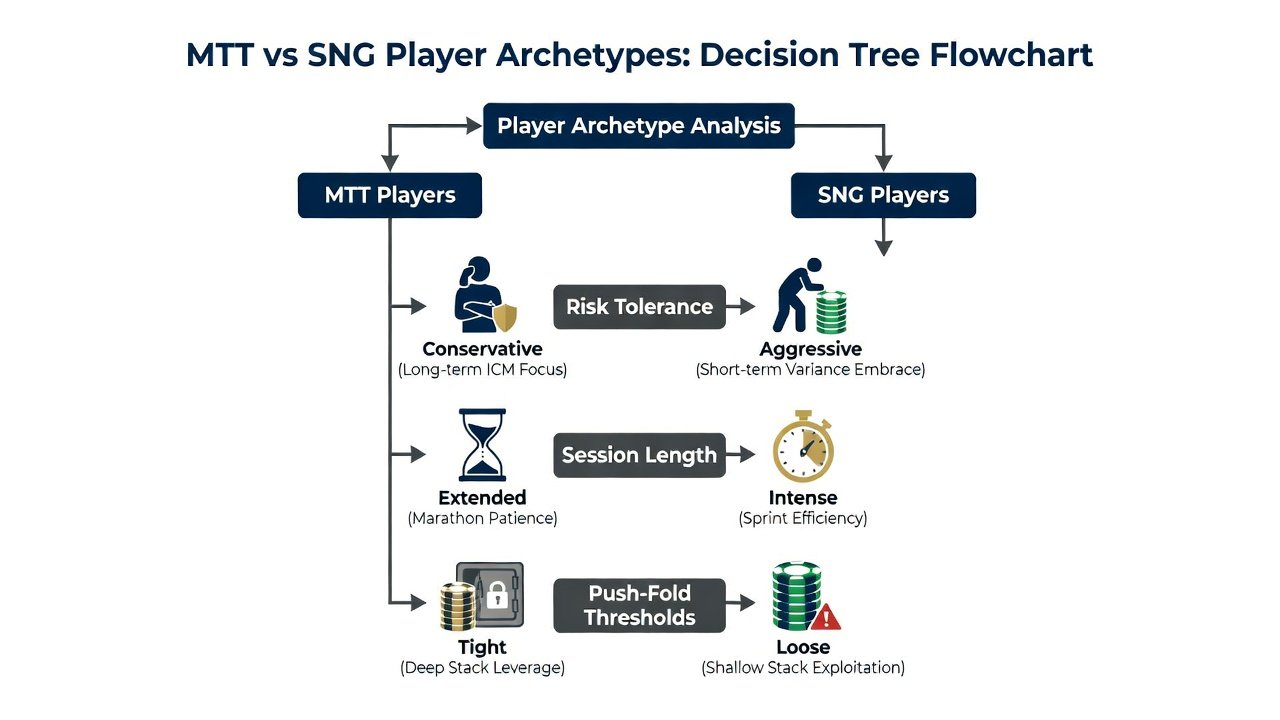
MTT Specialist Archetype: Deep-stack expert who thrives on long-term edges and positional play. Decision tree example: Early levels—tighten range to preserve stack and avoid marginal spots. Mid stages—accumulate chips via selective 3-bets and value betting. Final table—shift to ICM-aware aggression using stack sizes to pressure shorter players. SNG Grinder Archetype: Short-stack master who exploits frequent bubbles and fast structures. Decision tree: Levels 1-3—play tight to build image. Bubble phase—expand push-fold ranges by 15-20% versus loose opponents while tracking exact ICM implications. Hybrid Player: Switches based on bankroll goals and daily energy levels. Test both formats on small stakes without overlap by maintaining separate tracking software sessions and never mixing results in the same database.
2026 Meta Adjustments for Online Speed
Online platforms have accelerated blind structures significantly. Faster MTTs now commonly feature 8-12 minute levels, increasing push-fold frequency earlier than in previous years. SNG hypers continue to dominate volume play for grinders seeking quick sessions. Adjust ranges using modern solvers that account for current player pool tendencies and platform-specific dynamics. Resources like PokerNews and CardPlayer provide ongoing coverage of these meta shifts. Additional insights appear on sites such as WSOP for official tournament rule updates.
Practical Tips for Testing Both Formats on a Small Bankroll
- Allocate 20 buy-ins per format in completely separate tracking folders to avoid data crossover.
- Play a minimum of 50 MTTs and 100 SNGs before attempting any meaningful ROI comparison.
- Avoid overlap by scheduling MTTs exclusively on weekends and SNGs during weekday evenings.
- Review every hand weekly using equity software and note specific spots where format differences affected decisions.
- Stop expansion after reaching a consistent win-rate target in one format before moving volume to the other.
- Track mental state after sessions to identify which format reduces tilt and improves focus over time.
- Use demo modes or low-stakes freerolls initially to practice decision trees without real money risk.
Short FAQ on Format Switching
How long should I stick with one format before evaluating?
Commit to a minimum of 100-150 tournaments to gather statistically meaningful data before considering a switch.
Can I successfully play both MTTs and SNGs at the same time?
Yes, but keep bankrolls and result tracking entirely separate to prevent variance from one format affecting decisions in the other.
What should I watch for regarding 2026 platform changes?
Monitor rake adjustments and blind speed increases closely, as SNGs remain more sensitive to rake than MTTs with larger fields.
How do I handle mental fatigue when switching formats?
Start with shorter SNG sessions on high-energy days and reserve longer MTT blocks for weekends when focus is highest.
Mastering both MTTs and SNGs ultimately gives you maximum flexibility across different schedules and bankroll phases. Use the quiz results as your starting point, then refine your approach through consistent real-world results and ongoing study.

No comments yet. Be the first!