 GambleLore

Introduction to MTT vs SNG in 2026
Texas Hold'em players in 2026 face a clear choice between multi-table tournaments (MTTs) and sit-and-go (SNG) formats. Each format rewards different tendencies, time commitments, and risk profiles. Understanding these differences helps players maximize results based on their personal style rather than chasing trends. MTTs involve hundreds of entrants competing over several hours for top-heavy payouts, while SNGs pit smaller groups against each other in quicker, more structured games. The 2026 meta emphasizes data-driven adjustments, with solvers influencing both formats heavily. This guide breaks down how aggression levels, available playing time, and risk tolerance determine the best fit, supported by concrete examples of payout structures and variance patterns observed in recent seasons.
Core Differences Between MTTs and SNGs
MTTs offer massive prize pools but require endurance through multiple stages, from early accumulation to late-stage survival. SNGs provide faster feedback loops, often concluding in under an hour, making them ideal for players seeking immediate results. Payouts in MTTs can reach life-changing sums at the top, whereas SNGs deliver more frequent but smaller cashes. In 2026, online platforms have refined blind structures, increasing the importance of adapting to faster levels in both formats. Players must consider how their natural tendencies align with these mechanics to avoid frustration and suboptimal play.
Player Archetypes and Format Fit
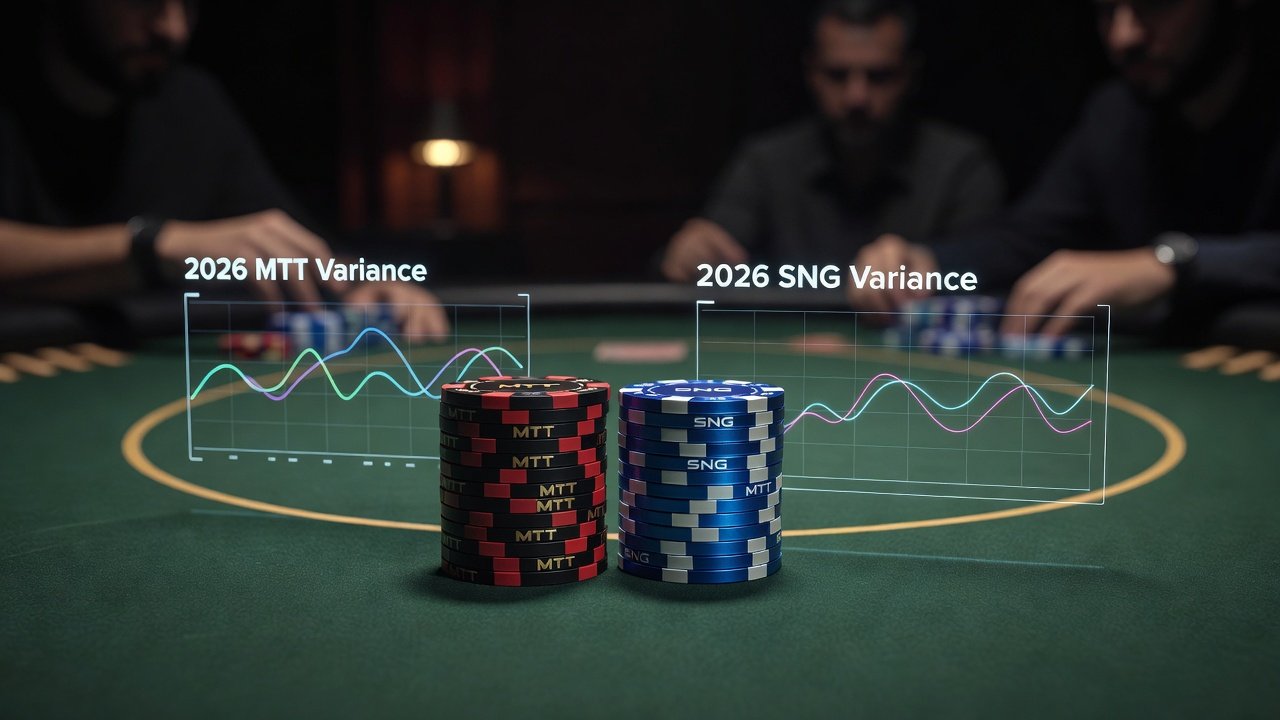
Aggressive players thrive in SNGs where early pressure can force folds, while patient types excel in MTTs with deep stacks and late-stage pay jumps. Passive players often prefer MTTs to avoid constant ICM confrontations. Time availability matters: SNGs suit short sessions, whereas MTTs demand blocks of several hours. Risk tolerance further refines the choice. High risk tolerance players chase MTT final tables for large payouts. Lower tolerance players gravitate to SNGs with more predictable structures and quicker resolutions. Real variance examples show MTTs can produce swings exceeding 50 buy-ins in a month, while SNGs typically limit swings to 15-20 buy-ins under similar volume. Consider a loose-aggressive archetype who enters many pots early; this style generates frequent edges in SNGs but risks bustouts in MTTs before reaching valuable pay jumps.
Tight-Aggressive vs Loose-Passive Tendencies
Tight-aggressive players excel across both formats but particularly in MTTs by navigating ICM spots with precision. Loose-passive styles struggle in SNGs due to frequent all-in decisions but can accumulate chips steadily in MTTs through implied odds. Matching these profiles prevents common pitfalls like over-folding in high-pressure SNG bubbles or bleeding chips in long MTT fields.
Side-by-Side Comparison Tables
| Metric | MTT | SNG |
|---|---|---|
| Push-Fold Threshold (20bb) | Shove 22+/AQ+ from late position | Shove 33+/AJ+ from cutoff |
| ICM Pressure | High near final table bubble | Intense from 4 players left |
| Average ROI (Aggressive) | 12-18% in soft fields | 8-14% in regular speed |
| Average ROI (Passive) | 5-9% with survival focus | 3-7% with tight play |
| Typical Session Length | 4-8 hours | 30-60 minutes |
| Bankroll Requirement | 150 buy-ins recommended | 100 buy-ins recommended |
These thresholds adjust based on stack sizes and opponent tendencies. For instance, at 15 big blinds in an MTT, widening to include suited connectors becomes viable when antes are in play, unlike the more polarized SNG spots.
ICM Pressure and Variance Deep Dive
ICM differences create distinct decision points. In MTTs, bubble pressure builds gradually over hours. SNGs deliver immediate ICM from the start of short-handed play. This affects how players adjust ranges and when they take calculated risks. Variance manifests differently too. An MTT player might experience long periods of min-cashes before a deep run, while an SNG specialist sees steadier but capped returns. World Series of Poker structures illustrate how payout distributions reward survival in MTTs more than consistent small cashes in SNGs.

Practical Decision Trees for Switching Formats
Follow this tree when considering a mid-year switch. First assess your last 500 hands for aggression factor. If above 3.5, test SNGs for two weeks. Track ROI weekly. If below 5% after 100 games, add MTT volume during weekends only. Re-evaluate every 30 days using session length logs and bankroll stability. Branch one: High time availability leads to MTT focus with dedicated study blocks on ICM scenarios. Branch two: Limited time directs players toward SNGs with emphasis on push-fold charts. Branch three: If variance feels overwhelming, hybrid approaches work by allocating 70% of volume to the stronger format. Real example: A player with 120 buy-ins switched from MTTs to SNGs mid-2026 after tracking showed repeated 30 buy-in downswings, stabilizing results within four weeks.
Step-by-Step Transition Plan
- Review 30 days of results for format-specific leaks
- Select one new format and play 50 games minimum
- Adjust ranges using solver outputs for the chosen structure
- Monitor mental game and session enjoyment
- Scale volume gradually if metrics improve
Mistakes to Avoid When Choosing Formats
- Switching formats without tracking session results
- Ignoring time-of-day variance in MTTs
- Over-adjusting push-fold charts without ICM software
- Neglecting bankroll cushions during transitions
- Copying high-volume pros without matching personal schedules
2026 Meta Shifts FAQ
How have solver updates changed SNG play?
Updated solvers tightened early position ranges by 8% compared to 2025, rewarding players who adapt quickly to shorter effective stacks.
Should recreational players avoid MTTs?
No. Low-stakes MTTs still offer the best learning environment for patience and stack management despite higher variance.
What bankroll rules apply in 2026?
Most professionals recommend 100 buy-ins for SNGs and 150 for MTTs to handle downswings comfortably.
Are there new tools for format comparison?
Yes, several tracking sites now integrate cross-format dashboards that highlight archetype-specific ROI trends.
Additional Practical Advice for 2026 Players
Study routines should include reviewing both formats weekly. Aggressive players benefit from SNG-specific bubble drills, while MTT specialists focus on final table simulations. Software like equity calculators helps quantify edges in push-fold situations across varying stack depths. Community forums provide meta insights but require filtering for 2026-specific advice. Players transitioning mid-year often find success by maintaining a core volume in their proven format while experimenting with 20% allocation to the alternative.
PokerStars resources offer extensive format-specific training materials that align with current solver outputs.
Conclusion
Matching your style to MTT or SNG formats in 2026 leads to better results and more enjoyable sessions. Use the tables and decision trees above to test small changes and refine your approach throughout the year. Consistent tracking and gradual adaptation remain the most reliable paths to long-term improvement regardless of the chosen format.
Learn more proven approaches in our gambling strategies section.

No comments yet. Be the first!