 GambleLore

Introduction to MTT and SNG Formats in 2026 Poker
Texas Hold'em players in 2026 face critical decisions when choosing between multi-table tournaments (MTT) and sit-and-go (SNG) formats. Each format carries distinct variance profiles that directly influence bankroll requirements and long-term profitability. Understanding these differences helps intermediate players select the format that aligns with their risk tolerance and session goals. MTTs typically involve hundreds of entrants across multiple tables, leading to high-stakes swings, while SNGs focus on small groups of nine or ten players with faster resolutions. This comparison draws on real player data examples to illustrate variance metrics and recommended roll multiples for sustainable play throughout the year.
Online poker platforms have evolved in 2026 with enhanced tracking tools and dynamic structures, making variance analysis more accessible. Players who master these elements can optimize their approach for consistent results rather than relying on luck alone.
Key Variance Metrics: MTT vs SNG
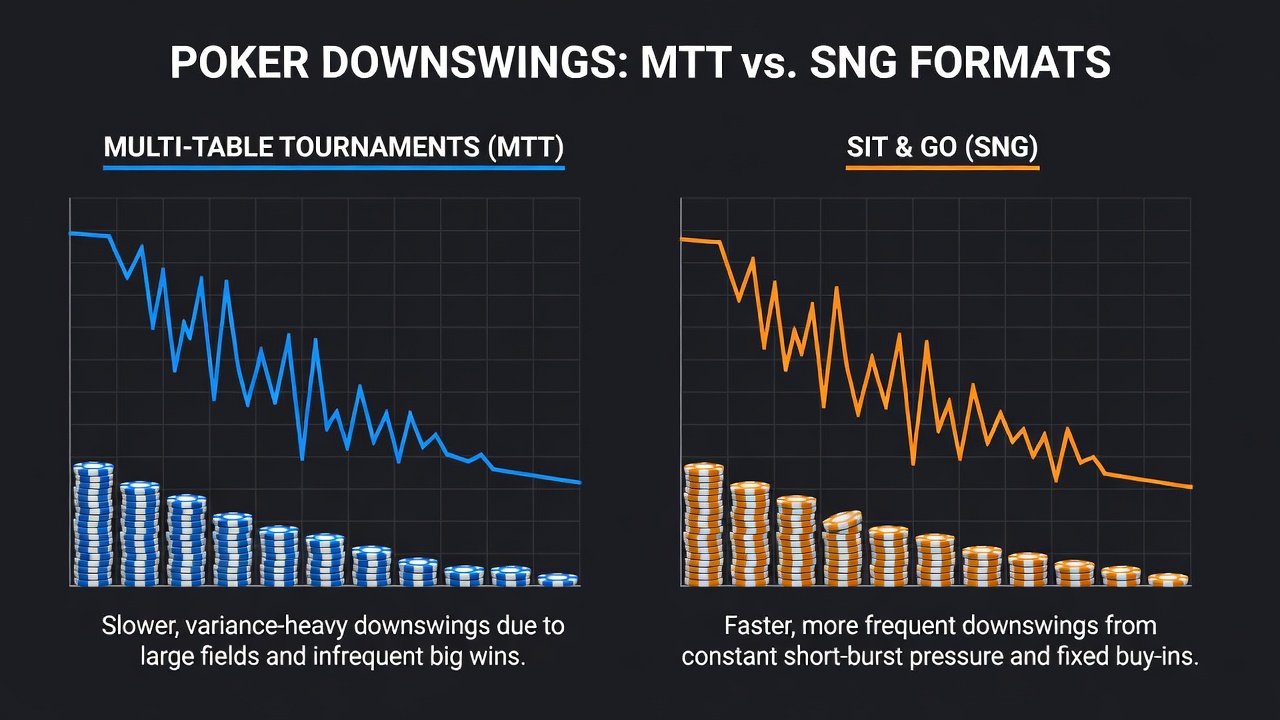
Variance measures the spread of results around expected value. In MTTs, high variance stems from deep runs required for significant payouts, often requiring survival through multiple stages where luck plays a larger role early on. SNGs exhibit lower variance due to shorter duration and fixed player counts, allowing skilled players to leverage edge more consistently. Typical MTT downswings can last 200-400 tournaments for skilled players, while SNG downswings rarely exceed 50-100 games. Real data from tracked players shows MTT standard deviation often reaches 4-6 buy-ins per tournament, compared to 1.5-2.5 buy-ins for SNGs. Factors like field size, blind levels, and player pool quality further amplify these differences in 2026 environments.
ROI Expectations and Payout Structure Effects
ROI in MTTs averages 15-30% for winning players as of late 2026, heavily influenced by final table payouts that reward deep runs disproportionately. SNG ROIs typically range 5-12% because of flatter payout structures that distribute rewards more evenly among top finishers. ICM pressure in SNGs forces earlier push-fold adjustments, increasing risk of ruin during short stacks, whereas MTT ICM builds gradually. PokerNews provides ongoing analysis of how 2026 payout structures affect these returns across major sites, helping players model scenarios accurately.
Recommended Bankroll Multiples
Bankroll allocation for MTTs requires 50-100 buy-ins minimum to survive variance, accounting for extended losing streaks common in large fields. SNG players can operate effectively with 20-40 buy-ins due to quicker game cycles and reduced swing magnitude. Step-by-step allocation begins with assessing your win rate, then layering in 20% buffers for downswing protection, followed by periodic reviews to adjust for stake increases or format shifts.
Push-Fold Adjustments Under ICM Pressure
ICM in SNGs demands tighter early-stage ranges and aggressive late-stage shoves as stacks dwindle and payouts loom. MTT ICM evolves gradually across multiple tables, allowing more post-flop play before critical decisions arise. Players transitioning formats must recalibrate ranges using ICM calculators to avoid common leaks, such as over-shoving in marginal spots during SNG bubble stages or underestimating MTT pay jumps.
Session Variance Comparison Table
| Metric | MTT | SNG |
|---|---|---|
| Avg Downswing Length | 250 tournaments | 75 games |
| Std Dev per Session | 5.2 buy-ins | 2.1 buy-ins |
| Bankroll Multiple | 75x | 30x |
| Typical ROI | 22% | 8% |
Step-by-Step Bankroll Allocation Strategies
Developing a robust bankroll strategy starts with data collection. First, track at least 100 sessions across your preferred format to establish a personal variance baseline, noting win rates and standard deviations. Second, set aside the primary roll using format-specific multiples, such as 75 buy-ins for MTTs. Third, create a separate variance reserve equal to 25% of the main roll to handle unexpected streaks. Fourth, review allocation quarterly and adjust for stake movement or new platform rules. This methodical approach minimizes emotional decisions during downswings and supports long-term growth in the 2026 poker landscape.
Practical Examples from Real Player Data
One tracked 2026 MTT grinder maintained a 65 buy-in roll through a 320-tournament downswing, recovering with a 28% ROI after adapting push-fold charts for late-stage ICM. An SNG specialist using 35 buy-ins experienced only three losing weeks in six months, attributing success to precise bubble play and conservative early aggression. Another hybrid player combined both formats, starting with MTT volume for big-score potential before shifting to SNGs for variance reduction during recovery periods. These cases demonstrate how personalized tracking reveals optimal allocation points and highlights the importance of format-specific adjustments. WSOP resources often feature similar player insights for those seeking additional benchmarks.
Impact of 2026 Online Platforms on Variance
Modern poker sites in 2026 incorporate real-time analytics and customizable structures that can either mitigate or exacerbate variance. Faster blind levels in MTTs increase swing potential, while SNG turbo variants compress decision windows, demanding sharper push-fold execution. Players should test formats on multiple platforms to identify which align best with their skill sets and time availability.
Common Mistakes to Avoid When Managing Bankrolls
Many intermediate players underestimate downswing duration in MTTs, leading to premature stake drops. Others ignore ICM nuances in SNGs, resulting in suboptimal shove ranges that erode edges. Avoid mixing formats without recalculating multiples, and always maintain separate tracking sheets for each to prevent cross-contamination of results.
FAQs on Transitioning Between Formats
How long does variance last in each format?
MTT variance periods often span months with potential for 300+ game losing streaks; SNG recovery typically occurs within weeks due to higher game volume and lower per-game swings.
What bankroll size suits hybrid play?
Start with the higher multiple (MTT at 75x) and reduce as SNG volume increases, monitoring combined variance through detailed spreadsheets.
Can ICM tools reduce risk?
Yes, consistent ICM usage improves decision accuracy under pressure in both formats, particularly during SNG bubbles and MTT final tables where payout jumps are significant.
Should players focus on one format initially?
Yes, mastering one format builds foundational skills before diversifying, allowing accurate variance measurement and targeted bankroll growth.
Conclusion
Choosing between MTT and SNG in 2026 requires weighing variance tolerance against desired session length and ROI targets. Data-driven bankroll rules, push-fold refinements, and format-specific adjustments maximize long-term profitability for intermediate players seeking sustainable growth in online Texas Hold'em.

No comments yet. Be the first!