 GambleLore

Introduction to MTT vs SNG Profitability in 2026
Texas Hold'em players in 2026 face a key choice between multi-table tournaments (MTTs) and sit-and-go (SNG) formats. Both offer distinct paths to profit, shaped by evolving player pools, software tools, and schedule demands. This breakdown examines adjusted ROI, variance effects, time investment, and practical decision tools to help optimize earnings this year. MTTs feature large fields and escalating payouts, while SNGs deliver quicker resolutions with top-heavy structures. Understanding these differences allows players to align formats with skill levels and availability. In today's online ecosystem, where traffic volumes remain robust across major platforms, selecting the right mix can significantly impact long-term bankroll growth and personal sustainability.
Payout Structure Differences and Their Impact
MTT payouts typically reward the top 10-20% of entrants, creating long-term variance but higher upside for deep runs. SNGs usually pay the top three spots in nine-player games, offering more consistent but smaller returns. These structures influence risk tolerance and session planning in 2026 environments where online traffic remains steady. For instance, an MTT might see 15% of the field cash with prizes scaling dramatically toward the final table, rewarding patient play and survival skills. In contrast, SNG payout structures concentrate 70% of the prize pool in first place, encouraging aggressive late-stage adjustments. Players transitioning between formats often notice how MTTs reward endurance while SNGs emphasize precision in shorter windows. This distinction affects mental preparation, as MTT grinders must manage extended periods of chip accumulation before payout thresholds.
Adjusted ROI and Variance Impact Analysis
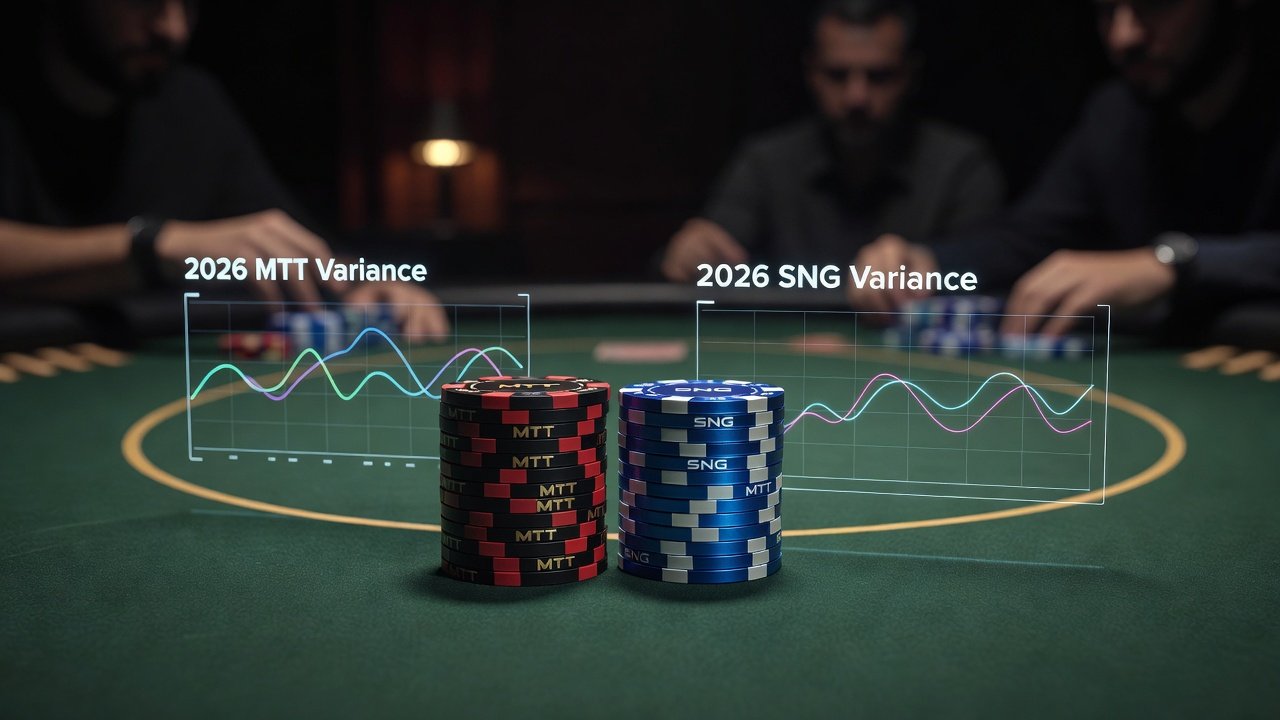
Adjusted ROI accounts for rake and buy-in levels. MTT players often see ROI between 20-40% for skilled regulars, tempered by higher variance from large fields. SNG ROI tends toward 5-15% with lower swings due to shorter durations. Variance impact is greater in MTTs, requiring larger bankrolls to weather downswings. Data comparisons show average MTT win rates at 0.5-1.5 big blinds per 100 hands in deep runs versus steadier SNG rates of 2-4 big blinds per 100 hands in heads-up or three-way finishes. To calculate adjusted ROI, subtract rake impact and normalize for field difficulty using historical data from similar stakes. Variance in MTTs can lead to 30-50% swings in monthly results, whereas SNG variance stays closer to 10-15%. Players tracking these metrics over hundreds of games gain clearer insights into true profitability beyond raw win rates.
PokerNews provides ongoing coverage of format trends that support these metrics.
Push-Fold Adjustments Under ICM Pressure
Independent Chip Model (ICM) pressure intensifies in late SNG stages and MTT final tables. Players must tighten opening ranges by 10-20% compared to chip EV models. For example, in a 9-player SNG with 15 big blinds, folding marginal hands like KJo from early position preserves equity. MTT adjustments scale with field size, emphasizing survival until pay jumps. Tools like ICM calculators help refine these spots in real time. Additional considerations include stack sizes relative to the average and payout jumps; in MTTs with 100+ players, ICM becomes critical only after reaching the money, while SNGs apply it from the bubble onward. Practicing these adjustments through simulations builds intuition for high-pressure decisions that directly affect profit margins.
Format-Specific Bankroll Requirements with Examples
Bankroll management differs sharply. MTT players typically need 50-100 buy-ins for a single stake level due to variance, while SNG specialists manage with 20-40 buy-ins. A real-world example: a $50 MTT player might allocate $5,000 total, whereas an SNG grinder at the same level could operate comfortably with $2,000. Another case involves a mid-stakes player moving from $20 SNGs to $50 MTTs, requiring an immediate 60% bankroll increase to maintain proper risk controls. These figures align with current 2026 online platform standards and help prevent ruin during inevitable variance streaks. Monitoring drawdown periods in each format guides when to adjust stakes or switch emphasis.
Step-by-Step Decision Framework for Choosing Formats
- Assess your available time: SNGs suit 1-2 hour sessions; MTTs require 4+ hours. Factor in commute or family obligations when planning weekly volume.
- Evaluate skill in short-stack play: SNGs reward push-fold mastery. Dedicated study of 100+ ICM scenarios weekly accelerates improvement.
- Review variance tolerance: MTTs demand mental resilience for long droughts. Journal emotional responses after sessions to identify patterns.
- Match schedule to format: Part-time players often prefer SNG volume for flexibility around work or other commitments.
- Test both with tracked sessions before committing 70% of volume to one. Run parallel 50-game samples in each format to compare personal metrics.
- Factor in learning curve: New players benefit from SNG repetition before tackling MTT field sizes and structures.
Data-Driven Comparisons of Average Win Rates
Across 2026 tracked samples, MTT regulars average higher hourly rates in peak months but with 2-3x the standard deviation of SNG players. SNGs provide more predictable hourly earnings, ideal for steady income. Combining both formats can smooth overall results. For example, a player logging 200 MTTs might achieve 1.2 big blinds per 100 hands net, while an equivalent SNG volume yields 2.8 big blinds per 100 hands with far less fluctuation. These comparisons highlight why hybrid schedules often outperform pure specialization in volatile years.
Practical Tools for Tracking Results Across Formats
Use software like PokerTracker 4 or Hold'em Manager 3 to log sessions by format. Set custom tags for MTT deep runs versus SNG finishes. Export monthly reports to calculate adjusted ROI and variance. Integrate ICM tools such as ICMIZER for pre-session study. Regular reviews every 30 days help refine 2026 schedules. Additional options include custom spreadsheets that separate time invested per format, allowing hourly rate calculations that account for both playing and study hours. Cross-referencing results with public leaderboards from major sites reveals whether personal performance aligns with top performers.
Card Player offers additional strategy resources for result tracking.
WSOP shares format insights useful for long-term planning.

Time Investment and Realistic Hourly Expectations
Time allocation plays a major role in 2026 profitability. MTTs often consume 5-8 hours per tournament including late registration, while SNGs average 45-90 minutes. Skilled players report MTT hourly rates of $25-60 at mid-stakes after variance smoothing, compared to $18-35 for consistent SNG volume. Balancing the two prevents burnout and maximizes total earnings by filling gaps in schedules with quicker SNGs.
Common Mistakes to Avoid When Comparing Formats
- Overlooking rake differences that erode small-stakes SNG margins more than MTTs.
- Ignoring mental fatigue from MTTs when stacking multiple tables without breaks.
- Failing to adjust bankroll rules when mixing formats, leading to overexposure.
- Neglecting ICM study, which disproportionately hurts SNG results in bubble stages.
FAQ: Common Challenges When Switching Formats
How do I handle the mental shift from quick SNGs to long MTTs?
Start with smaller MTT fields and build stamina gradually. Focus on process over results during transition periods. Incorporate short breaks and mindfulness techniques to maintain focus over extended sessions.
What bankroll move is needed when adding MTTs to an SNG schedule?
Increase total bankroll by 30-50% to cover added variance before ramping volume. Track drawdowns separately for each format to fine-tune requirements over time.
Are win rates sustainable year-round in both formats?
Yes, with consistent study, though MTTs show more monthly fluctuation. Seasonal player pool changes can temporarily boost or reduce edges, requiring adaptive strategy tweaks.
Which format suits beginners better for building foundational skills?
SNGs provide faster feedback loops and repeated exposure to critical push-fold spots, making them ideal starting points before progressing to MTT complexity.
Conclusion
Balancing MTTs and SNGs in 2026 maximizes profit potential by leveraging each format's strengths. Apply the decision framework, track rigorously, and adjust based on personal data for sustained success. Continued analysis of win rates, variance, and time efficiency ensures the optimal schedule evolves with your skills and lifestyle.

No comments yet. Be the first!