 GambleLore

Introduction to Short Stack Play in Texas Hold'em Tournaments
In the high-pressure world of Texas Hold'em tournaments, especially online, short stack play can be your ticket to survival and deep runs. When your chip stack dwindles to 10-20 big blinds (BB), traditional post-flop play becomes risky. Instead, shift to aggressive push-fold strategies. These tactics leverage fold equity and maximize your stack's value before blinds escalate.
This guide dives into proven short stack strategies, focusing on push-fold charts, optimal shoving ranges, and survival tactics tailored for online poker. We'll explore real-world examples of players turning tiny stacks into final table glory and how to adapt for 2026's faster-paced, high-stakes environments.
Understanding Push-Fold Charts
Push-fold charts are essential tools for short stack players. They dictate when to shove all-in or fold based on your position, stack size, and ante structure. Derived from Nash equilibrium calculations, these charts assume opponents play optimally against your shove.
For instance, with 10BB in late position, you might shove 45% of hands, including suited connectors like 76s and broadway cards. Tools like ICMIZER or Hold'em Resources Calculator generate these, but free versions abound online.
Key Factors Influencing Charts:
- Stack Size: Tighter ranges under 8BB; wider above 15BB.
- Position: UTG shoves ~15-20%; Button ~50%+.
- Antes: Higher antes widen ranges due to dead money.
Study PokerNews for updated strategy articles that reference these charts.
Optimal Shoving Ranges for Maximum Equity
Optimal shoving ranges balance equity realization and fold equity. From the small blind, shove pairs 22+, A2s+, K9s+, QTs+, JTs, ATo+, KJo+. In the big blind vs. steal, defend wider but shove selectively.
Visualize ranges like this:
- Early Position (10BB): 22+, A9s+, KTs+, QJs, AJo+, KQo
- Middle Position: Add suited aces down to A5s, more broadways
- Button (12BB): Any ace, suited kings, 54s+
Practice with equity calculators to see why: A shove with A5o has ~35% equity vs. calling ranges and forces folds 70%+ of the time.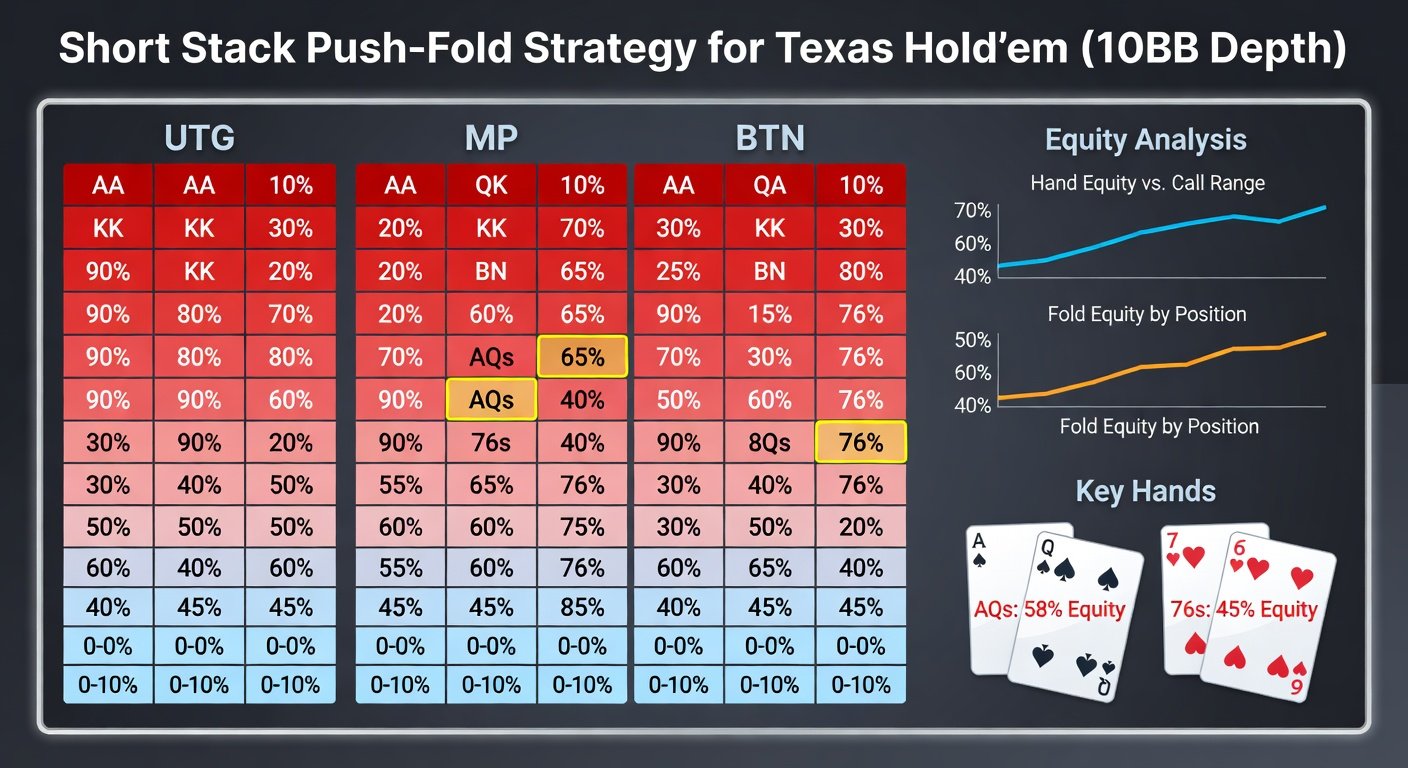
Survival Tactics: Beyond the Shove
Short stack survival isn't just shoving. Employ these tactics:
- Avoid Marginal Spots: Fold medium-strength hands if called likely. Live for double-ups.
- Steal Blinds Aggressively: From late position, shove into unopened pots.
- ICM Considerations: Near bubbles, tighten up to ladder payouts.
- Table Dynamics: Target calling stations with premium shoves; exploit tight players.
In online settings like PokerStars MTTs, fast structures demand precision. Track villain stats via HUDs for adjusted ranges.
Real-World Examples: From Short to Deep Runs
Consider Chris Moneymaker's 2003 WSOP miracle run, though not purely short stack, he doubled repeatedly from crumbs. More relevant: Online pro 'Spraggy' in a 2023 GG Poker event shoved 7BB with AQo from cutoff, got called by KJs, and spiked to ladder into top 10.
Another: In a $100K GTD on partypoker, player 'shortyftw' navigated 5BB to final table by shoving 12/15 steals, per hand histories. These examples highlight discipline—wait for spots, then explode.
For deeper analysis, check player stats on CardPlayer.
Adapting Short Stack Strategies for 2026 High-Stakes Environments
By 2026, online poker evolves with AI solvers, faster blind structures, and bounty hunters. Adapt like this:
Tech Integration: Use apps like PokerSnowie for real-time range advice. Solver-trained GTO play tightens defenses, so widen shoves slightly.
Bounty Effects: In PKOs, loosen vs. bounties—shove lighter for knockouts.
Multi-Tabling: Automate chart memorization; focus on position and stack depth.
High-stakes fields feature pros, so deviate: Bluff less vs. nits, value shove vs. callers. Reference Texas Hold'em basics on Wikipedia for foundational ICM math.
Common Mistakes and Pro Tips
Avoid these pitfalls:
- Shoving too wide early—wait for position.
- Ignoring antes— they juice pots massively.
- Hero-calling light—short stacks lose races often.
Pro tips: Review sessions with replays. Bankroll 100+ buy-ins for variance. Mental game: Stay patient; short stack is power, not weakness.
Conclusion: Ladder Up with Short Stack Mastery
Mastering short stack strategies transforms tournament frustration into triumph. Internalize push-fold charts, hone shoving ranges, and execute survival tactics. With discipline and adaptation, turn 10BB into deep runs—even in 2026's fiercest fields. Grind smart, shove bold, and cash big.


No comments yet. Be the first!