 GambleLore

In the fast-evolving world of online poker, Texas Hold'em tournaments in 2026 demand razor-sharp strategies. With quicker play speeds, AI-influenced opponents, and massive fields, dominating requires more than luck. This guide delivers the top 10 essential tips, blending timeless fundamentals with advanced techniques like optimal bluffing frequencies, position-based aggression, and post-flop decision trees. Whether you're grinding low-stakes satellites or high-roller events, these strategies will boost your edge.
1. Master Bankroll Management for High-Stakes Online Events
Bankroll management is your poker lifeline, especially in volatile online tournaments. For high-stakes play, maintain 100-200 buy-ins for your level. In 2026's hyper-turbo formats, variance spikes due to faster blinds—aim for a $10,000 bankroll before $50 MTTs.
- Never risk more than 2-5% of your roll per event.
- Use tools like tracking software to monitor swings.
- Scale up only after 20-30 winning sessions.
For deeper insights, check Upswing Poker, a leading training resource.
2. Exploit Position-Based Aggression
Position is power in Texas Hold'em. In late position (button, cutoff), open-raise 3-4x more frequently—up to 40% of hands in online games. Early position? Tighten to 15%.
Online dynamics amplify this: faster play means less time for reads, so aggression steals blinds relentlessly. Example: UTG with AJo? Fold. Button with 76s? Raise and c-bet 60% of flops.
3. Optimize Bluffing Frequencies with GTO Solvers
Game Theory Optimal (GTO) play counters AI bots common in 2026 online fields. Bluff 20-33% on polarized rivers—adjust based on opponent tendencies.
- Vs. tight regs: Bluff more on dry boards (e.g., K72 rainbow).
- Vs. fish: Value bet thin, bluff less.
- Use solvers like PioSolver for preflop charts.
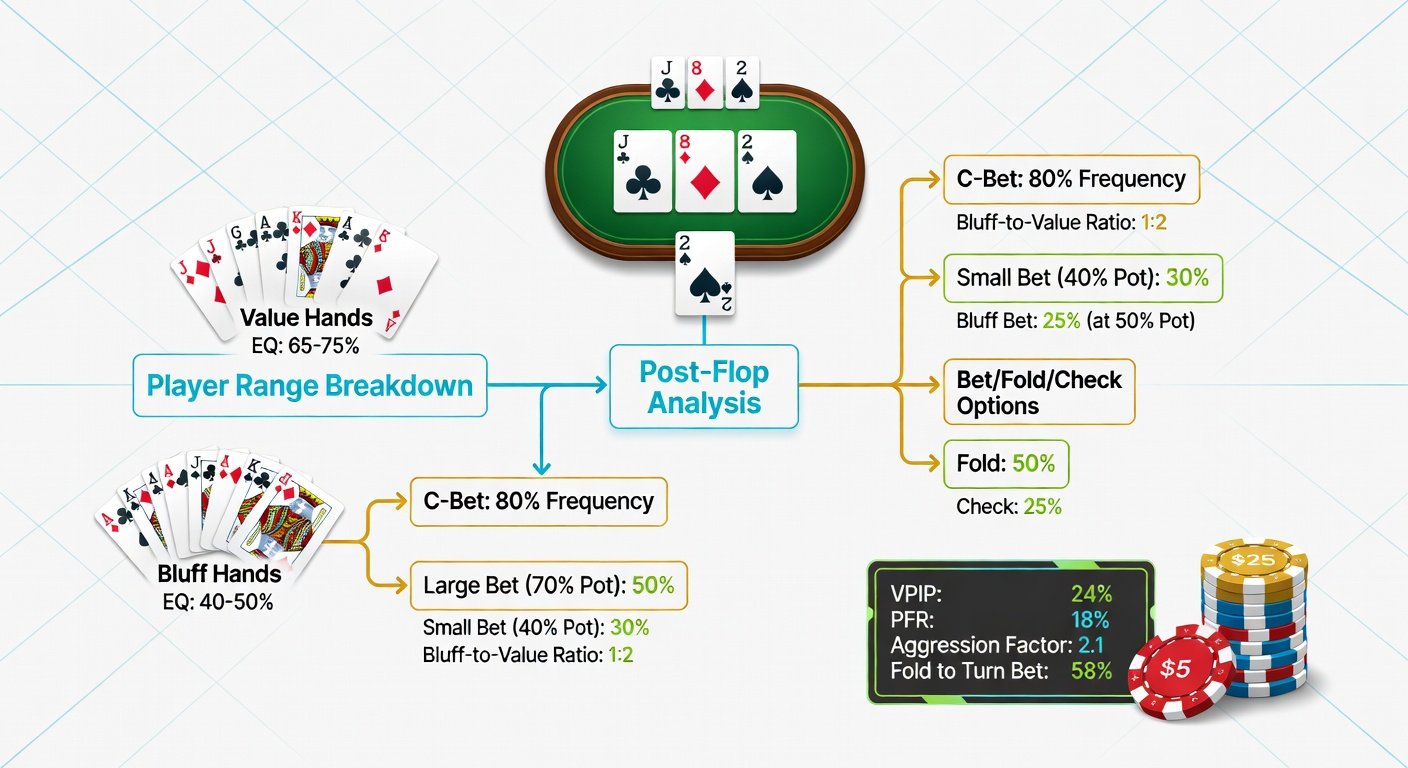
Real hand: You hold QJ on a J-8-2 flop vs. loose caller. Bet 50% pot; if they fold 70%+, you're golden.
4. Navigate Post-Flop Decision Trees
Post-flop play wins tournaments. Build decision trees: Check ranges, bet sizes, and folds dynamically.
Tree example for button vs. BB flop:
- Top pair: Bet 33-75% pot.
- Draws: Semi-bluff 40% frequency.
- Miss: Check-fold 80% vs. aggro.
In fast online games, automate with HUD stats like VPIP/PFR from PokerNews.
5. Adapt to Faster Play Speeds and AI Opponents
2026 platforms like PokerStars turbo MTTs blind up 20% faster. Counter with preflop range simplification: Play 22+, A2s+, K9s+, QTs+, JTs, AT0+, KJo+ from late pos.
AI foes are emotionless—exploit by varying bet sizes (25%, 50%, 75%) to unbalance their solvers.
6. ICM Pressure in Late Stages
Independent Chip Model (ICM) dictates bubble and final table play. Fold premium hands if short-stacked and covered. Tool tip: Use ICMIZER for push-fold charts.
Hand example: 10BB on bubble with AKo, villain covers you—shove only if >40% equity edge.
7. Steal Blinds with Precision
In short-stack scenarios (15BB+), raise-fold 2.5x from late pos 50% of time. Track fold-to-steal (FTS) stats—target >70% FTS players.
8. Multi-Tabling Discipline
Online pros multi-table 4-12 screens. Start with 4 tables max; focus on VPIP <25%. Use hotkeys for speed without errors.
Pro tip: Bankroll scales with tables—200 buy-ins per stake.
9. Review Hands with AI Tools
Post-session, upload hands to GTO Wizard or MonkerSolver. Identify leaks like over-calling rivers.
2026 trend: AI coaches analyze in real-time via apps.
10. Mental Game and Tilt Control
Tilt kills bankrolls. Use breaks every 2 hours, meditation apps. Set stop-loss: Down 10 buy-ins? Quit.
For official tournament rules, visit the WSOP site.
Conclusion: Stack the Deck in Your Favor
Implement these 10 tips to crush Texas Hold'em tournaments in 2026. Combine bankroll discipline, GTO bluffing, positional aggression, and post-flop mastery. Practice on free sites, review relentlessly, and watch your ROI soar. From satellites to Sunday majors, you're now equipped to dominate online fields against humans and AIs alike.

No comments yet. Be the first!