 GambleLore

Introduction to Multi-Sport Parlays in 2026
Building profitable parlays that combine football, NBA, and tennis betting requires careful analysis of odds, correlations, and implied probabilities. In 2026, bettors who understand how these sports interact can create higher-value combinations while managing risk effectively. Parlays multiply odds across multiple legs, offering substantial payouts but increasing difficulty. Success depends on selecting compatible selections rather than random high-odds picks. This guide explores the full process of constructing such parlays with depth, including how to evaluate risk-reward ratios and identify favorable opportunities across these distinct sports.
Multi-sport betting has grown in popularity because it allows bettors to leverage expertise from different leagues and events happening simultaneously. However, the added complexity means that superficial approaches often lead to losses. Instead, a systematic method focusing on data-driven decisions yields better long-term results.
Understanding Correlation Factors Between Sports
Correlation plays a critical role when mixing football, NBA, and tennis. Positive correlations occur when outcomes influence each other, such as weather affecting both football and outdoor tennis events. Negative correlations can help diversify risk across unrelated markets. For instance, NBA player performance metrics often show little direct link to tennis match durations, allowing for more independent legs in a parlay.
Analyzing historical data shows that NBA games often correlate with player fatigue factors that differ from tennis match durations. Football matches may align with league standings that indirectly influence betting markets. Bettors should examine past seasons to quantify these relationships rather than assuming independence. Advanced tools can help measure covariance between different sport outcomes, improving parlay construction accuracy.
Advanced Correlation Analysis
Deeper examination reveals that certain variables like travel fatigue in tennis and NBA back-to-back games create measurable overlaps. In football, international breaks can affect team motivation in ways that occasionally mirror NBA rest patterns. By tracking these factors over multiple seasons, you can assign correlation coefficients to refine probability estimates.
Selecting Compatible Legs
Choose legs with moderate correlation to balance payout potential and win probability. Avoid stacking too many underdogs unless supported by strong data. Focus on markets like moneyline, spreads, and over/under that have proven compatibility across these three sports. For example, pairing a football total with an NBA player prop works well when both involve high-scoring tendencies, whereas mixing them with a low-scoring tennis set requires careful adjustment.
Key Criteria for Leg Selection
Evaluate each potential leg based on recent form, head-to-head records, and situational factors such as home advantage. Compatible legs typically share similar volatility levels to prevent one outlier from ruining the entire parlay. Always cross-reference multiple data sources before finalizing combinations.
Calculating Implied Probabilities for Parlays
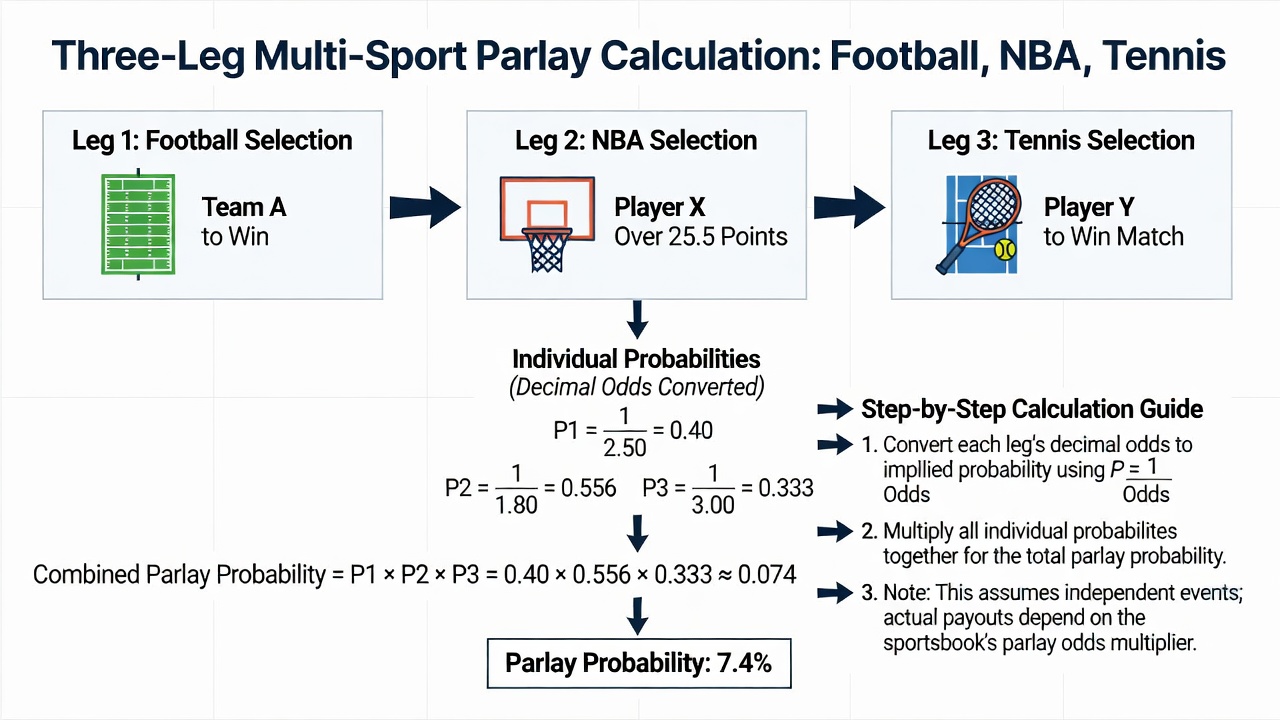
Convert each leg's odds into implied probability and multiply them together. This gives the combined probability of the parlay hitting. Compare this against the offered parlay odds to identify value. For decimal odds, divide 1 by the odds to get the implied probability percentage. American odds require conversion formulas depending on whether they are positive or negative.
For example, a three-leg parlay with individual implied probabilities of 60%, 55%, and 65% yields a combined probability of 21.45%. If the bookmaker's parlay pays at better than 4.66-to-1, it may offer positive expected value. Repeat this calculation for every potential combination and maintain a spreadsheet to track historical accuracy of your estimates.
Use odds comparison tools from established platforms to ensure you capture the best available lines before combining them. This step prevents small discrepancies from compounding into significant disadvantages.
Step-by-Step Three-Leg Parlay Examples
Consider this practical example: a football underdog moneyline at +150 (implied 40%), an NBA player prop over at -110 (implied 52.4%), and a tennis set winner at -130 (implied 56.5%). The combined implied probability is approximately 11.8%, so the parlay must pay at least 7.5-to-1 to break even in the long run. Walk through each leg by verifying team news, injury reports, and surface conditions before committing.
Another example mixes a football total over, an NBA spread, and a tennis match winner. Calculate the payout multiplier first, then assess whether the implied edge justifies the risk. A third detailed scenario might involve a championship football match, an NBA playoff game, and a Grand Slam tennis encounter, adjusting probabilities for higher stakes environments. Document each outcome to build a personal database of successful patterns.
NBA official site provides detailed stats useful for NBA legs in multi-sport parlays.
Common Pitfalls to Avoid
- Overestimating correlations without statistical backing, which leads to inflated win probabilities
- Ignoring line movement across different sportsbooks that can erode value quickly
- Placing too many legs without proper bankroll sizing, increasing variance dramatically
- Failing to account for different sport schedules and rest factors that affect player performance
- Chasing losses by increasing stake sizes after a failed parlay
Bankroll Allocation for Multi-Sport Bets
Limit multi-sport parlays to 1-3% of your total bankroll per wager. This conservative approach accounts for the higher variance compared to single-sport betting. Track results separately for football-NBA-tennis combinations to refine your strategy over time. Consider dividing your bankroll into dedicated segments for each sport before merging them into parlays, ensuring no single category dominates exposure.
Review performance monthly and adjust percentages based on hit rates. This disciplined framework prevents emotional decisions during losing streaks.
Using Odds Comparison Tools Effectively
Compare lines across multiple sportsbooks before locking in a parlay. Small differences in individual legs compound dramatically when multiplied. Tools that aggregate real-time odds help identify the most favorable combinations quickly. Incorporate filters for specific markets to streamline the process and focus only on high-value opportunities.
ATP Tour official site offers reliable tennis statistics for building informed selections.
Practical Tips for 2026 Betting
- Review recent form across all three sports with emphasis on the last five events
- Factor in travel schedules for NBA and tennis players to predict fatigue
- Monitor injury reports and lineup changes right up to game time
- Adjust stake sizes based on combined probability rather than fixed amounts
- Simulate parlays using historical data to test robustness before real-money bets
- Stay updated on rule changes or tournament formats that may alter odds dynamics
Conclusion
Mastering parlay strategies that span football, NBA, and tennis demands discipline, data analysis, and smart bankroll management. By focusing on correlations, accurate probability calculations, and value identification, bettors can improve their long-term results in 2026. Consistent application of these principles turns occasional wins into sustainable returns.
FAQ
How much bankroll should I allocate to multi-sport parlays?
Keep individual parlays between 1% and 3% of your total bankroll to manage variance effectively.
Are football, NBA, and tennis parlays more profitable than single-sport bets?
They can offer higher payouts but require stronger analytical skills due to added complexity and lower hit rates.
What tools help compare odds across these sports?
Reputable comparison sites and official league resources such as FIFA provide foundational data for informed decisions.
How do I handle schedule conflicts between the three sports?
Prioritize legs from events with overlapping rest periods and avoid combining matches where one sport's timing creates undue fatigue variables.


No comments yet. Be the first!