 GambleLore

Introduction to Underdog Betting in 2026
Betting on underdogs offers high-reward potential when favorites are overpriced by sportsbooks. In 2026, lines continue to shift based on public bias toward star teams and players, creating consistent value opportunities across football, the NBA, and tennis. This in-depth guide examines how to identify mispriced underdogs using advanced stats, historical trends, and situational factors. Readers will find concrete step-by-step examples from each sport, risk-reward calculations, cross-sport comparisons, and actionable bankroll strategies designed for immediate application.
Successful underdog betting demands discipline and data rather than emotion. Favorites attract the majority of public money, which inflates their odds and leaves profitable openings on the opposite side. By focusing on objective metrics instead of reputation, bettors can build an edge that compounds over a full season.
Spotting Mispriced Underdogs via Stats and Trends
Identifying value starts with comparing your own probability estimates to the implied probabilities embedded in betting lines. In football, examine expected goals, progressive passes, and set-piece efficiency. NBA analysis centers on player impact estimates, pace-adjusted offensive ratings, and back-to-back performance splits. Tennis requires surface-specific win percentages, first-serve points won, and return-game conversion rates.
Key trends to monitor include recent form against similar competition, travel distance, rest days, and motivation levels. Public perception often overreacts to a single high-profile loss or win, pushing lines away from true probabilities. Cross-reference multiple data sources and maintain a personal database of historical results to refine your models over time.
Football Underdog Examples and Calculations
Consider a 2026 Premier League fixture where a mid-table side with strong underlying numbers hosts a title contender. Historical patterns show such underdogs cover the spread or win outright roughly 22 percent of the time when they generate higher expected goals despite lower possession. Step-by-step process: first calculate expected goals differential using recent match data, adjust for venue and injuries, then convert the result into an estimated win probability. If the bookmakers' line implies only a 15 percent chance, the underdog offers positive expected value.
Practical applications include targeting draw options or double-chance markets when outright wins carry higher variance. Real 2026 scenarios often appear in cup competitions where rotation and motivation create further mispricings.
NBA Underdog Strategies in 2026
The NBA schedule produces frequent mismatches due to back-to-backs and load management. Underdogs perform especially well in road games against rested favorites on the second night of a back-to-back. Use pace-adjusted defensive ratings and three-point volume trends to spot these edges. A detailed example involves a team with elite transition offense facing a slower half-court opponent after a cross-country flight. When the spread sits above six points yet your model projects a 38 percent win probability, the moneyline on the underdog becomes attractive.
Additional value appears in player prop markets for underdog role players who see increased usage when stars rest. Always verify injury reports close to tip-off because lineups can shift rapidly.
Tennis Underdog Opportunities
Tennis provides some of the cleanest statistical edges because matches are individual and surface-specific. Underdogs excel on their preferred surfaces against players with weak return statistics. Focus on qualifiers or players returning from minor injuries who hold strong historical records on the given court. A 2026 scenario might involve a rising player on clay who has won 65 percent of recent matches on that surface but faces a higher-ranked opponent with poor clay results. Calculate implied probabilities from the odds and compare against your surface-adjusted win rate estimate.
Checklist items before betting include serve percentage trends, recent break-point conversion, and head-to-head data filtered by surface and best-of-five versus best-of-three formats.
Cross-Sport Comparisons for Bettors
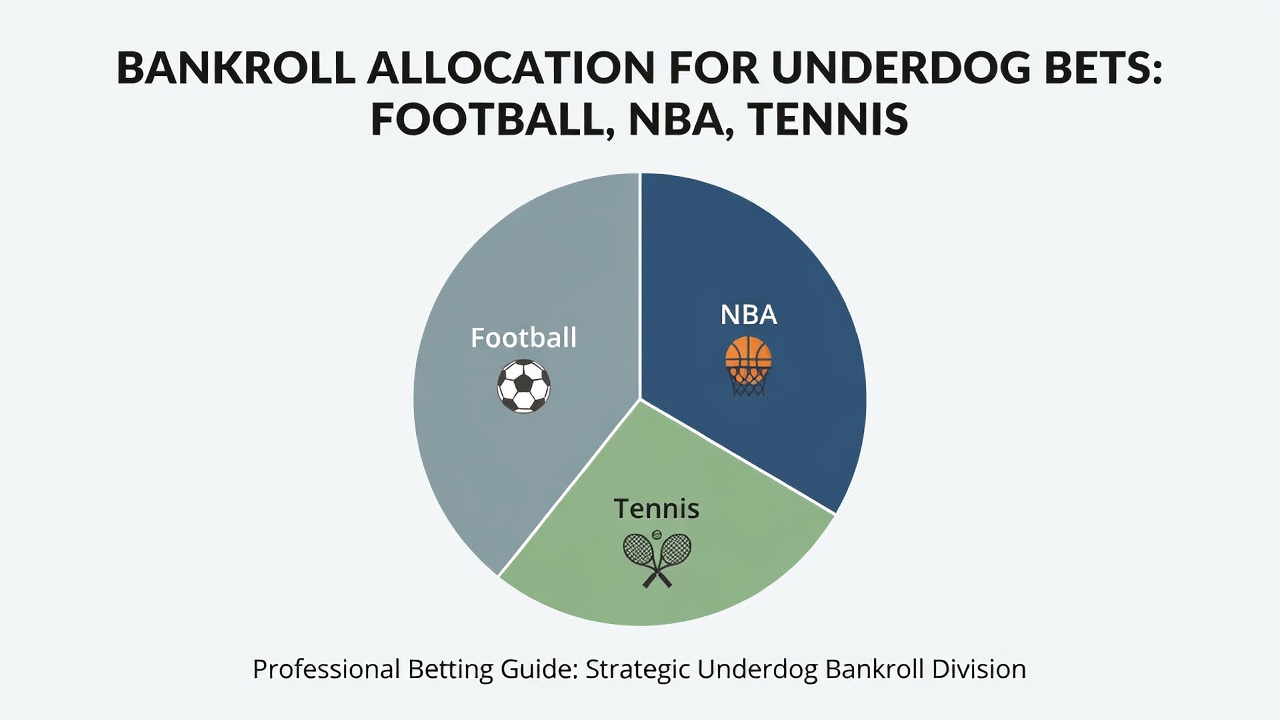
Football features lower variance and frequent draws, making it suitable for smaller unit bets on draw or double-chance markets. The NBA offers higher scoring swings that reward totals and live betting when momentum shifts occur. Tennis delivers individual matchups with transparent statistical edges and often higher payouts on underdogs due to the binary outcome. Allocate bankroll proportionally: 1 percent units on football for consistency, up to 2 percent on NBA when strong situational edges appear, and selective 1.5 percent stakes on tennis for higher-reward opportunities.
Bankroll Allocation Tips and Checklists
Divide your total bankroll into units of 1 to 2 percent per wager. Maintain detailed records of every bet including stake, odds, sport, and reasoning. Reassess lines within 30 minutes of start time to capture late movement. Never exceed 5 percent on any single underdog regardless of perceived edge.
- Review at least three independent data sources before finalizing a selection.
- Calculate minimum required win probability for positive value.
- Set daily and weekly loss limits to prevent tilt.
- Rebalance unit size only after documented long-term results.
Mistakes to Avoid When Betting Underdogs
Common errors include chasing recent losses with larger stakes, ignoring line movement, and overvaluing recent form without context. Another frequent mistake is betting every underdog rather than only those with clear statistical edges. Avoid parlays that combine multiple underdogs because variance increases dramatically. Finally, do not rely solely on public betting percentages without verifying the underlying numbers.
Step-by-Step Application Guide
Begin each betting day by scanning the schedule for games with clear motivation or rest differentials. Run your probability model on selected matches, compare to current odds, and record only those with at least a 5 percent edge. Place the wager, log the details, and review results weekly to identify patterns. Adjust your approach based on what the data reveals rather than single outcomes.
Common Pitfalls and FAQ
FAQ: How do I avoid chasing losses? Establish strict bankroll rules in advance and review historical performance instead of reacting emotionally to short-term results.
FAQ: Are underdogs more profitable in playoffs? Regular-season data typically provides better value because playoff motivation can inflate favorite pricing.
FAQ: What tools help with 2026 odds comparison? Use aggregator sites alongside official league statistics from sources such as FIFA, NBA.com, and ATP Tour.
FAQ: Should I bet live or pre-game on underdogs? Pre-game offers more stable lines while live betting can capture momentum shifts once the match begins.
FAQ: How many sports should I focus on initially? Start with one sport until your process is consistent, then expand gradually to maintain analytical depth.
Conclusion
Underdog betting across football, NBA, and tennis rewards thorough preparation and disciplined execution in 2026. Apply the statistical methods, follow the checklists, and maintain strict bankroll rules to realize long-term profitability. Begin with small test wagers to refine your models before scaling up.
No comments yet. Be the first!