 GambleLore

Introduction to Value Betting in 2026 Sports Markets
Value betting is the holy grail for serious sports bettors. Unlike casual wagering based on gut feelings or favorites, value betting focuses on finding odds where the bookmaker's implied probability undervalues the true chance of an outcome. In 2026, with advanced analytics, live data streams, and AI-driven odds from bookmakers, opportunities abound in tennis, NBA basketball, and football (soccer). This guide dives deep into concepts, calculations, hypothetical 2026 matchups, tools, and strategies to turn value bets into consistent profits while minimizing risks.
Why 2026? Expect tighter margins due to legalized sports betting expansions, but inefficiencies persist in niche markets like ATP tennis challengers, NBA player props, and football lower leagues. By calculating expected value (EV), you can quantify edges as small as 2-5% that compound over thousands of bets.
What is Value Betting and Expected Value (EV)?
Value betting occurs when your assessed probability of an outcome exceeds the bookmaker's implied probability from the odds. The core metric is Expected Value (EV), which measures long-term profitability.
The EV formula for a bet is:
EV = (Probability of Winning × Decimal Odds - 1) × Stake - (Probability of Losing × Stake)
Simplified for unit stake:
EV = (P × Odds) - 1
Where P is your estimated true probability (as a decimal, e.g., 0.60 for 60%). Positive EV (+EV) bets are profitable over time.
- Implied Probability: Convert odds to probability: For decimal odds, it's 1 / Odds. E.g., 2.00 odds = 50% implied.
- Your Edge: If your P > implied probability, there's value.
Bookmakers build in a margin (vig or juice), typically 4-10%, so always seek +EV to overcome it.
Step-by-Step: Calculating EV with 2026 Hypothetical Examples
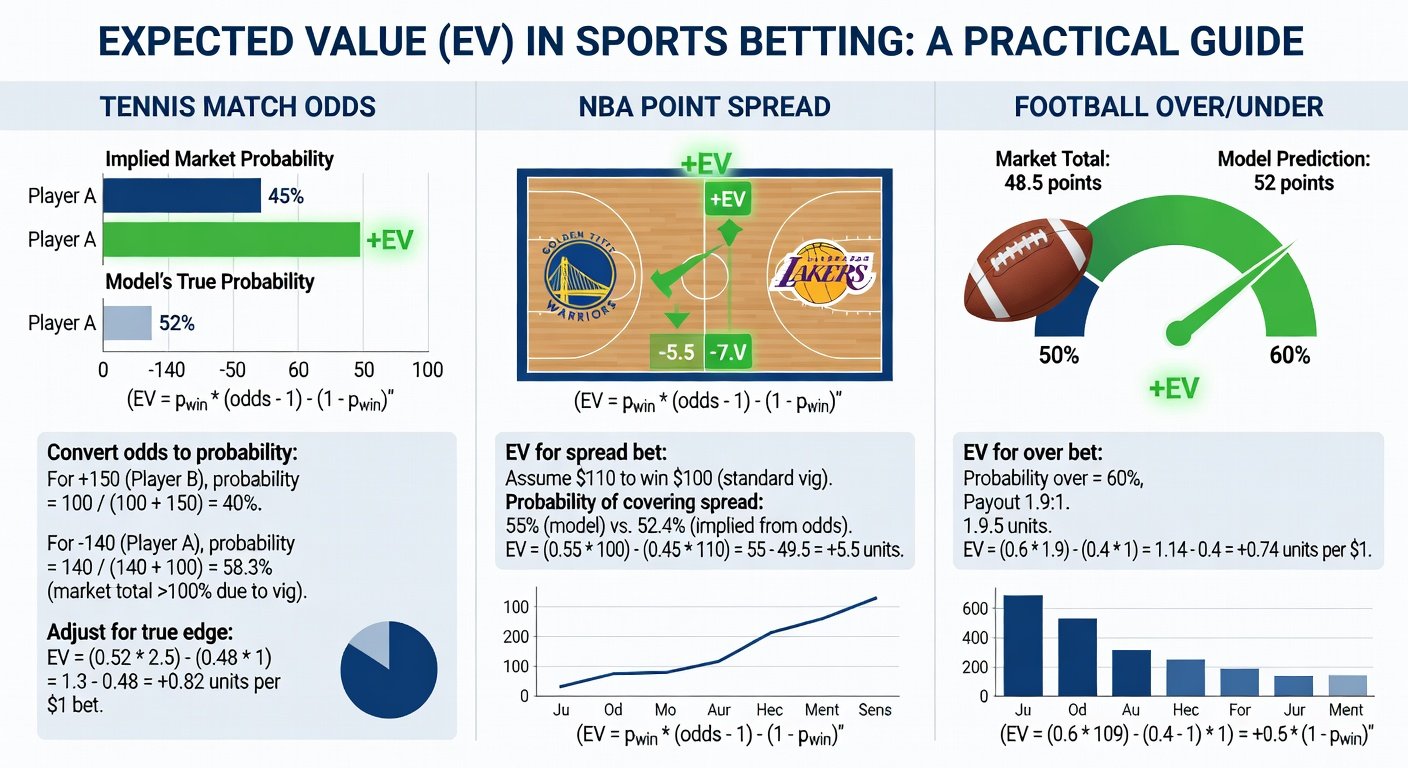
Let's apply this to tennis, NBA, and football using fictional but realistic 2026 scenarios. Assume you're comparing odds across bookies.
Tennis: ATP Australian Open Qualifier - Player A vs. Player B
Hypothetical matchup: Rising star Player A (world #45) vs. veteran Player B (#120) on hard courts, January 2026. Your model (based on Elo ratings, H2H, surface stats) gives Player A a 65% win probability.
Bookmaker odds: Player A at 1.75 decimal (implied prob: 1/1.75 = 57.1%).
- EV = (0.65 × 1.75) - 1 = 1.1375 - 1 = +0.1375 or +13.75% edge.
- Stake $100: Expected profit $13.75 per bet.
If odds drop to 1.60 (62.5% implied), EV = (0.65 × 1.60) - 1 = +0.04 or +4% – still value!
NBA: Lakers vs. Warriors Playoff Game 3, June 2026
LeBron's successor leads Lakers; Curry's final season for Warriors. Your model (accounting injuries, pace, advanced stats like PER and RAPTOR) predicts Lakers +4.5 spread cover at 58% probability.
Odds: Lakers +4.5 at -110 American (1.91 decimal, implied ~52%).
- Convert American: Decimal = (100 / 110) + 1 = 1.91.
- EV = (0.58 × 1.91) - 1 = 1.1078 - 1 = +0.1078 or +10.78%.
Visit the NBA official site for real-time stats to refine models.
Football: UEFA Champions League Semi-Final - Man City vs. Real Madrid
May 2026: City favored at home. Your Poisson model (goals distribution from xG data) gives Over 2.5 goals 62% probability.
Odds: Over 2.5 at 1.95 (51.3% implied).
- EV = (0.62 × 1.95) - 1 = 1.209 - 1 = +0.209 or +20.9% – huge value!
Check UEFA's homepage for tournament fixtures and stats.
Essential Tools for Odds Comparison and Value Hunting in 2026
Finding discrepancies across 50+ bookmakers is key. Use these free/paid tools:
- OddsPortal or OddsChecker: Aggregate lines from global books. Scan for +EV by exporting to spreadsheets.
- Betfair Exchange: Peer-to-peer for true market odds, often sharper than traditional books.
- Custom Models: Build with Python (Pandas, Scikit-learn) using APIs from Sportradar or free sources like ATP stats.
- Alert Apps: 2026 apps like RebelBetting or Trademate scan for value in real-time.
Pro tip: Focus on tennis (high variance, many matches), NBA props (player-specific edges), and football Asians (low vig).
Advanced Strategies to Maximize Profits
1. Bankroll Management: Kelly Criterion
Don't flat bet. Use fractional Kelly: Stake = (EV / (Odds - 1)) × Bankroll fraction (e.g., 1-2% max).
Example: +10% EV at 2.00 odds, 2% bankroll: Stake = 0.10 / 1 × 0.02 × $10,000 = $20.
2. Line Shopping and Market Timing
Compare 5+ books. Bet early on tennis futures; wait for NBA injury news; shop football halves.
3. Specialization and Volume
Bet 100+ value spots/month at 2-5% EV. Tennis: Challenger tours. NBA: Totals in high-pace games. Football: Correct scores in mispriced leagues.
4. Avoid Common Mistakes
- Chasing losses or parlays (negative EV).
- Ignoring vig: Always calculate true implied prob.
- Overconfidence: Validate models with backtesting.
- Neglecting recency: Weight 2026 form heavily.
Risk Management and Responsible Betting
Even +EV strategies have variance – expect 10-20 bet downswings. Set stop-losses at 10% bankroll drawdown. Use tools like betting trackers (e.g., BetTracker apps).
Remember, sports betting is entertainment. For guidance, refer to the UK Gambling Commission. Never bet more than you can afford; seek help if needed.
In tennis, weather delays add risk; NBA back-to-backs inflate totals variance; football reds disrupt models. Diversify across sports.
Conclusion: Your Path to 2026 Value Betting Success
Value betting transforms gambling into investing. Master EV calcs with tennis underdogs, NBA spreads, and football overs using 2026 hypotheticals as blueprints. Arm yourself with tools, strategies, and discipline for sustainable edges. Start small, track everything, and scale. The bookies' margins are beatable – happy hunting!

No comments yet. Be the first!