 GambleLore

Introduction to Advanced Sports Betting Strategies
Sports betting has evolved into a sophisticated endeavor, blending data science, psychology, and market savvy. In 2026, with AI-driven odds and real-time global data, developing advanced strategies is essential for consistent profits. This guide walks you through risk assessment, live betting, arbitrage, data analytics, pitfalls to avoid, and future adaptations. Whether you're betting on NFL, soccer, or tennis, these steps will sharpen your edge.
Step 1: Master Risk Assessment
Risk assessment is the foundation of any profitable betting strategy. Start by calculating expected value (EV) for every bet: EV = (Probability of Winning × Potential Profit) - (Probability of Losing × Stake).
- Define Your Bankroll: Allocate only 1-5% of your total bankroll per bet to survive variance.
- Assess Probabilities: Use historical data to estimate true odds, not just bookmaker lines.
- Kelly Criterion: Apply this formula for optimal stake sizing: Stake = [(Odds × Probability - 1) / (Odds - 1)] × Bankroll. Adjust for conservatism (e.g., half-Kelly).
- Volatility Analysis: Track standard deviation in outcomes for sports like basketball (high variance) vs. baseball (lower).
Tools like spreadsheets or apps help simulate thousands of bets to quantify ruin risk.
Step 2: Live Betting Tactics for Dynamic Edges
Live betting thrives on in-game shifts. Bookmakers adjust odds slower than informed bettors can react.
- Momentum Tracking: Bet on comebacks when momentum swings, like a soccer team dominating possession post-red card.
- Injury and Sub Responses: Monitor real-time updates; hedge if key players exit.
- Partial Cash-Outs: Lock in profits mid-game while leaving room for upside.
- Market Overreactions: Public panic after early goals creates value on the trailing side.
Practice with low stakes on platforms offering fast interfaces. Speed is your advantage.
Step 3: Exploit Arbitrage Opportunities
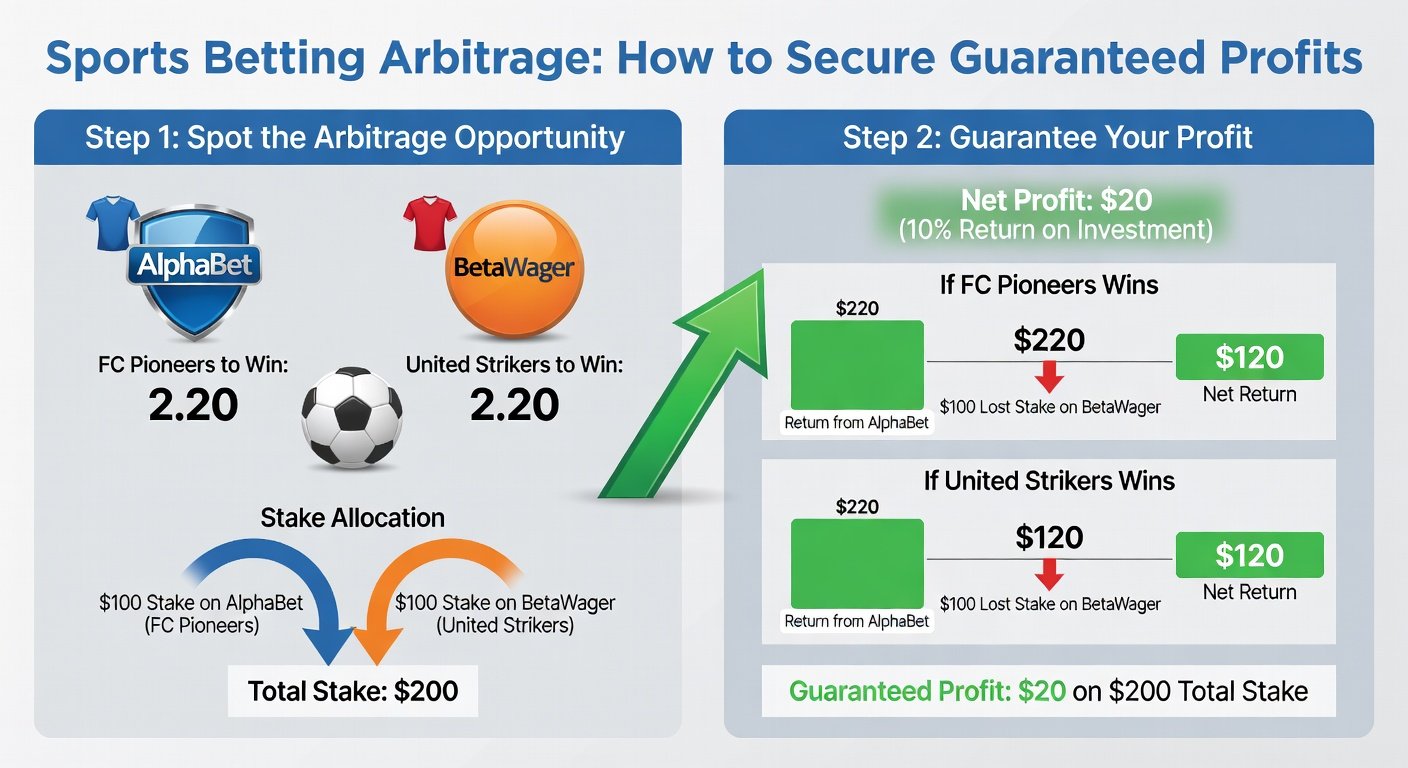
Arbitrage (arb) guarantees profit by betting all outcomes across bookmakers with differing odds. For a two-outcome event, if Book A offers 2.10 on Team X and Book B 2.10 on Team Y, stake proportionally for risk-free gain.
- Scan Tools: Use odds comparison sites to spot 1-2% arbs.
- Calculate Stakes: Total Stake / Odds for each side ensures equal returns.
- Account Management: Maintain balances across 5+ books to execute quickly.
- Mitigate Risks: Watch for odds changes or voided bets.
Learn more about the math behind it on Wikipedia's Arbitrage Betting page. Arbs are rare but compound with volume.
Step 4: Leverage Data Analytics for Predictive Power
Data analytics turns betting into science. Collect metrics like player xG (expected goals), pace-adjusted efficiency, or weather impacts.
- Sources: Pull from APIs or sites like ESPN for stats.
- Build Models: Use Python/R for Poisson regression in soccer or Elo ratings for tennis.
- Machine Learning: Train models on historical data to predict totals or spreads.
- Backtesting: Validate strategies over 1,000+ past games before live use.
Advanced users integrate sentiment analysis from social media for public bias edges.
Step 5: Avoid Common Pitfalls
Even pros falter. Key traps:
- Chasing Losses: Stick to your system; tilt leads to ruin.
- Overconfidence: No bet is >60% certain long-term.
- Ignoring Juice: Factor vig (bookmaker margin) into EV.
- Parlay Trap: High payouts mask poor value.
Promote sustainability by following guidelines from the UK Gambling Commission. Set stop-losses and review monthly.
Step 6: Adapt to 2026 Market Changes
By 2026, expect:
- AI Odds-Making: Bookies use ML; counter with superior models incorporating micro-stats like biometric fatigue.
- Regulated Crypto Betting: Faster settlements via blockchain reduce arb windows.
- Global Micro-Markets: Bet on 1st-quarter points or player props; diversify there.
- Exchange Dominance: Platforms like Betfair grow; peer-to-peer offers better liquidity.
Stay agile: Monitor regulations, test new markets quarterly, and evolve models with fresh data.
Conclusion: Path to Consistent Profits
Combine these strategies: Assess risks rigorously, pounce on live edges, arb when possible, analytics-driven bets, dodge pitfalls, and future-proof. Track ROI over 500+ bets; aim for 5-10% yield. Discipline trumps genius. Start small, scale smart, and bet responsibly for 2026 success.


No comments yet. Be the first!