 GambleLore

Introduction to Value Betting in Horse Racing
Horse racing enthusiasts are always on the lookout for ways to gain an edge over bookmakers. In 2026, with advanced data analytics and AI-driven odds, value betting emerges as a powerhouse strategy. Unlike gut-feel punting, value betting focuses on mathematical edges where odds offered exceed a horse's true probability of winning. This approach promises long-term profitability, even if you endure short-term losses.
This guide explores value betting tailored for horse racing, teaching you to identify undervalued odds, compute expected value (EV), and weave it into your betting routine. We'll compare it to traditional methods and share real-world examples from recent races. By the end, you'll have a step-by-step plan to elevate your game.
What is Value Betting?
Value betting hinges on the principle that if a bookmaker's odds imply a lower probability of an outcome than your assessed true probability, there's value. For instance, if you believe a horse has a 25% chance of winning (true odds 4.0), but the bookie offers 5.0 (20% implied), that's +EV.
In horse racing, where fields are large and variables like track conditions, jockey form, and pace abound, mispriced odds are common. Bookmakers adjust lines based on public money, creating opportunities for sharp bettors.
Spotting Undervalued Odds in Horse Racing
To find value, start with thorough analysis:
- Form Study: Review recent performances, focusing on distance, ground, and class. Tools like speed figures highlight hidden gems.
- Jockey and Trainer Stats: Top combinations win disproportionately. Check win rates at specific tracks.
- Market Movements: Early odds drifts signal value; steamers often overvalue favorites.
Pace Analysis: Front-runners in sprints or closers in stamina tests can be overlooked.
- Live Data: In 2026, apps provide real-time sectional times and heart rates for precise modeling.
Compare your probability estimate against decimal odds using the formula: Implied Probability = 1 / Odds. If yours > implied, bet.
Calculating Expected Value (EV)
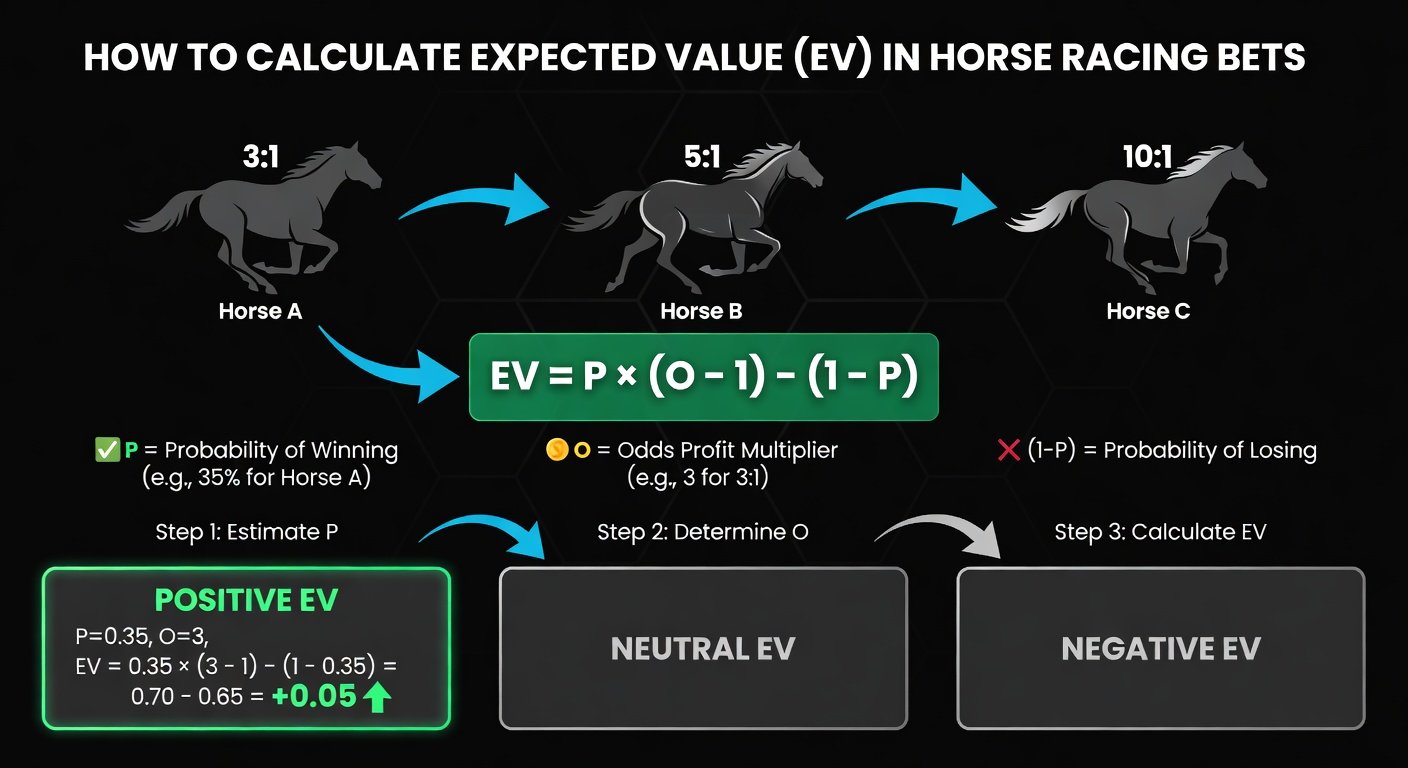
EV is your profit metric: EV = (Probability of Win × (Odds - 1)) - (Probability of Loss × 1).
Example: Horse at 6.0 odds, your prob 20% (0.2). EV = (0.2 × 5) - (0.8 × 1) = 1 - 0.8 = +0.2 units per unit staked. Positive EV? Bet.
For exotics like each-way or places, adjust accordingly. Use spreadsheets or 2026 betting software for bulk calculations.
Value Betting vs. Traditional Strategies
Traditional approaches like backing favorites or Dutching chase short-term wins but bleed vig (bookie's cut, ~5-10%). Value betting ignores tipsheets, focusing on edges across all races.
| Strategy | Pros | Cons |
|---|---|---|
| Value Betting | Long-term +EV, scalable | Variance, requires skill |
| Favorites Only | High strike rate | Poor value, low ROI |
| Dutching | Covers multiples | Erodes margins |
Value bettors achieve 5-15% ROI over thousands of bets, per studies from sites like the UK Gambling Commission.
Real-World Examples from Recent Races
Consider the 2024 Cheltenham Gold Cup. Bookies priced Galopin Des Champs at 2.5 (40% implied), but form suggested 50%+. EV +0.25 units. It won, vindicating the bet.
In the 2025 Kentucky Derby (projected for 2026 trends), a mid-pack closer at 12.0 odds had undervalued pace setup. Bettors spotting sectional advantages cashed big.
Another: Ascot's Queen Anne Stakes, where a drifter from 8.0 to 10.0 offered value due to ignored trainer hot streak. Check historical data at Racing Post for patterns.
Step-by-Step Guide to Implementing Value Betting
- Build Your Model: Assign probabilities using multi-factor weights (form 40%, speed 30%, etc.). Backtest on past races.
- Shop Odds: Compare 5+ books; 2026 exchanges like Betfair yield best prices.
- Bankroll Management: Kelly Criterion: Stake = (EV × Bankroll) / (Odds - 1). Fractional for safety (e.g., half-Kelly).
- Track Bets: Log every wager in a spreadsheet for ROI analysis.
- Scale Up: Automate with APIs from data providers. Review weekly, refine model.
- Responsible Play: Set limits; value betting mitigates losses but demands discipline.
Start small: Target 100+ bets/month at +2% EV for sustainable growth.
Advanced Tips for 2026
Leverage AI: Platforms predict outcomes using machine learning on vast datasets. Integrate weather APIs for ground bias.
Exotics Value: Places in big fields often +EV; trifectas via probability trees.
Avoid Biases: Don't chase losses or favor pretty horses—stick to math.
Conclusion
Value betting transforms horse racing from gamble to investment. By spotting undervalued odds, calculating EV, and methodically betting, you'll outpace traditional punters in 2026. Consistency is key: grind +EV spots daily. Equip yourself with data, patience, and discipline for boosted profits. Happy betting!


No comments yet. Be the first!