 GambleLore

Introduction to Betting Strategies for Beginners
Entering the world of betting in 2026 requires a solid foundation built on discipline rather than luck. This guide covers essential concepts for newcomers interested in sports betting and horse racing, focusing on straightforward methods that do not require complex analytics tools. Understanding how to allocate your bankroll wisely, interpret odds correctly, and spot value opportunities forms the bedrock of long-term success. Throughout this article we explore practical steps, real-world examples, and proven techniques to help you build sustainable strategies that stand the test of time.
Many beginners jump straight into placing wagers without grasping the fundamentals, leading to quick losses and frustration. By taking time to learn core principles first, you position yourself for more informed decision-making across popular events like football matches, tennis tournaments, and horse races worldwide. This approach emphasizes patience, research, and consistency over chasing quick wins.
Bankroll Allocation Basics
Effective bankroll management starts with setting aside a dedicated amount of money strictly for betting activities. Divide your total bankroll into smaller units, typically risking no more than 1-5% on any single wager depending on your confidence level. This approach protects against losing streaks and keeps you in the game longer. Beginners should begin conservatively, perhaps allocating just 1% per bet until they gain experience and confidence in their selections.
Track every bet meticulously using a simple spreadsheet or notebook. Include details such as date, event, selection, odds, stake, and outcome. Review weekly results to adjust unit sizes if necessary. Consistent allocation prevents emotional decisions during downswings and provides valuable data for refining your overall approach over months of activity. Consider separating your betting funds from everyday finances to maintain clear boundaries and reduce stress.
Interpreting Odds and Identifying Value
Odds represent the probability of an outcome and determine potential returns. Decimal odds, common in many regions, show total payout including stake. For example, odds of 2.50 mean a winning $10 bet returns $25 total. Fractional odds popular in the UK express profit relative to stake, such as 5/2 meaning you win five units for every two staked. Moneyline odds used in North America indicate how much you need to risk or stand to win on favorites and underdogs alike.
Value exists when the odds offered exceed the true probability of an event occurring. Calculate implied probability by dividing 1 by the decimal odds. Compare this figure against your own assessment of likelihood derived from basic research like team form or horse past performances. Spotting value consistently requires practice but becomes easier as you build intuition through repeated analysis of events. Always cross-reference multiple bookmakers to find the best available odds on your chosen selection.
Step-by-Step Process for Selecting Bets
- Research upcoming events using free public statistics and previews from reliable sources.
- Identify outcomes where your estimated probability beats the implied probability from the odds.
- Determine stake size based on your pre-set bankroll rules and confidence rating.
- Place the bet only when all criteria align, avoiding impulse decisions driven by emotion or hype.
- Record the details immediately after placement for future review and learning.
Common Beginner Mistakes to Avoid
- Chasing losses by increasing stakes dramatically after a defeat, which often leads to larger setbacks.
- Betting on too many events without thorough research, diluting focus and increasing variance.
- Ignoring external factors such as weather conditions in horse racing or player injuries in sports.
- Over-relying on tips from unverified sources instead of forming independent opinions through personal analysis.
- Failing to set strict loss limits before starting a betting session or week, resulting in overspending.
Flat Staking Compared with Basic Risk Management
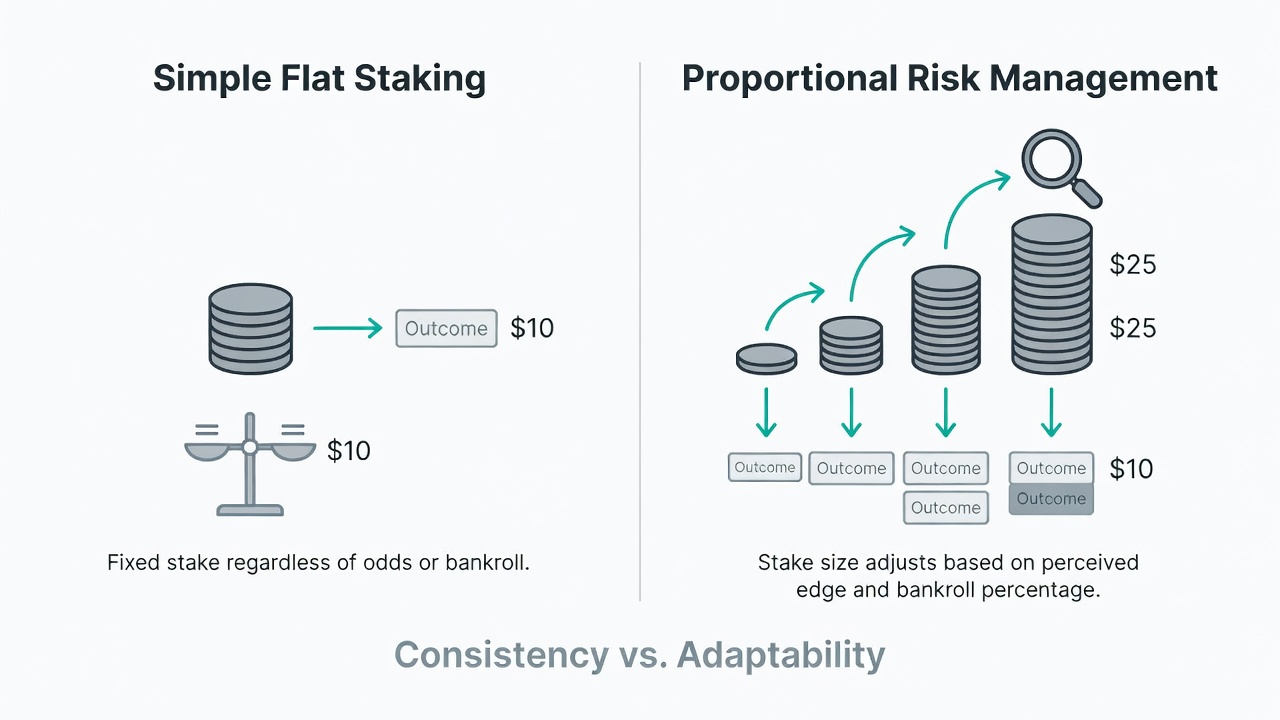
Flat staking involves wagering the same fixed amount on every selection. This simple method suits beginners by removing guesswork around stake sizing and promoting consistency across all bets regardless of perceived strength. It helps maintain discipline and allows clear tracking of results over time without complicated adjustments.
Introductory risk management builds on flat staking by introducing proportional adjustments. For instance, slightly reducing stakes after a series of losses while maintaining overall structure. Both techniques emphasize preservation of capital over aggressive growth in early stages. Flat staking offers simplicity and ease of use, while basic risk management adds a layer of flexibility that can help navigate variance more smoothly. Beginners benefit from starting with flat staking before experimenting with minor variations.
Real-World Examples from Popular Events
Consider a Premier League football match where bookmakers offer 1.80 on the home team. After reviewing recent form, head-to-head records, and home advantage, you assess true probability at around 60%. Since implied probability from 1.80 odds sits near 55%, this represents a value opportunity under flat staking rules. Logging the result afterward reveals whether your assessment was accurate and highlights areas for improvement in future matches.
In horse racing, a maiden race might show a horse at 4.00 odds despite strong trial performances. Basic analysis reveals potential underestimation by the market, allowing a calculated small stake aligned with bankroll percentages. Another example could involve a tennis match where surface preferences and recent head-to-head data point to an undervalued player at longer odds, providing another practical illustration of value identification in action.
Actionable Checklists for New Bettors
Pre-Bet Checklist
- Confirm bankroll allocation limits are respected and stakes remain within guidelines.
- Verify latest team or horse news and any last-minute changes.
- Calculate rough value margin by comparing your probability estimate to implied odds.
- Ensure emotional state remains neutral and decisions are not influenced by recent results.
Post-Bet Review Checklist
- Log outcome and reasoning accuracy for each selection placed.
- Note any overlooked factors that could have influenced the result.
- Adjust future research focus if patterns emerge from multiple reviews.
Frequently Asked Questions
How much should beginners start with?
Start with an amount you can comfortably afford to lose entirely, often a few hundred dollars as an initial test bankroll. This keeps risk manageable while you learn.
Is horse racing easier than sports betting for newcomers?
Both require similar discipline. Horse racing may offer more frequent races but demands attention to track conditions and jockey form alongside basic form study.
Can strategies guarantee profits?
No strategy eliminates risk entirely. Focus remains on making informed decisions that improve long-term probabilities rather than promising certain returns.
What resources help with basic research?
Free statistics from official league sites and racing publications provide solid starting points without needing paid tools or subscriptions.
Conclusion
Building betting strategies in 2026 begins with mastering fundamentals like bankroll control, odds interpretation, and value identification. By following structured processes, avoiding common pitfalls, and applying consistent staking methods, beginners can develop habits that support responsible and informed participation. Use the checklists provided to maintain discipline and refine your approach over time for better long-term results across sports and horse racing.


No comments yet. Be the first!