 GambleLore

Introduction to Implied Probability in Betting
Implied probability transforms betting odds into a percentage chance of an outcome occurring. This skill helps bettors evaluate whether a wager offers value by comparing the implied figure against their own estimated probability. In 2026, mastering these calculations supports smarter decisions across sports betting and horse racing without needing advanced software or paid tools. Bettors who understand this concept can consistently identify discrepancies between market prices and real-world likelihoods, leading to better long-term results.
Understanding implied probability starts with recognizing that bookmakers build margins into their odds. The total implied probabilities for all outcomes in an event exceed 100 percent, creating the bookmaker's edge. By reversing the odds formulas, you can quantify this edge and identify where value may exist. This approach applies equally to football matches, tennis tournaments, basketball games, and horse racing events where multiple outcomes compete for attention.
Converting Decimal Odds to Implied Probability
Decimal odds remain popular in Europe and Australia. The formula is straightforward: divide 1 by the decimal odds. For example, decimal odds of 2.50 imply a 40 percent probability because 1 divided by 2.50 equals 0.40. Another example uses odds of 1.80, where 1 divided by 1.80 produces roughly 0.5556 or 55.56 percent. Step-by-step: take the decimal figure, perform the division, then multiply by 100 to express it as a percentage. This method works for single outcomes and extends easily to multi-outcome events like horse races.
Consider a live football match where the favorite sits at 1.65. The calculation yields 60.61 percent. If your independent assessment reaches 68 percent, the difference signals potential value. Always refresh odds before calculating because markets shift rapidly during live events.
Converting Fractional Odds to Implied Probability
Fractional odds appear frequently in the UK. The calculation is (denominator) divided by (numerator plus denominator). For odds of 5/2, add 5 plus 2 to reach 7, then divide 2 by 7 to get approximately 0.2857 or 28.57 percent. Odds of 7/4 require adding 7 plus 4 for 11, then dividing 4 by 11 to reach 36.36 percent. Always convert the resulting decimal into a percentage for easy comparison. Fractional odds of 1/1 imply 50 percent probability since 1 divided by (1 plus 1) equals 0.50.
These conversions prove especially useful in horse racing where fractional pricing dominates. A 9/2 shot converts to 18.18 percent implied probability. Comparing this figure against pace, track conditions, and jockey form allows bettors to spot overlays quickly.
Converting American Odds to Implied Probability
American odds split into positive and negative values. For positive odds such as +200, divide 100 by (odds plus 100). This yields 100 divided by 300, or 33.33 percent. For negative odds like -150, divide the absolute value of the odds by (absolute value plus 100). So 150 divided by 250 equals 0.60 or 60 percent. These formulas help when comparing across international markets.
Take a basketball moneyline at +350. The implied probability calculates to 22.22 percent. If research suggests the underdog has a 30 percent chance, the price presents clear value. Negative odds of -250 convert to 71.43 percent, common for heavy favorites in baseball or hockey.
Identifying Bookmaker Margins
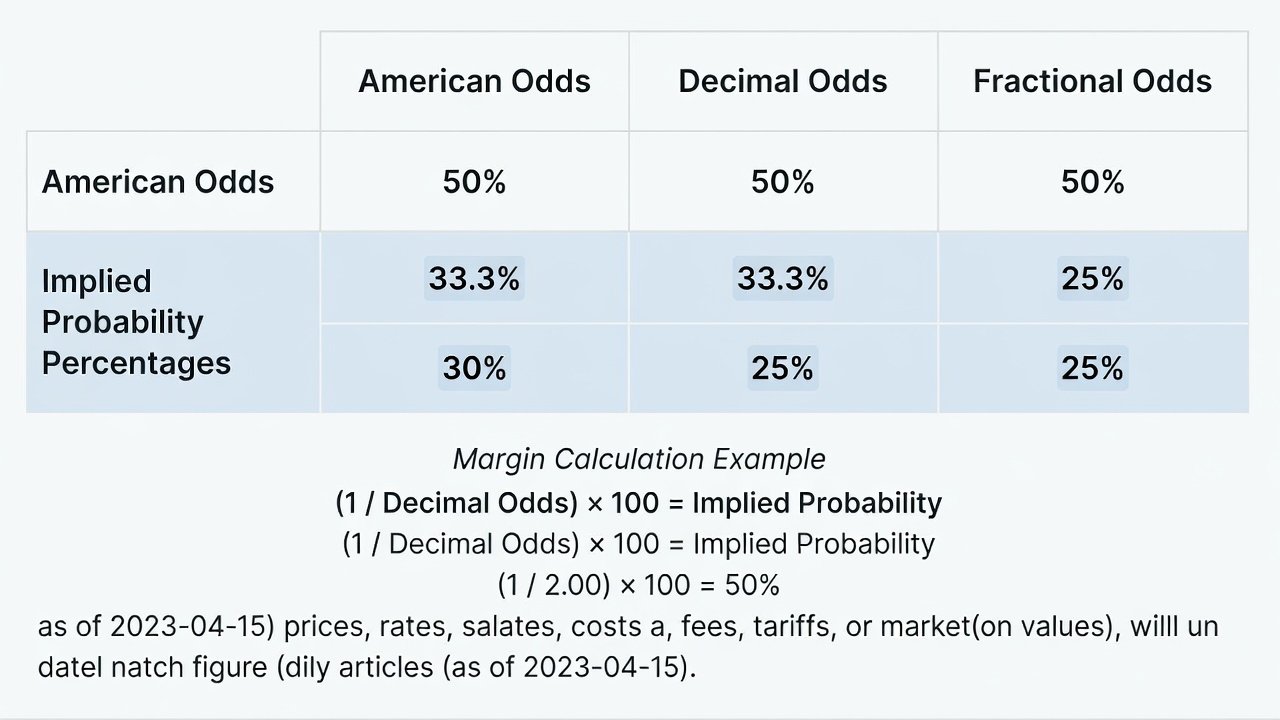
Bookmaker margins appear when you sum the implied probabilities of all outcomes. A fair book would total exactly 100 percent. Real margins often range between 2 percent and 10 percent depending on the sport and market liquidity. Lower margins typically appear in major league football while higher margins occur in niche horse racing markets.
For a tennis match with two players at decimal odds of 1.90 and 2.10, the implied probabilities are 52.63 percent and 47.62 percent. Their sum reaches 100.25 percent, revealing a small margin. Larger margins indicate less competitive pricing. In a three-way football market with odds of 2.20, 3.40, and 3.80 the probabilities total 106.8 percent, showing a typical 6.8 percent overround.
Spotting Value Opportunities
Value exists when your estimated probability exceeds the implied probability from the odds. If you assess a horse at 35 percent chance of winning but the odds imply only 28 percent, the bet carries positive expected value over time. This principle holds across football, basketball, and horse racing. Consistent edge hunting requires disciplined probability estimation rather than gut feeling.
Advanced bettors often adjust raw implied probabilities by removing the margin first. Normalizing percentages provides a clearer baseline for comparison and reduces the risk of overestimating edges in high-margin books.
Real-World Bet Examples
- A Premier League match lists a team at decimal odds of 3.00. Implied probability is 33.33 percent. If your model suggests 40 percent, the price offers value.
- In horse racing, fractional odds of 6/1 imply 14.29 percent. Your assessment of 20 percent creates a potential overlay.
- American odds of +300 on an underdog imply 25 percent. Adjusting for margin and comparing to your forecast reveals whether the wager merits consideration.
- Live tennis set betting at 2.40 decimal odds converts to 41.67 percent. Your data-driven estimate of 48 percent justifies the stake.
- A basketball total over at American odds of -110 implies 52.38 percent. If your projection reaches 58 percent, the market has mispriced the line.
Common Calculation Errors to Avoid
- Forgetting to convert the decimal result into a percentage before comparing values.
- Misapplying the American odds formula by confusing positive and negative signs.
- Ignoring the overround when assessing multi-outcome events such as outright tournament winners.
- Using outdated odds without refreshing the market, which distorts margin calculations.
- Rounding too early in the process and losing precision in close value decisions.
Quick-Reference Tables for Odds Conversion
| Decimal | Implied % | Fractional | Implied % | American | Implied % |
|---|---|---|---|---|---|
| 1.50 | 66.67 | 1/2 | 66.67 | -200 | 66.67 |
| 2.00 | 50.00 | 1/1 | 50.00 | +100 | 50.00 |
| 3.00 | 33.33 | 2/1 | 33.33 | +200 | 33.33 |
| 4.50 | 22.22 | 7/2 | 22.22 | +350 | 22.22 |
Checklist for Applying Implied Probabilities
- Convert all odds to percentages using the correct formula for each format.
- Calculate the total margin by summing implied probabilities.
- Estimate your own probability based on research and data.
- Compare your figure to the implied probability and note any edge.
- Adjust for margin in multi-outcome events by normalizing the percentages.
- Record the wager details and review results over time.
FAQs on Margin Adjustments and Multi-Outcome Events
How do I adjust for margin in a three-way market?
Sum the implied probabilities, then divide each individual probability by the total. This normalizes the figures so they add to 100 percent, allowing fairer comparison with your estimates.
What changes in multi-outcome events like horse racing?
The overround grows larger with more runners. Always normalize the implied probabilities or focus on the margin percentage rather than raw totals. In an eight-horse race the combined implied probability might reach 115 percent before normalization.
Should I always avoid high-margin markets?
High margins reduce value frequency but do not eliminate it. Strong probability estimates can still overcome larger edges in selected spots. Focus on your edge size relative to the margin.
How do implied probabilities behave in live betting?
Live markets fluctuate rapidly. Recalculate implied probabilities after every odds change to maintain accuracy and avoid chasing outdated value signals.
Conclusion
Calculating implied probabilities equips bettors with a practical mathematical framework. Regular use of the formulas, margin checks, and value comparisons leads to more informed wagering across sports and racing. Practice with current markets to refine accuracy and maintain discipline in every decision. For broader context on sports data and analysis, explore resources such as BBC and The Guardian. Consistent application of these skills builds a sustainable approach to betting that prioritizes evidence over intuition.


No comments yet. Be the first!