 GambleLore

Introduction to Backtesting Betting Strategies
Backtesting serves as the cornerstone for any serious bettor aiming for consistent results in 2026. Rather than relying on intuition or short-term luck, this process lets you simulate strategies against years of real historical outcomes. Intermediate bettors who move beyond basic tips often discover that rigorous backtesting reveals hidden strengths and weaknesses in their approaches. Whether you focus on football accumulators, tennis matchups, or horse racing form, understanding how strategies performed across different conditions prepares you for future variables like regulatory shifts or evolving team dynamics. This comprehensive guide walks through every essential step, providing actionable details and examples tailored to sports and horse racing markets.
Selecting Reliable Historical Datasets
Quality data forms the bedrock of accurate backtesting. Begin by sourcing datasets that cover multiple seasons, ideally spanning five to ten years to account for cyclical trends such as promotion and relegation in leagues or changing track surfaces in racing. Reputable platforms like Kaggle host extensive collections of match results, odds movements, and performance statistics. Prioritize sources that include granular details such as home versus away splits, weather conditions, and injury reports. Always cross-reference multiple datasets to fill gaps and validate accuracy. For horse racing, include variables like jockey changes, distance preferences, and going descriptions. Poor data quality leads to misleading conclusions, so dedicate time to cleaning entries before running any simulations.
Defining Key Success Metrics
Success in backtesting goes beyond simple win rates. Core metrics include return on investment (ROI), calculated as net profit divided by total stakes placed, expressed as a percentage. Strike rate measures the proportion of successful bets, helping assess consistency. Additional indicators such as profit factor (gross profits divided by gross losses) and maximum drawdown reveal risk exposure during losing runs. Incorporate expectancy calculations to estimate average profit per bet over large samples. These metrics allow direct comparison between strategies and highlight whether a high strike rate compensates for lower odds or if a selective approach yields better long-term value. Document each metric clearly during testing to avoid cherry-picking favorable results.
Choosing Free or Low-Cost Backtesting Tools
Modern bettors have access to powerful yet affordable tools for simulation. Programming environments like Python, supported by libraries such as pandas for data handling and backtrader for strategy testing, enable fully customized backtests at zero cost. Python offers flexibility for scripting complex accumulators or filtering criteria. Spreadsheet applications provide an entry point for those less comfortable with code, while specialized betting software adds features like automated odds scraping. Evaluate tools based on your technical comfort level and the volume of data you plan to process. Start with small test cases to confirm outputs match manual calculations before scaling up.
Step-by-Step Example: Accumulator Strategy Backtest
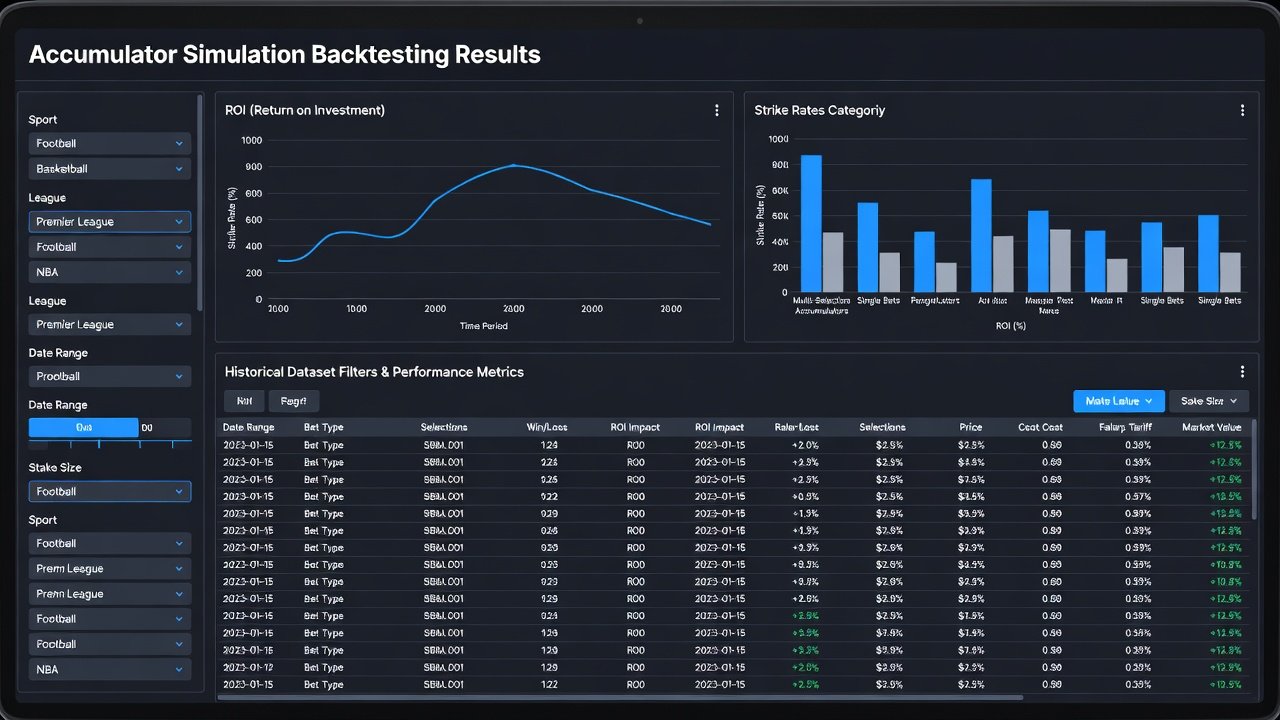
To illustrate the process, consider backtesting a four-leg football accumulator focused on matches with low expected goal totals. First, import five seasons of league data and filter for fixtures where both teams average under 2.8 goals per game historically. Next, apply odds thresholds to ensure value, such as requiring combined odds above 6.0. Simulate 500 such accumulators using 1 percent bankroll stakes per bet. Track cumulative profit, individual leg success rates, and overall ROI across the sample. In one example run, tightening the goal average filter to 2.5 improved ROI by 12 percent while reducing the number of qualifying bets by 30 percent. Analyze results by season to detect any performance drift, then adjust parameters like stake sizing or league restrictions accordingly. This iterative refinement demonstrates how small changes compound into meaningful improvements.
Avoiding the Pitfall of Overfitting
Overfitting represents one of the most common reasons backtested strategies fail in live conditions. It happens when parameters are excessively tuned to historical noise rather than underlying patterns. Mitigate this risk by splitting your dataset into in-sample and out-of-sample portions, typically reserving 20 to 30 percent for final validation. Implement walk-forward optimization, advancing the testing window progressively to mimic real-time decision making. Cross-validation across different time periods and market conditions further strengthens robustness. Always question whether a strategy would have worked without the benefit of hindsight adjustments.
Incorporating 2026-Specific Variables
Future seasons introduce new elements that historical data alone cannot capture. Anticipate rule modifications such as expanded video assistant referee protocols in football or updated medication guidelines in horse racing. Adjust simulations by modeling these changes, for instance by increasing draw probabilities in tightly regulated leagues or reducing performance variance in certain equine categories. Run sensitivity analyses that alter key inputs by 5 to 15 percent to observe strategy resilience. This forward-looking approach ensures your methods remain viable amid 2026 developments rather than becoming obsolete.
Manual vs Automated Backtesting Comparison
| Aspect | Manual Method | Automated Method |
|---|---|---|
| Speed | Slow, limited to hundreds of bets | Processes thousands instantly |
| Accuracy | Prone to human error | Consistent calculations |
| Flexibility | Easy custom tweaks | Requires coding updates |
| Cost | Free | Free to low-cost tools |
| Scalability | Poor for large datasets | Excellent for extensive testing |
Running Multi-Scenario Tests
Comprehensive testing requires evaluating strategies under varied conditions. Compare flat staking against percentage bankroll and Kelly criterion approaches to understand risk-adjusted returns. Introduce scenario variations such as fluctuating odds due to market movement or reduced liquidity in smaller markets. Test performance during high-volume periods like major tournaments versus quieter mid-season phases. These multi-scenario exercises build confidence that a strategy can withstand real-world fluctuations expected in 2026.
Data Cleaning and Preparation Best Practices
Before running simulations, invest effort in preparing data. Remove duplicate entries, standardize date formats, and handle missing values through interpolation or exclusion. Normalize odds to decimal format for consistency across bookmakers. Create derived fields such as goal difference trends or form streaks to enrich analysis. Thorough preparation prevents garbage-in-garbage-out problems that undermine entire backtesting projects.
Common Pitfalls and How to Avoid Them
- Using biased datasets that exclude push results or voided bets, which skews true probabilities
- Ignoring bookmaker margin fluctuations that erode value over time
- Neglecting transaction costs and withdrawal fees in long-term simulations
- Overlooking correlation between legs in accumulators, leading to overstated success rates
- Failing to account for sample size when declaring statistical significance
FAQ
How much historical data is enough?
At least three full seasons provide a solid baseline, though five or more improve reliability for seasonal sports and racing.
Can I backtest without coding skills?
Yes, spreadsheet templates and no-code platforms allow basic simulations, though advanced testing benefits from scripting knowledge for greater precision.
What is the biggest mistake beginners make?
Optimizing solely for maximum ROI without considering drawdowns and sample size leads to fragile strategies that collapse under pressure.
How often should I re-run backtests?
Quarterly reviews incorporating the latest season data help maintain relevance as team compositions and rules evolve.
Conclusion
Effective backtesting transforms betting from guesswork into a measurable, improvable process. By combining quality datasets, clear metrics, rigorous validation, and forward-looking scenario planning, you develop strategies equipped for 2026 challenges. Begin with focused tests on familiar markets, validate thoroughly against unseen data, and iterate continuously. This disciplined methodology separates sustainable success from fleeting wins.


No comments yet. Be the first!