 GambleLore

Introduction to Simulation-Based Blackjack Improvement
Blackjack remains one of the most skill-influenced casino games, where players can reduce the house edge through optimal play. In 2026, simulation tools allow both beginners and intermediate players to refine strategies without financial risk. These programs run thousands of hands based on defined rules, decks, and betting systems to reveal statistical outcomes. This approach provides data-driven insights that complement traditional chart memorization and help players understand long-term expectations in various casino environments.
Simulations help identify how strategy variations perform across blackjack variations like single-deck, multi-deck, and those with surrender options. By modeling real casino conditions, players gain confidence before live sessions. The ability to test thousands of scenarios quickly makes simulations indispensable for anyone serious about improving consistency and minimizing losses over time.
Selecting Reliable Simulation Software
Choosing the right tool is critical for meaningful results. Look for programs that support customizable rules, multiple betting systems, and detailed output reports including win rates and drawdowns. Popular options include standalone desktop applications and web-based platforms that handle large-scale runs efficiently without requiring advanced technical knowledge. Ensure the software allows importing basic strategy charts and tracks metrics like expected value, standard deviation, and win rate per hand.
Key features to prioritize include support for 2026 rule sets such as common casino variations with side bets or continuous shuffle machines, the ability to run at least 10,000 hands quickly on standard hardware, and exportable data for further spreadsheet analysis. Avoid tools with limited customization, as they may not reflect specific table conditions you encounter at different casinos. Reading user reviews on independent forums can help identify the most accurate and user-friendly options currently available.
Setting Up Realistic Scenarios
Before running simulations, configure parameters to mirror actual play as closely as possible. Start with standard multi-deck games using 6 decks, dealer hits on soft 17, and double after split allowed. Input your preferred basic strategy deviations and test common variations such as European no-hole-card rules or games offering late surrender. Adjust deck penetration levels to simulate real shuffling practices at land-based or online casinos.
For accuracy, include realistic session lengths, table limits, and comps if relevant to your play style. Define bankroll sizes and stop-loss thresholds to simulate responsible play and avoid emotional decisions. This setup ensures results translate directly to real-world casino environments and helps prepare for different rule combinations you might face during travel or online sessions.
Step-by-Step Example: Running a 10,000-Hand Simulation
Follow these steps for a typical test using simulation software to gather reliable data:
- Open the program and create a new session with chosen rules such as 6 decks and DAS allowed.
- Load or input the basic strategy chart you want to test, including any index plays for card counting if applicable.
- Select a betting system such as flat betting at one unit or a simple 1-2 unit spread based on true count.
- Set the number of hands to 10,000 and enable variance tracking along with session-based logging.
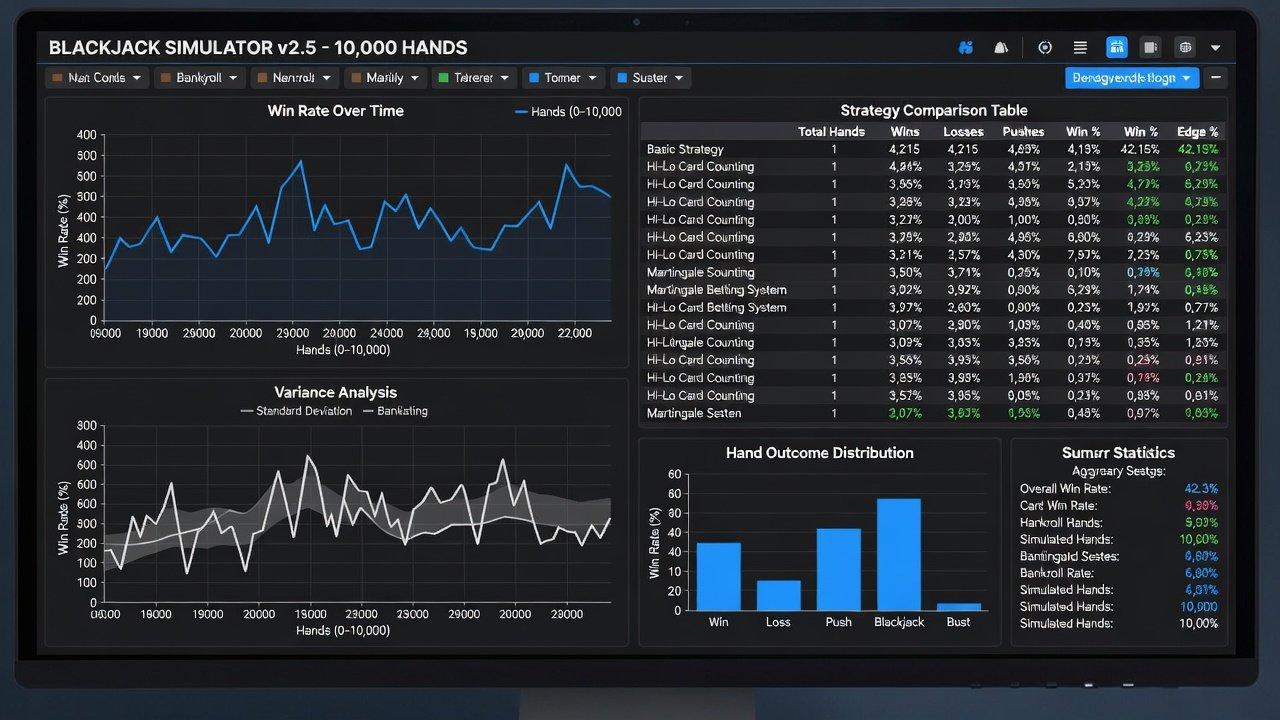
- Run the simulation and monitor progress through real-time graphs showing cumulative winnings and bet fluctuations.
- Export results including average bet size, win rate per hand, maximum drawdown, and overall return percentage.
Repeat the run multiple times with different random seeds to account for variance and produce a robust dataset. This method allows direct comparison between strategies and reveals which adjustments provide the most meaningful edge improvements in practice.
Analyzing Results for Edge Optimization
After each simulation, examine key metrics carefully to extract actionable insights. Expected value per hand indicates long-term profitability, while standard deviation highlights volatility that affects bankroll swings. Look for strategies that maintain a positive edge above 0.5 percent in favorable rulesets while keeping drawdowns manageable. Cross-reference results against baseline simulations using perfect basic strategy to quantify any gains from custom adjustments.
Compare outcomes across betting systems by running parallel simulations under identical conditions. Flat betting often shows lower variance than progressions, helping preserve bankrolls during extended downswings. Identify patterns where certain deviations increase overall return without excessive risk exposure. This analysis phase turns raw numbers into practical strategy refinements you can apply immediately.
Comparing Outcomes Across Betting Systems
Simulations reveal clear differences between systems when tested rigorously. For instance, compare the Martingale against a conservative 1-3 unit spread in identical 6-deck conditions over repeated 10,000-hand runs. The data typically shows that aggressive progressions amplify losses during losing streaks, whereas measured approaches yield steadier results and better risk-adjusted returns over the long term.
Use these comparisons to select a system matching your risk tolerance and available bankroll. Beginners benefit from flat betting initially to build familiarity, while intermediates can explore optimized spreads based on true count in card-counting scenarios. Documenting results across at least three different systems provides a clear decision framework for choosing the best fit for your goals in 2026 play.
Practical Tips for Interpreting Variance Data
Variance data prevents overconfidence from short-term wins or frustration from normal fluctuations. Focus on confidence intervals rather than single-run results to understand the range of possible outcomes. If a strategy shows a 1 percent edge but high standard deviation, expect significant swings in live play that require adequate bankroll reserves.
Track maximum drawdown carefully to set appropriate bankroll requirements before heading to the tables. Aim for sessions where simulated results stay within 20 to 30 percent of your total bankroll to maintain discipline. Cross-reference multiple simulations to smooth out anomalies and build a more reliable picture of expected performance across different rule sets and session lengths.
Common Pitfalls and How to Avoid Them
- Overfitting to one set of rules without testing variations that appear at different casinos.
- Ignoring deck penetration effects in shoe games which can dramatically change counting effectiveness.
- Running too few hands, leading to misleading conclusions that do not hold up over larger samples.
- Neglecting to update strategy for new casino rules or promotions introduced in 2026.
- Failing to account for table minimums and maximums when scaling bet sizes in simulations.
FAQ
How many hands should I simulate for reliable data?
At minimum 10,000 hands per scenario, with multiple runs for statistical significance and to reduce the impact of random variance.
Can simulations replace live practice?
They supplement it effectively by providing volume and data but should be combined with actual table experience for timing, psychology, and real-time decision making.
Are free simulation tools accurate enough?
Many free options provide solid results if they allow full rule customization and accurate random number generation; always verify outputs against known benchmarks from established sources.
What role does bankroll management play in simulation results?
Proper bankroll sizing based on simulated drawdowns helps prevent ruin and ensures you can withstand variance when transitioning to live play.
Conclusion
Simulation tools empower players to refine blackjack strategies with precision in 2026. By following structured testing, detailed analysis, and careful comparison of systems, both beginners and intermediates can achieve more consistent outcomes while managing risk effectively. Start with basic setups and gradually incorporate advanced variations to build a personalized, data-backed approach that improves results over time. For further reading on core rules, see the Blackjack rules overview and explore additional resources at Gambling.com.


No comments yet. Be the first!