 GambleLore

Introduction to Advanced 4-Bet Strategies in 2026
Four-betting has become a cornerstone of preflop aggression in fast-paced online multi-table tournaments (MTTs). With solver advancements available in 2026, players can refine their 4-bet ranges for maximum expected value (EV). This guide delivers concrete steps for implementing GTO baselines while adding exploitative tweaks against loose opponents. Players seeking to improve their win rates must understand that 4-betting is not simply about pushing chips; it requires precise sizing, range construction, and postflop planning that adapts to modern fast-fold formats where stack depths often hover between 25 and 40 big blinds.
Understanding when and how to 4-bet separates winning regulars from the field. Focus on position, stack depths, and opponent tendencies to build a robust strategy that boosts win rates immediately. In 2026, online MTTs reward players who balance aggression with data-driven decisions rather than relying on intuition alone.
Optimal 4-Bet Sizing for Fast Online MTTs
Solver data from 2026 recommends sizing 4-bets between 2.2x and 2.8x the 3-bet size in most 25-40bb effective stack scenarios common in fast MTTs. Smaller sizes maintain balance, while larger sizings apply pressure on loose callers. For example, when facing a 2.5bb 3-bet, a 5.5-7bb 4-bet keeps your range protected while denying equity to marginal calling hands.
Key metric: Against players who fold more than 55% to 4-bets, use a 2.5x sizing as of late 2026 solver outputs. This forces folds without overcommitting your stack. At shallower depths under 30bb, consider slightly larger 2.8x sizings to maximize fold equity before committing fully postflop. Always calculate the resulting stack-to-pot ratio to ensure you retain flexibility on later streets.
Position-Based Adjustments
From the button, 4-bet wider against cutoff 3-bets, targeting 8-12% of hands. In the blinds, tighten to 5-7% because of out-of-position disadvantage postflop. Button 4-bets benefit from closing the action and having position on subsequent streets, allowing more speculative hands to be included.
- Button vs small blind: Merge value hands like QQ+ with bluffs such as suited connectors.
- Big blind vs button: Polarize more aggressively with AA/KK and low suited aces.
- Small blind vs cutoff: Include suited broadways as semi-bluffs to balance premium holdings.
Polarized vs Merged 4-Bet Ranges
2026 GTO solutions favor polarized ranges in 4-bet pots at 30bb+ depths. Polarization allows you to have nutted hands and pure bluffs, making postflop decisions clearer. Merged ranges work better at shorter stacks under 25bb, where you can comfortably get all-in with medium-strength hands like AJs or 99.
When constructing polarized ranges, include AA, KK, AK as value and low suited aces plus suited connectors as bluffs. Merged constructions incorporate hands like JJ, TT, and AQs that perform well in all-in situations. 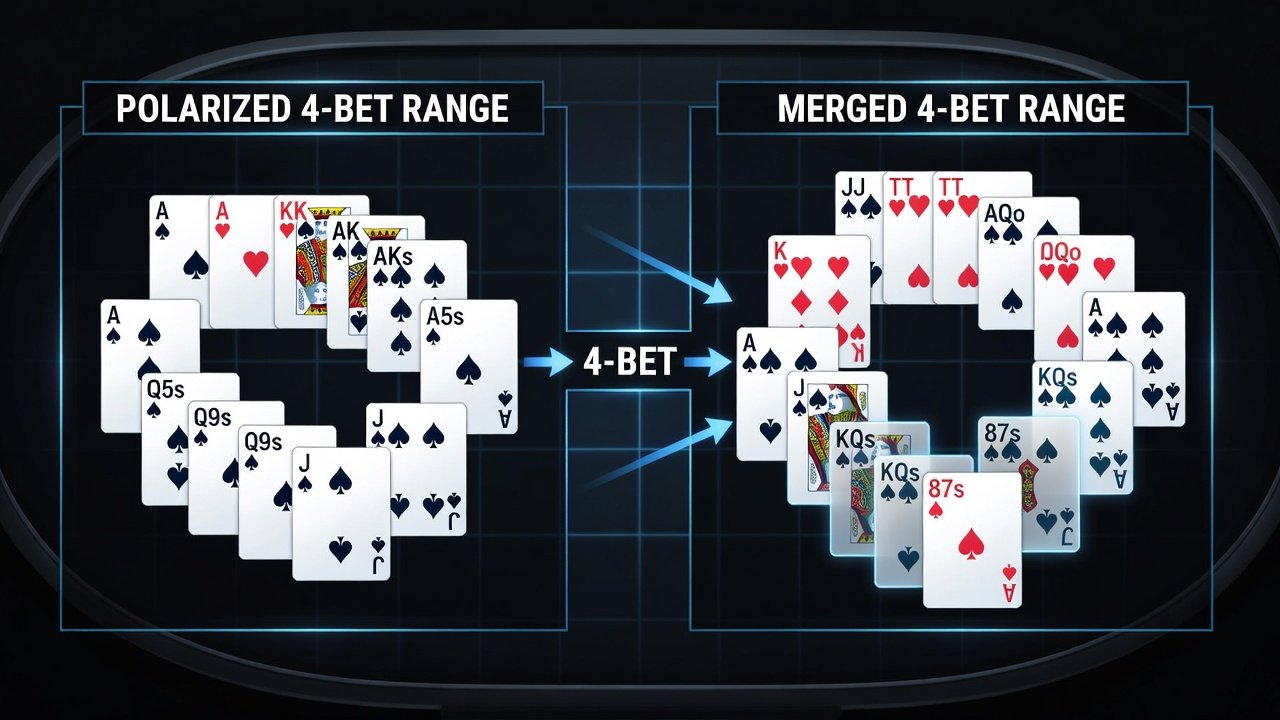
PokerNews regularly publishes updated solver charts that align with these principles.
Common 4-Bet Spots from Button and Blinds
Button 4-bets shine against tight 3-bettors from early position. Example hand: You hold A5s on the button facing a 3-bet from UTG. A 2.3x 4-bet exploits their folding frequency while retaining equity when called. Another spot arises when the cutoff 3-bets a button open; here, expand to include hands like KQo and 65s for balance.
From the small blind, 4-bet QQ+ and AK for value, plus suited wheel aces as bluffs against aggressive big blind defenders. In the big blind versus a small blind 3-bet, defend wider by 4-betting JJ+ and suited connectors to prevent the opponent from realizing equity cheaply.
Postflop Planning in 4-Bet Pots
After a successful 4-bet, plan continuation bets on dry boards with your entire range. On wet boards like 9-8-7, check back medium pairs to protect your checking range. Real example from a popular site: 40bb stacks, button opens, small blind 3-bets, button 4-bets with 22. Flop comes A-7-2 rainbow — check-fold to aggression as the range is capped.
Another scenario involves a button 4-bet with A5s called by the small blind. On a flop of K-5-3, lead for 40% pot to extract value from weaker fives and protect against overcards. On coordinated boards, mix in delayed continuation bets with your bluffs to maintain balance.
Card Player offers extensive hand database analysis for studying these spots.
GTO Baselines vs Exploitative Tweaks
Start with solver-derived GTO ranges, then deviate against specific player types. Against loose callers who defend 4-bets at 35%+, reduce bluff frequency by 15% and add more value hands. Against nits who fold 70%+, increase bluff combos like suited connectors and lower pocket pairs.
Track opponent stats over at least 500 hands before making large adjustments. Use HUD data to identify players with high fold-to-4-bet percentages and target them selectively during late stages of MTTs.
Quick-Reference 4-Bet Checklist
- Confirm effective stack depth before sizing your 4-bet.
- Identify opponent 3-bet frequency from database stats.
- Choose polarized or merged construction based on depth.
- Plan flop textures and continuation bet frequencies in advance.
- Track results over 5,000 hands minimum before adjusting ranges.
- Review session recordings to spot leaks in postflop play.
- Adjust for tournament stage, tightening near the bubble.
FAQ: Bankroll Impact of Aggressive 4-Betting
How does 4-betting affect variance? Higher aggression increases short-term swings but improves long-term ROI when executed correctly. Maintain at least 100 buy-ins for fast MTTs to weather downswings. Should beginners start with GTO or exploitative? Begin with GTO baselines from 2026 solvers, then layer exploits once comfortable with ranges.
What is the recommended sample size for range adjustments? Aim for 3,000-5,000 hands against similar player pools before making meaningful changes. How do ICM considerations alter 4-bet strategy near payouts? Tighten ranges significantly when pay jumps are large, favoring value over bluffs.
WSOP resources provide foundational bankroll management advice applicable to tournament play.
Conclusion
Implementing these 4-bet strategies with 2026 solver insights will elevate your preflop game and win rates in online MTTs. Track your results, refine ranges, and stay disciplined with bankroll management for sustained success. Consistent application of these principles leads to measurable improvements over time.


No comments yet. Be the first!