 GambleLore

Introduction to Bankroll Management in Texas Holdem
Texas Holdem remains one of the most popular poker variants worldwide, and in 2026, online poker players face increasing variance due to tougher competition and larger fields in tournaments. Effective bankroll management separates recreational players from professionals who sustain long careers. This guide covers five core rules that address risk-of-ruin calculations, proper stake selection, session budgeting, responsible limit movement, and variance tracking. Whether grinding $0.25/$0.50 cash games or entering mid-stakes MTTs, these principles help minimize the chance of going broke while maximizing growth opportunities. Bankroll rules are not just about numbers; they incorporate psychology and discipline. Many players ignore them during winning streaks, only to face devastating downswings. By applying proven strategies, you can build resilience against the inherent swings in poker. Understanding these concepts deeply allows players to make informed decisions that protect their funds over thousands of hands and multiple sessions.
Rule 1: Calculate Your Risk of Ruin Accurately
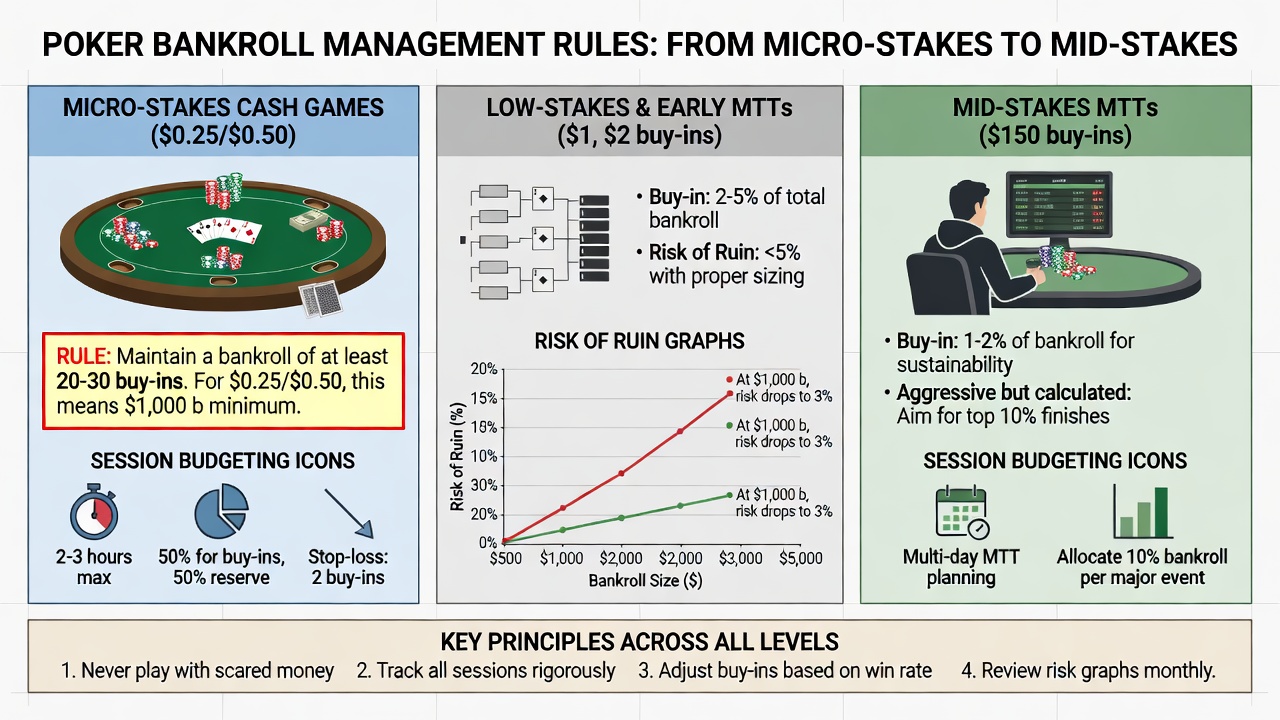
Risk of ruin refers to the probability that your bankroll will reach zero before achieving your goals. For cash games, a standard formula uses your win rate, standard deviation, and buy-in requirements. Players at $0.25/$0.50 should aim for at least 20-30 buy-ins to keep risk below 5% over 10,000 hands. In tournaments, the calculation shifts because of higher variance—mid-stakes MTTs often require 50-100 buy-ins for similar safety. A common error is underestimating standard deviation, which can lead to unexpected losses even for skilled players. Real-world examples demonstrate that even strong regulars can experience 20-30 buy-in swings in a single month at micro stakes. Use free online calculators or custom spreadsheets to model different scenarios before committing significant funds. Breaking down the math involves estimating your hourly win rate in big blinds, then factoring in the standard deviation per 100 hands to project survival rates over extended volumes. This proactive approach prevents emotional decisions when results turn negative.
Rule 2: Select Stakes Based on Your Current Bankroll
Proper stake selection prevents overexposure and ensures longevity. For online cash games, never exceed 5% of your total bankroll per buy-in. This means a $1,000 bankroll supports $0.25/$0.50 play comfortably but requires moving down if variance hits hard. In poker tournaments, allocate no more than 1-2% per entry to account for the all-or-nothing nature of MTTs. Compare this disciplined method to reckless play where players jump into $1/$2 with only 10 buy-ins, often leading to quick depletion of funds. Proven strategies include maintaining separate bankrolls for cash games and tournaments to avoid cross-contamination. Consider your overall goals: if your aim is steady growth, stick to lower percentages during uncertain periods. Always reassess your roll weekly to adjust stakes dynamically without overextending.
Rule 3: Implement Strict Session Budgeting and Stop-Losses
Session budgeting controls daily risk and protects your mental game. Set a maximum loss limit of 3-5 buy-ins per session and establish a win goal to lock in profits. For example, at $0.25/$0.50, a $150 stop-loss prevents emotional decisions during downswings. Track time played as well, since fatigue increases error rates significantly after four or five hours. Common mistakes include chasing losses without limits or extending sessions beyond planned durations. Instead, use software alerts to enforce rules automatically. This approach not only safeguards capital but also preserves energy for higher-quality decisions in future sessions. Incorporate rest periods and review each session's key hands to identify patterns that could be improved.
Rule 4: Move Up Limits Responsibly with Proven Results
Advancing stakes requires consistent profits over thousands of hands, not a single heater or lucky run. Demonstrate at least 10 buy-in wins at the current level before stepping up. For mid-stakes MTTs, build a dedicated satellite bankroll to test higher entries without risking your main roll. Handle variance by reviewing hand histories in detail and noting any leaks that appear under pressure. Players who move up too quickly often return to lower limits after big losses, eroding confidence and bankroll simultaneously. Create a clear progression plan with milestones, such as achieving a positive ROI over 500 tournaments before increasing buy-ins. Patience here separates sustainable careers from boom-and-bust cycles that plague many aspiring pros.
Rule 5: Track Performance with Dedicated Software
Software like PokerTracker or Holdem Manager provides essential data on win rates, variance, and leak identification. Import hands regularly and set benchmarks such as a minimum 2bb/100 win rate at micro stakes before considering moves upward. Review monthly reports to adjust strategies during downswings and celebrate steady progress. Integrate these tools with bankroll spreadsheets for holistic oversight of your entire poker operation. Avoid relying on manual tracking alone, as it misses critical patterns that software reveals instantly through graphs and filters. Supplement with free resources from established sites to refine your understanding of advanced metrics like all-in adjusted EV.
Handling Variance with Real-World Examples
Variance affects every player, from micro-stakes cash games to mid-stakes tournaments. At $0.25/$0.50, a typical downswing might last 8,000 hands with a 15 buy-in loss before recovery. In MTTs, a single bad beat in a final table can erase weeks of careful play. Combat this by sticking to your rules and avoiding tilt-induced deviations. Compare successful players who maintain logs versus those who quit during tough times—the difference often comes down to preparation and adherence to bankroll principles.
Practical Bankroll Checklist
- Calculate risk of ruin monthly using updated win rates and adjust buy-in multiples accordingly.
- Maintain minimum buy-in requirements for all game types including cash and tournaments.
- Enforce session stop-losses without exception to protect both bankroll and mindset.
- Prove profitability over 10,000+ hands before any limit increases or tournament entries.
- Review software reports weekly and adjust for variance spikes immediately.
- Separate cash game and tournament bankrolls to isolate different risk profiles.
- Reassess after any 20+ buy-in downswing with a full strategy audit.
- Incorporate rest days and mental game exercises into your routine.
FAQ on Common Bankroll Scenarios
What should I do during a prolonged downswing?
Drop stakes temporarily, review hands for leaks with software, and maintain discipline without forcing volume. Most downswings resolve with continued volume at proper stakes and consistent application of fundamentals.
How do bonuses affect bankroll rules?
Treat bonuses as part of your roll only after fully clearing requirements. Factor in the time investment and rake involved before adding cleared amounts to your available funds for play.
Is bankroll management different for live versus online Texas Holdem?
Online variance is typically higher due to faster hand volume, so apply stricter buy-in multiples. Live games allow slightly smaller rolls because of slower pace and better player reads from physical tells.
Should I use multiple tracking tools simultaneously?
Yes, combining two complementary programs can provide deeper insights, but start with one to master its features before expanding to avoid data overload.
Conclusion
Applying these five bankroll rules consistently will position you for long-term success in Texas Holdem throughout 2026. Focus on data-driven decisions rather than emotion to navigate variance effectively. For further poker strategies and tips, explore resources from PokerNews, Card Player, and 888poker. Start implementing the checklist today to build a sustainable poker career that withstands the challenges of modern online play.


No comments yet. Be the first!