 GambleLore

Introduction to AI in Texas Holdem Poker
Texas Holdem continues to dominate the poker landscape in 2026, drawing millions of players to online tournaments where skill edges can translate into substantial winnings. Intermediate players, already familiar with basic strategies and solvers, are increasingly adopting artificial intelligence and machine learning tools to push beyond traditional limits. These technologies process enormous volumes of hand data, identify subtle patterns in opponent behavior, and generate recommendations that adapt to evolving game conditions. This comprehensive guide examines how to integrate such tools into online tournament play, covering everything from platform selection and real-time assistance to automated reviews and opponent modeling based on recent tournament datasets. By blending AI insights with foundational poker knowledge, players can achieve more consistent results while continuing to develop their intuitive skills.
The shift toward AI-assisted play reflects broader trends in gaming and strategy sports, where data analytics have become essential. Unlike older solvers that required manual input and static outputs, modern 2026 platforms leverage neural networks and reinforcement learning to simulate millions of scenarios in seconds. This allows for dynamic range adjustments during tournaments with varying stack depths and payout structures. Players who master these integrations often report improved decision-making speed and reduced emotional tilt during high-pressure moments.
Popular 2026 AI Platforms for Poker
Leading platforms in 2026 include evolved versions of established tools like GTO Wizard and PioSolver, which now incorporate advanced machine learning modules for tournament-specific modeling. Newer entrants emphasize seamless integration with major online poker clients, offering real-time overlays and cloud-based hand databases. These systems draw from aggregated data across thousands of tournaments to build predictive models that account for player pool tendencies at different stakes and formats. For instance, users can import anonymized hand histories from major online series to calibrate their custom strategies against current meta shifts.
Key capabilities extend to multi-table support, allowing simultaneous analysis across several tournaments. Machine learning components continuously update ranges based on new inputs, making the tools more responsive than static solver outputs. Intermediate players benefit from tutorial libraries within these platforms that explain complex concepts like ICM pressure and bubble dynamics through interactive simulations.
Real-Time Decision Aids and Their Benefits
Real-time AI aids function as digital coaches during live sessions, displaying probability distributions and suggested actions directly on the screen. These overlays factor in current board texture, pot odds, and historical opponent statistics to recommend folds, calls, or raises with confidence intervals. In practice, this helps players navigate tricky spots such as defending blinds against late-position steals or navigating multi-way pots on coordinated boards.
The primary advantage lies in minimizing cognitive load during fast-paced online play. Manual methods often lead to rushed decisions influenced by fatigue or bias, whereas AI suggestions provide an objective baseline. However, successful users treat these aids as learning companions, reviewing why certain actions were recommended after sessions to internalize the logic. Over time, this hybrid approach strengthens both technical proficiency and table awareness.
Step-by-Step Setup for Custom Range Building
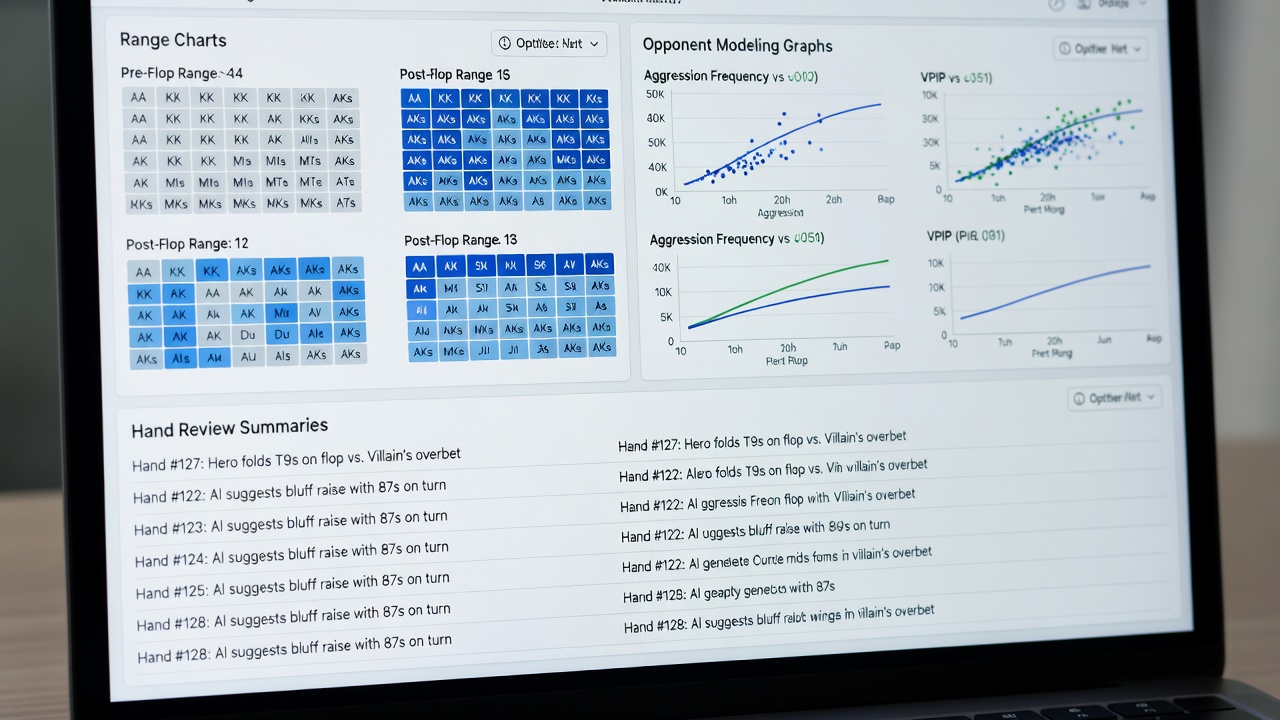
Setting up custom ranges begins with selecting a platform that supports API connections to your preferred poker client. Once installed, configure tournament parameters including average stack sizes, blind levels, and payout structures to mirror real event conditions. Next, upload recent hand histories from sources like major online festivals to train the model on prevailing player behaviors.
Proceed by defining position-specific ranges using adjustable sliders that account for factors such as effective stack depth and prior action. Test these ranges against simulated opponent profiles generated from tournament data, iterating until the outputs align with your risk tolerance. Finally, export the refined ranges as quick-reference charts or integrate them into heads-up displays for in-game use. This methodical process ensures ranges remain dynamic and context-aware rather than generic.
Hand Review Automation and Opponent Modeling
Automation tools scan entire session logs to flag recurring leaks, such as excessive continuation betting on dry boards or suboptimal river calling frequencies. Opponent modeling employs clustering techniques to categorize rivals into archetypes like tight-aggressive or loose-passive based on metrics including aggression factor and fold-to-three-bet percentages. Drawing from 2025 tournament archives, models reveal how early-position ranges tighten significantly in high-stakes events, enabling precise exploitative adjustments against unknown online opponents in 2026.
Post-Session Analysis Features
Beyond real-time support, post-session modules generate detailed reports highlighting equity realization and deviation from optimal lines. Players can replay hands with alternative decision trees, comparing outcomes against AI-generated benchmarks. This feature proves especially valuable for tracking progress across multiple tournaments, revealing patterns invisible during live play. Examples include identifying spots where hero calls succeeded due to specific blocker effects or where fold equity was underutilized.
AI-Assisted Play vs Manual Methods: Pros and Cons
- Pros of AI: Accelerated pattern recognition across vast datasets, consistent adherence to game theory optimal principles, and the ability to scale analysis for multi-table sessions without increased mental effort.
- Cons of AI: Dependency on stable internet connections, occasional need for recalibration when player pools evolve, and the risk of reduced personal skill development if used excessively without review.
- Pros of Manual: Fosters deeper conceptual understanding through hands-on calculation and works reliably in offline study environments without technical requirements.
- Cons of Manual: Slower review cycles that limit the volume of hands analyzed, plus greater vulnerability to confirmation bias and emotional influences during evaluation.
Common Mistakes to Avoid
Many intermediate players rush into real-time AI use without first mastering post-session reviews, leading to superficial application. Another frequent error involves ignoring platform terms of service, which can result in account restrictions. Always cross-reference AI suggestions with personal notes to avoid blind trust, and maintain a balanced study routine that includes non-digital resources.
Beginner-Friendly Integration Checklist
- Begin with trial periods on two leading platforms to evaluate interface usability and data import features.
- Conduct weekly automated reviews of at least one full session before activating any real-time overlays.
- Monitor performance metrics such as win rate and big blind per 100 hands over a minimum of 500 hands to quantify improvements.
- Supplement AI outputs with classic poker literature to reinforce core concepts like position play and bet sizing.
- Verify each site's policy on external software and maintain detailed logs of tool usage for personal accountability.
FAQs on Tool Accuracy, Ethics, and ROI
How accurate are these AI tools?
Accuracy varies with input data quality, yet leading platforms demonstrate strong alignment with solved equilibria in benchmark tests drawn from recent major tournaments, often exceeding 95 percent in controlled evaluations.
Is AI use ethical in online poker?
Real-time assistance during active play is prohibited by most operators, while post-session analysis remains widely accepted. Players should consult individual site rules to ensure compliance and promote fair play. For official tournament guidelines, consult WSOP official resources.
What ROI can players expect?
Documented case examples illustrate gains through lower error rates and better exploitation, though individual outcomes depend on consistent application and baseline skill levels.
Conclusion
AI tools represent a transformative resource for intermediate Texas Holdem players aiming to elevate their tournament performance in 2026. Through careful setup, thoughtful integration of real-time and review features, and adherence to ethical standards, these technologies deliver measurable advantages when combined with ongoing personal study. By expanding knowledge of both the tools and underlying strategies, players position themselves for long-term success in an increasingly competitive online environment. Further foundational education is available through PokerStars educational sections.


No comments yet. Be the first!