 GambleLore

Introduction to Check-Raising in Modern Texas Hold'em
Check-raising remains one of the most powerful yet underutilized weapons in tournament poker. In the 2026 meta, where solvers have refined ranges and players adapt quickly, mastering check-raises separates skilled competitors from the field. This guide delivers practical techniques for identifying optimal spots based on opponent tendencies, stack depths, board textures, and position dynamics. Effective check-raising requires balance. Without it, observant opponents exploit your frequencies. The 2026 environment rewards players who mix bluffs and value raises seamlessly while adjusting to both online and live dynamics. Players who neglect this tool often find themselves outmaneuvered in critical pots, especially as fields tighten and aggression levels rise across major events.
Identifying Optimal Check-Raise Spots
Success starts with reading the table. Focus on three key factors: opponent tendencies, effective stack depths, and board texture. Aggressive regulars who continuation bet too often on dry boards become prime targets. Against tight players, check-raise more selectively with strong hands. Stack depth matters. At 20-30 big blinds, check-raises often commit stacks, turning the move into a high-variance decision. Deeper stacks allow for more post-flop maneuvering and polarized ranges. Board texture dictates everything: coordinated flops favor check-raises with draws and strong made hands, while dry boards suit polarized bluffs. Consider a 40bb effective stack scenario where an opponent opens from middle position and you defend from the big blind with suited connectors. The flop comes with two suited cards and a high card; checking and raising here applies pressure while keeping weaker holdings in your range for balance.
Building Balanced Check-Raising Ranges
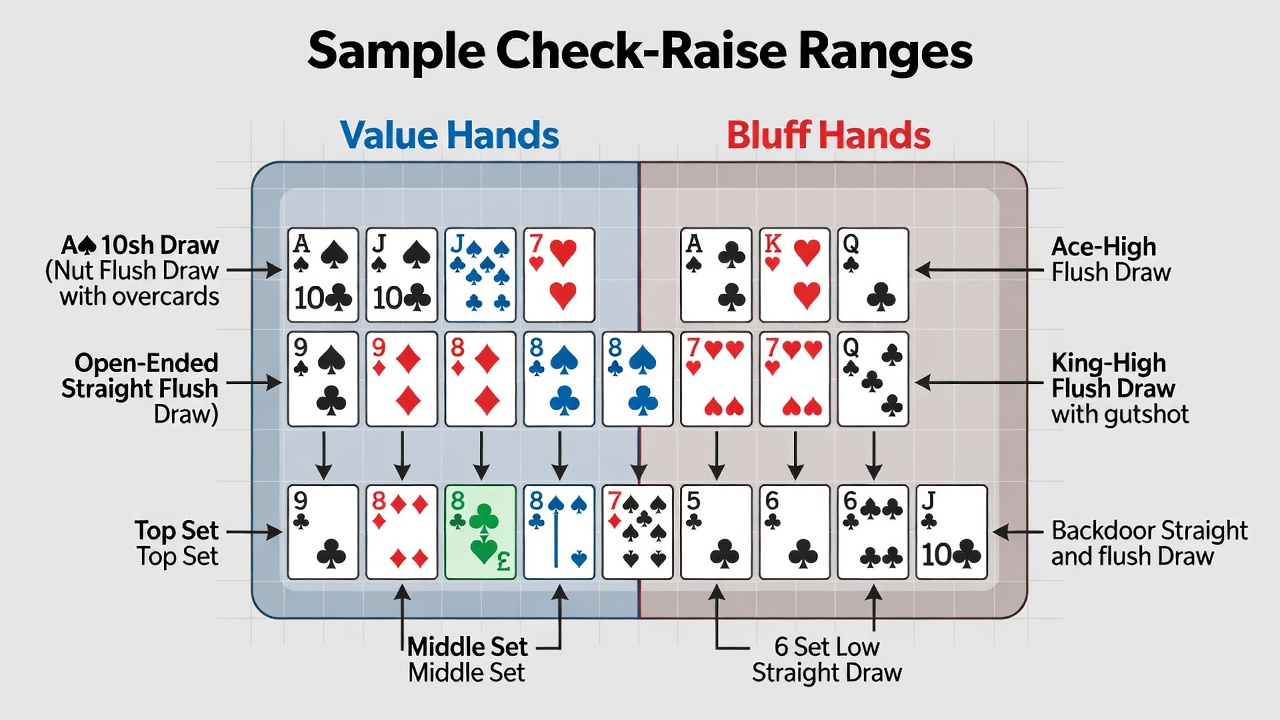
A balanced range mixes value hands and bluffs in proportions that prevent exploitation. Typical value hands include top pair with good kickers, sets, and overpairs. Bluff candidates feature strong draws like flush and straight draws, plus some backdoor equity hands that retain playability. Position influences range construction. In position, you can check-raise wider because you control the action on later streets. Out of position, tighten ranges to avoid difficult decisions on the turn and river. To construct these ranges effectively, review solver outputs that break down equity realization across multiple runouts. This prevents over-bluffing on bricks or under-bluffing on draw-heavy boards where fold equity is high.
PokerNews regularly publishes solver outputs that illustrate these balanced constructions for tournament players.
Timing Bluffs Versus Value Raises
Timing separates good check-raisers from great ones. Value raises should occur when your hand crushes the villain's likely calling range. Bluffs work best against players who fold too often to aggression on certain textures. Consider a recent hand example: blinds 500/1000 with 25bb effective stacks. You hold 8s7s on the button after an early position open. Flop comes As Ks Qs. Checking and raising a continuation bet with this nut flush draw pressures the opponent's range while maintaining balance with sets and two-pair hands. Another example involves a dry board like Kc 7d 2s where you hold a backdoor flush draw and overcards; a well-timed check-raise can fold out medium strength hands that would otherwise continue. Against loose callers, reduce bluff frequency and increase value check-raises. Against tight folders, increase bluffs on scary turn cards that complete obvious draws.
Adapting to Online Versus Live Environments
Online play allows higher volume and easier tracking of opponent stats. Use HUD data to identify players with high fold-to-check-raise frequencies. Live games demand stronger physical reads and note-taking between hands. Online tournaments in 2026 often feature faster structures, making stack preservation critical. Live events allow more time for table image development, enabling larger exploitative adjustments. The pace difference also affects decision trees, as live players tend to over-fold to repeated aggression while online regulars defend wider with software assistance.
Understanding Board Textures and Position Dynamics
Board textures break down into categories such as dry, wet, paired, and monotone. Dry boards like A72 rainbow allow wider bluff check-raises because the opponent misses more often. Wet boards with multiple draws require tighter value ranges to avoid reverse implied odds. Position adds another layer: button check-raises can be wider due to initiative, while small blind defenses must account for the big blind's potential three-bet. In late position, leverage your ability to float or raise selectively based on the number of callers behind.
GTO Versus Exploitative Approaches
Game theory optimal (GTO) play provides a solid baseline that avoids major leaks. However, pure GTO rarely maximizes profit against real opponents. The exploitative edge comes from deviating when you have reliable reads. For example, if a player folds 70% to check-raises on dry boards, increase bluff frequency by 15-20% while keeping value ranges intact. Track these adjustments with software to ensure long-term profitability. Card Player offers extensive strategy archives that compare GTO baselines with exploitative adjustments for tournament settings.
Practical Drills Using Solvers and Tracking Software
Regular practice accelerates mastery. Use GTO+ or PioSolver to build check-raising ranges on common flops. Input specific board textures and stack depths, then review output frequencies. Tracking software like Hold'em Manager or PokerTracker helps review sessions. Filter for check-raise spots and analyze EV of each decision. Aim for 500+ hands per week of focused review.
- Drill 1: Review 50 check-raise opportunities from recent sessions and compare to solver output, noting EV differences on each street.
- Drill 2: Build polarized ranges for three common flop types and memorize key hands at varying stack depths from 15bb to 60bb.
- Drill 3: Simulate live table dynamics by practicing with delayed decisions and verbal bet sizing to improve timing.
- Drill 4: Analyze 100 hands where you faced a check-raise and identify leaks in your own defending ranges.
Common Pitfalls and How to Avoid Them
Many players check-raise too wide without balance or too tight without pressure. Another frequent mistake involves failing to adjust to stack depths, leading to commitment errors on later streets. Over-reliance on one texture type also creates predictability. Integrate check-raising into your overall strategy by viewing it as one tool among many. Combine it with continuation betting, delayed continuation betting, and leading strategies for a complete post-flop plan. WSOP official resources emphasize holistic strategy integration for long-term tournament success.
FAQ
How often should I check-raise in tournaments?
Frequency depends on table dynamics, but aim for 8-12% of opportunities in the 2026 meta when balanced correctly across multiple board textures.
What is the difference between GTO and exploitative check-raising?
GTO maintains unexploitable frequencies while exploitative deviates based on specific opponent weaknesses for higher EV.
Can check-raising work in short-stack situations?
Yes, but ranges must be tighter and more value-heavy due to stack commitment and reduced post-flop playability.
How do solvers help refine check-raise ranges?
Solvers provide precise frequencies and equity breakdowns that serve as benchmarks, allowing you to spot deviations and refine exploitative adjustments.
Conclusion
Check-raise mastery elevates your tournament game in 2026. By focusing on spot identification, balanced ranges, timing, board textures, and environment-specific adjustments, you create consistent edges. Combine solver study with real-world tracking to refine your approach and dominate the tables.


No comments yet. Be the first!