 GambleLore

Introduction
Developing custom Texas Hold'em strategies is essential for serious online tournament players aiming for long-term edges in 2026. Standard advice often falls short against increasingly sophisticated opponents, so tailoring your approach to your unique strengths and leaks creates a sustainable advantage. This guide walks through self-assessment, integrating modern tools, and practical customization processes with real-world examples. Players who invest time in personalization consistently outperform those relying on generic charts because they exploit specific dynamics at their tables more effectively. In the fast-evolving landscape of online poker, where solver usage has become widespread, a bespoke strategy helps you stay one step ahead while maintaining your personal edge.
Self-Assessment of Strengths and Leaks
Begin by honestly evaluating your game. Track sessions using software to identify patterns in your play. Note areas like pre-flop aggression, post-flop decision-making, and tilt management. Create a detailed checklist: Do you over-fold to 3-bets? Are your river calls profitable? Use this data to prioritize improvements before building custom strategies. Spend at least two weeks reviewing your hand histories from multiple sessions, categorizing errors into categories such as value betting mistakes, bluff frequency issues, and positional awareness gaps. Compare your stats against population averages from tracking databases to spot outliers. For instance, if your VPIP is significantly lower than average in early position, this may indicate an overly tight leak that custom ranges can address. Incorporate mental game reviews by journaling emotional states during key hands to uncover tilt triggers that generic strategies ignore.
- Review 500+ hands for recurring mistakes across different stack depths
- Rate your skills in range reading, bet sizing, and bluffing on a 1-10 scale
- Identify emotional triggers that lead to deviations from optimal lines
- Analyze win rates by position and tournament stage
- Consult session notes for patterns in opponent interactions
Range Construction Tailored to Your Style
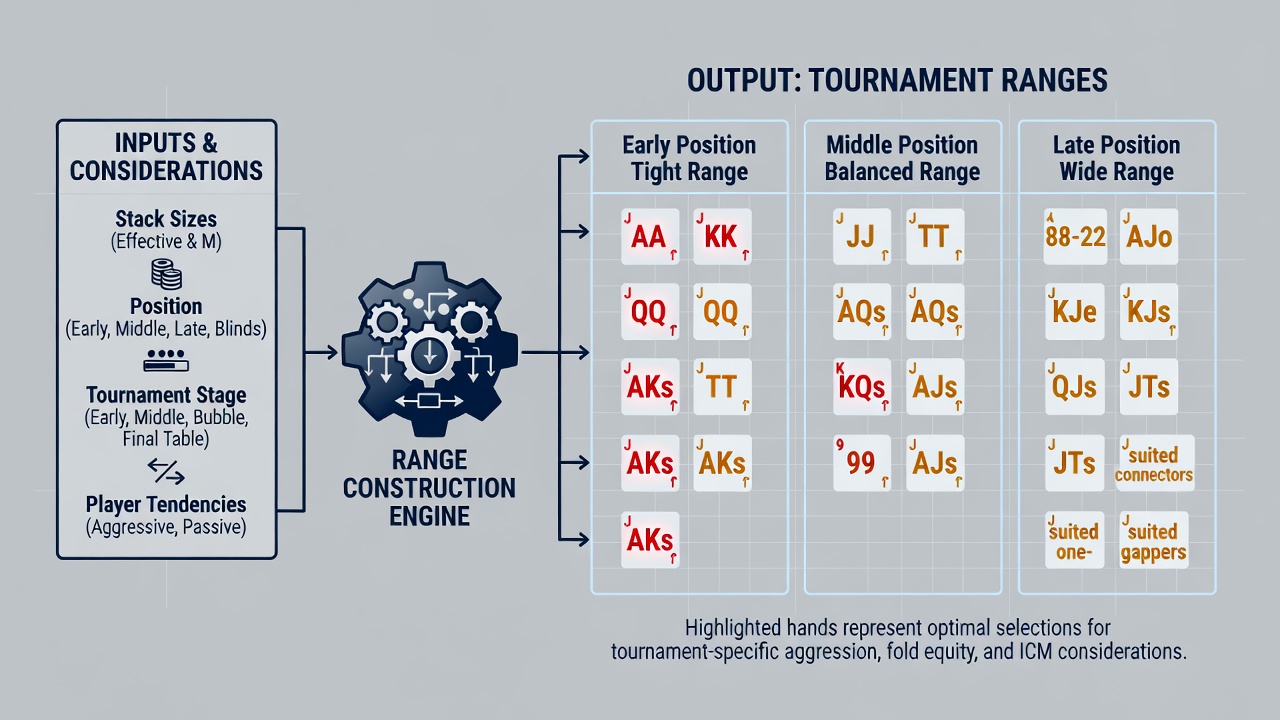
Range construction forms the backbone of any custom strategy. Instead of copying GTO charts, adjust ranges based on your preferred style. Aggressive players widen opening ranges in late position while tightening early position play. Incorporate position, stack sizes, and opponent tendencies for dynamic adjustments. For example, a loose-aggressive player might add suited connectors to their button opening range in soft tournaments but remove them against tight regulars. Build separate ranges for different stages: early, middle, and late. Test these against solver outputs to ensure they remain balanced while reflecting your personality. This personalization prevents predictable play that advanced opponents can exploit.
Integrating Bet Sizing with Modern Tools
Bet sizing must align with your ranges and goals. Use solvers and tracking tools to test sizings in various spots. Smaller sizes work well for value-heavy ranges, while larger bets polarize effectively. Experiment in low-stakes sessions to refine what fits your personality and bankroll comfort. Modern tools allow simulation of thousands of hands to compare outcomes of 33% pot bets versus 75% pot bets in specific board textures. Adjust for tournament payout structures where ICM pressure changes optimal sizing. A player favoring thin value might prefer smaller sizings to induce more calls, while a bluff-heavy style benefits from larger bets that maximize fold equity.
Step-by-Step Customization Process
- Define your core playing style from assessment data by listing top three strengths and three leaks
- Build baseline ranges using poker software and adjust them positionally for your aggression level
- Adjust for common tournament structures and blind levels by creating variants for regular, turbo, and deep-stack events
- Simulate scenarios and review results against both solver solutions and your own historical data
- Iterate based on session feedback by tracking key metrics like win rate per 100 hands and adjusting ranges monthly
- Incorporate opponent-specific notes from HUD data into dynamic range tweaks during play
Real-World Examples from Online Sessions
In a recent MTT on a major platform, a player identified a leak in calling wide on the river. By customizing their range to include more bluff-catchers only against loose opponents, they improved ROI significantly over 20 sessions. Another example involved tightening early-position ranges after noticing frequent multi-way pots, leading to better post-flop control and a 15% increase in win rate. A third case saw a mid-stakes regular add suited ace blockers to their 3-bet range after reviewing leaks, resulting in higher fold equity in heads-up pots during final tables.
Generic vs Custom Approaches Compared
Generic strategies provide a solid foundation but lack personalization. Custom approaches account for individual variance, leading to better adaptation against regulars. Players using tailored methods report higher win rates because they exploit specific table dynamics more effectively than those following one-size-fits-all advice. Generic charts often assume average opponent behavior, while custom strategies incorporate your observed tendencies and comfort zones, reducing deviations under pressure.
Common Pitfalls to Avoid
Avoid over-complicating ranges or ignoring table flow. Many players fail by not reviewing enough hands or neglecting mental game. Stay disciplined with your custom plan and resist copying trends without testing. Additional pitfalls include failing to update ranges as your skill evolves, neglecting ICM considerations in late stages, and allowing emotions to override planned adjustments. Always maintain a review routine to catch these issues early.
Adapting to Evolving 2026 Meta Trends
The 2026 online meta emphasizes solver-derived lines and rapid adjustments. Integrate new HUD stats and AI-assisted review tools to stay ahead. Regularly update your custom strategies as population tendencies shift. Resources like PokerNews provide ongoing coverage of emerging trends, while sites such as Card Player offer strategy archives that can inspire refinements. Focus on adapting to increased use of mixed strategies and shorter stack play in online fields.
FAQ
How long does it take to develop a custom strategy? Expect 4-6 weeks of dedicated review and testing for meaningful results, with ongoing monthly refinements.
Should I use GTO or exploitative ranges? Blend both, leaning exploitative when you have solid reads on opponents while maintaining GTO balance as a baseline.
What tools are recommended? Popular options include solvers and hand trackers from established providers for accurate simulations.
How often should I update my strategy? Review monthly and adjust after major meta shifts or personal performance plateaus.
Can custom strategies work in cash games too? Yes, the same self-assessment and range-building principles apply with adjustments for stack depths and game flow.
How do I handle variance during implementation? Track results over large sample sizes and maintain a separate mental game routine to stay consistent.
Conclusion
Custom Texas Hold'em strategies empower you to play with confidence and precision in 2026 online tournaments. Through consistent self-assessment and thoughtful integration of tools, you can build a personalized edge that generic advice cannot match. Start today with your own assessment checklist and watch your results improve over time.


No comments yet. Be the first!