 GambleLore

Introduction to GTO and Exploitative Play in 2026 Tournaments
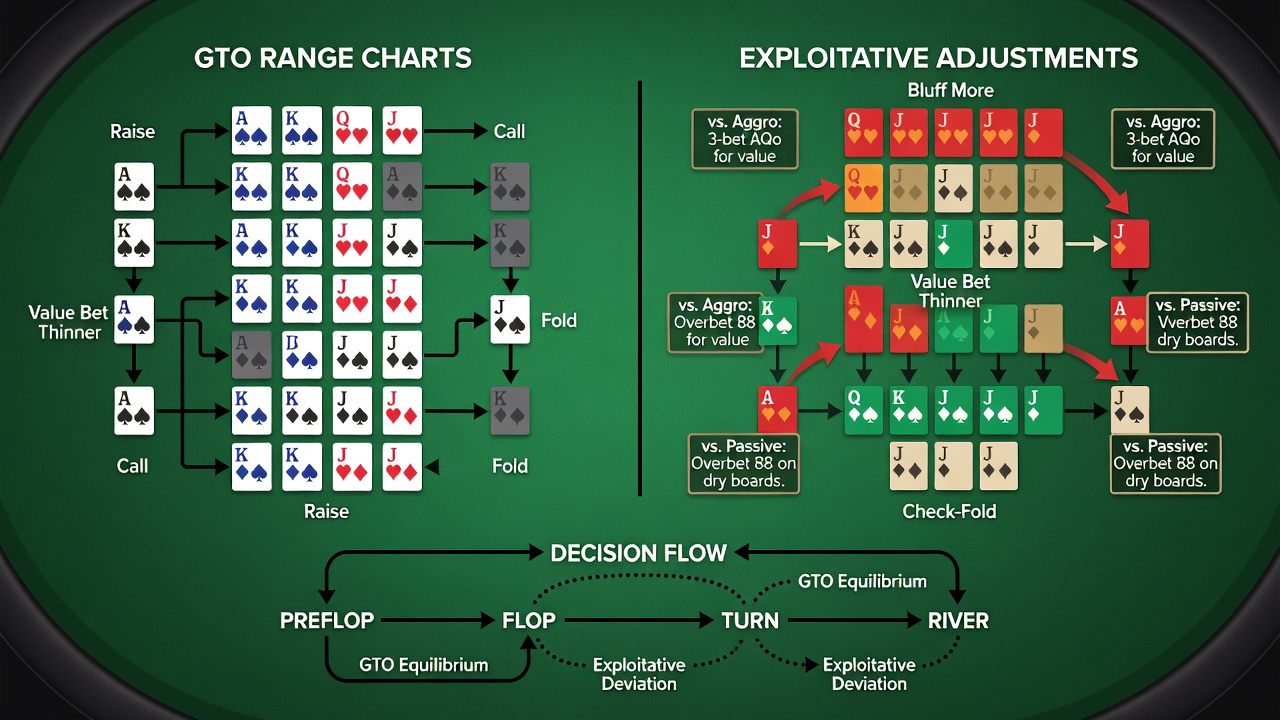
Texas Hold'em tournament players in 2026 face increasingly sophisticated competition both online and live. Understanding the balance between game theory optimal (GTO) strategies and exploitative adjustments separates winning players from the field. GTO relies on unexploitable equilibrium solutions derived from solvers, while exploitative play targets specific opponent weaknesses. Mastering when to deviate from GTO creates measurable edges in ICM spots and final tables. This comprehensive guide explores core concepts, practical adjustments, and decision frameworks used by top professionals. Readers will learn to identify leaks, adjust ranges dynamically, and apply 2026 meta-specific tactics across varying stack depths and payout structures.
Modern tournament fields blend recreational players with solver-trained regulars, making pure GTO insufficient on its own. Successful players use GTO as a foundation then layer targeted exploitation to maximize return on investment. The following sections break down each approach with concrete examples drawn from recent 2026 metas.
Defining GTO in Modern Poker Tournaments
Game theory optimal play seeks Nash equilibrium where no player can improve by unilaterally changing strategy. Solvers like PioSolver and GTO+ generate mixed strategies for preflop and postflop lines that remain profitable against perfect opponents. In tournaments, GTO incorporates ICM pressure, stack depths, and payout structures to recommend precise frequencies for continuation betting, check-raising, and 3-betting. These outputs account for bubble factors and pay-jump dynamics that change dramatically near the money or final table.
While pure GTO provides a robust baseline, it assumes opponents also play optimally. In real 2026 fields, many players deviate through recreational tendencies or outdated strategies learned from older training materials. GTO therefore serves as the defensive floor that prevents being exploited while you hunt for offensive edges elsewhere.
Understanding Exploitative Play
Exploitative strategies maximize profit by over-folding against frequent bluffers or value-betting thinner against calling stations. This approach requires accurate reads on opponent tendencies such as over-folding to river bets or under-bluffing in 3-bet pots. Successful exploitation often yields higher EV than strict GTO when opponent leaks are correctly identified and quantified.
Key exploitable tendencies include limp-calling too wide preflop, check-folding too often on dry boards, and failing to adjust 3-bet sizing against short stacks. The challenge lies in gathering reliable data without over-adjusting on small samples that lead to reverse exploitation.
Identifying Exploitable Tendencies in Opponents
Accurate identification begins with systematic observation. Online players should track VPIP and PFR stats in databases to spot loose-passive opponents who enter pots too frequently but fold too often postflop. Live players must note timing tells on big decisions and physical discomfort when facing aggression. Additional patterns include over-folding to river bets, limp-calling wide ranges in early position, and failing to 3-bet bluff enough against tight opening ranges.
- Track VPIP and PFR stats in online databases to spot loose-passive players who defend blinds too wide.
- Observe live tells such as timing tells on big decisions or physical discomfort when bluffing river barrels.
- Review hand histories for patterns like over-folding to aggression on later streets in multi-way pots.
- Note stack-size specific leaks, especially near pay jumps in 2026 tournament metas where ICM pressure amplifies mistakes.
- Monitor 3-bet defense frequencies to identify players who fold too much to aggression in position.
Adjusting Ranges Dynamically
Dynamic range adjustment starts with a GTO baseline then shifts frequencies based on reads. For example, widen your river bluff range against an opponent who folds 70% to river bets. Conversely, tighten value ranges against calling stations who defend too wide. In 2026 online tournaments, HUD data combined with population tendencies from sites like PokerNews allows rapid adjustments without abandoning core balance.
Always track your own deviation frequency to avoid becoming predictable. Small, incremental shifts of 10-15% in key frequencies often produce better long-term results than extreme overhauls that opponents can counter-exploit.
Practical Hand Examples from 2026 Metas
Consider a 40bb effective stack in a final-table bubble scenario with antes in play. GTO recommends a mixed 3-bet range from the cutoff including suited connectors and suited aces. Against a player who over-folds to 3-bets, shift to a polarized range with more bluffs while keeping premium value hands. In another example, on a 9-7-2 rainbow flop in position, GTO suggests 45% c-bet frequency. Against an opponent who folds 65% to flop c-bets, increase frequency to 70% while maintaining balance with strong value hands like top pair and sets.
A third example involves defending the big blind against a late-position open at 25bb effective. GTO mixes calls and raises with hands like suited connectors. When the opponent shows a high fold-to-3-bet stat, increase 3-bet bluff frequency with hands that have good postflop playability. These adjustments reflect current 2026 solver outputs calibrated to observed population stats from major online series.
Step-by-Step Decision Framework
- Establish GTO baseline using solver output for the specific stack and ICM situation, noting recommended frequencies for each action.
- Gather opponent data through stats or observation across at least 300-500 hands for statistical significance.
- Quantify the leak size (e.g., folds 15% more than GTO to river aggression) and estimate the EV impact per 100 hands.
- Calculate the EV gain from exploitation versus the risk of being counter-exploited if the opponent adjusts.
- Apply the adjustment in small sample sizes first, then review results in database software before scaling the deviation.
- Re-evaluate the read after 100 additional hands to confirm the leak persists or has been corrected.
This framework prevents over-adjustment while maximizing edges in both online and live settings.
Win-Rate Comparisons: GTO vs Exploitative Approaches
Studies of high-stakes 2026 tournament data show that pure GTO yields steady but modest ROI in tough fields. Players who successfully blend 70-80% GTO with targeted exploitation achieve noticeably higher win rates when reads are accurate. However, misapplied exploitation can reduce ROI by similar margins when opponents adjust or when reads prove incorrect. The optimal mix depends on field softness, personal read accuracy, and whether the event is online or live.
Blending approaches also helps during different tournament stages, with tighter GTO adherence early and more exploitation as stacks shorten and ICM pressure rises.
Online Versus Live Adjustments
Online environments provide rapid access to HUD stats and population reports, enabling quicker range adjustments. Live play requires greater reliance on physical tells, timing, and table image. In 2026, many players transition between formats, so maintaining a consistent GTO core while adapting exploitation methods remains essential for sustained success.
Common Pitfalls and How to Avoid Them
Many players over-adjust based on small samples or ignore reverse exploitation risks. Always maintain core GTO frequencies in key spots to stay unexploitable. Another pitfall is neglecting ICM implications when deviating from solver recommendations near pay jumps. Finally, failing to review hands after adjustments leads to repeated mistakes rather than continuous improvement.
Recommended Study Tools for 2026 Players
Combine solver work with database review software. Resources from WSOP official training materials and population reports help calibrate adjustments. Regular review of final table hands against updated solver libraries keeps strategies current. Additional practice comes from reviewing 2026 series hand histories shared on community forums and studying ICM-specific modules in modern training packages.
Conclusion
Balancing GTO foundations with exploitative adjustments delivers the highest edges in 2026 Texas Hold'em tournaments. Players who systematically identify leaks, apply measured adjustments, and review results consistently outperform both pure GTO robots and reckless gamblers. Implement the frameworks above to elevate your tournament results across both online and live formats.
FAQ
When should I stick strictly to GTO?
Stick close to GTO against unknown or highly skilled opponents where exploitation opportunities are limited or sample sizes remain small.
How many hands do I need to confirm an opponent leak?
Online, aim for at least 500 hands per stat; live requires more observation across multiple sessions and careful note-taking.
Can solvers account for 2026 tournament metas?
Yes, updated solver libraries incorporate recent population tendencies and ICM models from major series, allowing accurate baseline construction.
What is the biggest mistake when mixing GTO and exploitation?
The biggest mistake is over-adjusting without sufficient data, which turns a small edge into a large leak when opponents notice and counter.

No comments yet. Be the first!