 GambleLore

Introduction to MTT and SNG Profitability in 2026
Texas Hold'em players in 2026 face evolving dynamics between multi-table tournaments (MTTs) and sit-and-go (SNG) formats. Understanding profitability requires analyzing recent trends in player pools, software tools, and platform algorithms that have shifted slightly toward more aggressive early-stage play. This guide examines variance management, format selection based on bankroll size, payout impacts, and meta-specific adjustments to maximize edge while minimizing unnecessary risks in both formats.
2026 Profitability Metrics Comparison
MTTs offer higher potential returns due to larger fields and top-heavy payouts, while SNGs provide steadier cash flow with consistent top-three finishes. Data from major sites shows MTT ROI averaging 15-25% for skilled regulars, compared to 8-12% in SNGs as of late 2026. Variance remains higher in MTTs, demanding larger samples for reliable profit tracking. Players who specialize in MTTs often see their hourly rates fluctuate more dramatically, whereas SNG specialists benefit from predictable session lengths that allow for better work-life balance and consistent study time between games.
Variance Management Techniques
Effective variance control starts with session planning and emotional discipline. MTT players should cap daily entries at 5-7 tournaments to avoid emotional tilt after early bustouts. SNG grinders benefit from volume targets of 20-30 games per session but must incorporate mandatory breaks every two hours. Use tools like equity calculators to review hands immediately after sessions and maintain a 30+ buy-in buffer specifically for downswings. Additional techniques include tracking results in separate spreadsheets for each format, reviewing mental game logs weekly, and setting loss limits that trigger mandatory time away from the tables. These practices help sustain long-term profitability even during extended downswings common in 2026 player pools.
Bankroll Allocation for Different Sizes
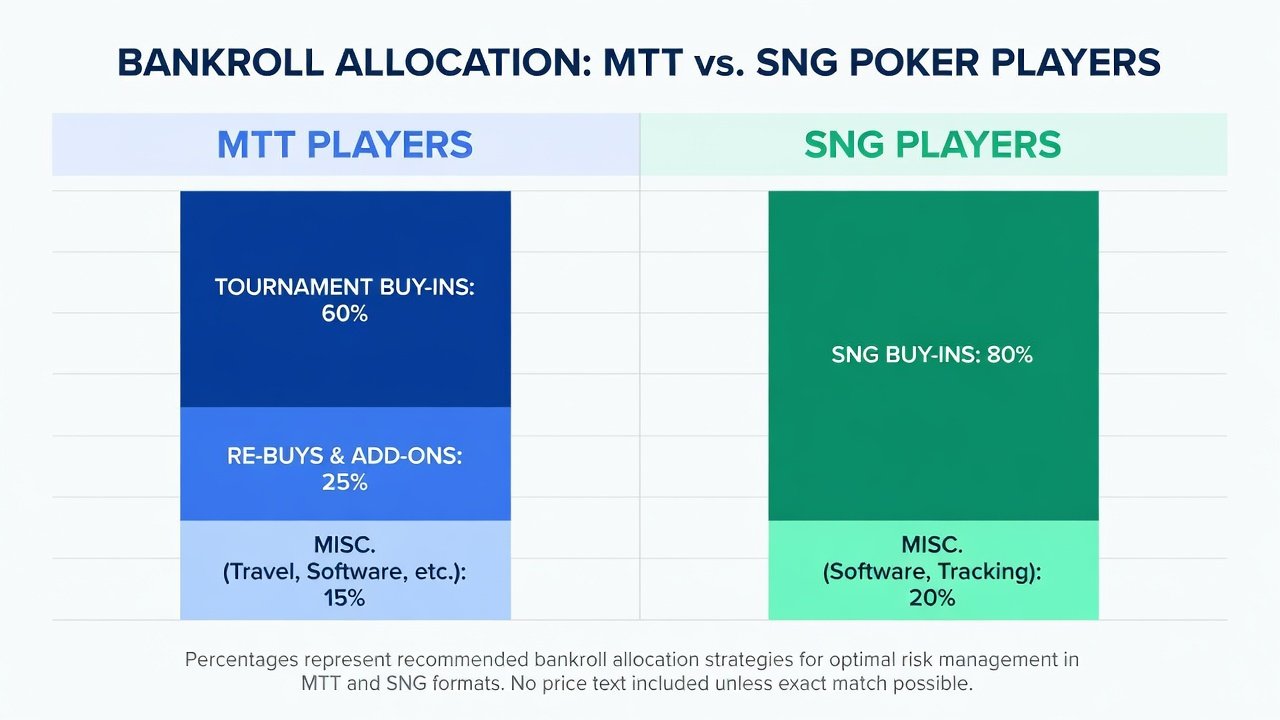
Bankroll management differs sharply by format and requires ongoing adjustment as your roll grows. A $5,000 bankroll supports 100+ MTT buy-ins at mid-stakes or 200+ SNG buy-ins, allowing for aggressive shot-taking in softer fields. Smaller rolls under $1,000 favor SNGs for lower variance and quicker feedback loops on skill development. Allocate 60% to MTTs and 40% to SNGs when bankroll exceeds 150 buy-ins for balanced growth. Players should also factor in monthly expenses and set aside 10-15% of profits for coaching or advanced software subscriptions to accelerate improvement.
Payout Structure Impacts and ICM Pressure
MTT payouts reward deep runs with exponential jumps, increasing ICM pressure near final tables where every decision carries outsized weight. SNGs feature flatter structures with quicker resolutions that reduce overall ICM complexity but demand precise short-stack play. Adjust calling ranges tighter in MTT late stages by 15-20% compared to early levels, especially when multiple short stacks remain. Explore payout calculators on PokerNews for real-time modeling of different payout structures and their impact on expected value.
Push-Fold Threshold Adjustments
Push-fold charts evolve with stack depths, blind levels, and opponent tendencies observed in 2026 metas. MTT push-fold thresholds tighten by 2-3 big blinds due to tougher fields and higher average skill levels. SNGs allow wider shoves from the button at 12-15bb because of the binary payout structure. Practice with ICMIZER simulations to refine these thresholds for specific formats and incorporate position-based adjustments that account for table dynamics seen on major platforms.
Meta-Specific Range Tweaks and Real-Hand Examples
Online platforms like PokerStars show tighter early-position ranges in MTTs compared to previous years. Example one: UTG raise with 88+ and AJ+ in 2026 MTTs versus wider 22+ and AT+ in SNGs during the same blind level. Example two: In a 6-max SNG with 18bb effective stacks, a cutoff shove range expands to include suited connectors like 65s when facing loose big blinds. Example three: MTT final table with 25bb stacks requires folding marginal hands like A9o to early position opens due to ICM implications. Review hand histories from recent sessions to identify leaks such as over-folding to 3-bets in high-ICM spots or failing to exploit recreational players who over-defend.
Step-by-Step Decision Frameworks
- Assess current bankroll size and recent variance tolerance based on the last 50 sessions.
- Review upcoming schedule for soft MTT fields during peak recreational hours.
- Calculate expected value using equity software before committing to high buy-in events.
- Switch formats if SNG ROI drops below 5% over a 100-game sample or if MTT variance causes extended losing streaks.
- Re-evaluate allocation percentages monthly and adjust based on win-rate trends.
When to Switch Formats Mid-Session
Monitor hourly win rates and emotional state every hour. Switch from MTTs to SNGs if variance spikes cause tilt after three consecutive busts or if table dynamics turn overly aggressive. Conversely, move to MTTs during peak evening hours when SNG lobbies fill with recreational players seeking quick action. Track all switches in a dedicated spreadsheet for pattern analysis and review monthly to refine your personal rules for format transitions.
Common Pitfalls to Avoid
- Ignoring ICM implications in MTT final tables leads to costly mistakes that erase weeks of profit.
- Overestimating SNG edges against improving regular player pools reduces long-term returns.
- Neglecting mental game during long MTT sessions results in suboptimal decisions late in tournaments.
- Failing to adjust ranges for 2026 rake structures and player pool changes creates consistent leaks.
- Underestimating the time required for proper hand review after each session.
- Chasing losses by jumping between formats without a clear plan.
FAQ on Time Commitment and Skill Edge
How much time is needed to realize edges? MTT players typically invest 15-20 hours weekly for consistent profits, while SNG grinders reach 30+ hours for volume-based edges that compound over time.
Does skill translate equally between formats? MTT skill edges manifest over larger samples due to higher variance; SNG edges appear faster but often cap at lower hourly rates. Combining both formats allows players to hedge variance while realizing full skill advantages.
What about time commitment for study? Dedicated players allocate at least five hours per week to reviewing hands and studying ICM scenarios to maintain an edge in 2026 environments.
Mastering these strategies positions players for sustained success across both MTT and SNG formats in the 2026 Texas Hold'em landscape.


No comments yet. Be the first!