 GambleLore

Introduction to European and American Roulette in 2026
Roulette continues to captivate players across online platforms and land-based casinos in 2026, yet the choice between European and American variants remains critical for anyone developing a serious strategy. The fundamental difference stems from wheel design, which alters probabilities and long-term player returns. European roulette uses a single-zero wheel, while the American version incorporates an additional double zero. This seemingly small variation creates substantial divergence in house edge, expected value, and the viability of common betting progressions.
Players seeking optimal results must understand these mechanics to adapt systems effectively. In this comprehensive guide, we examine rule distinctions, recalculate probabilities for both wheels, demonstrate how to modify Martingale and Fibonacci approaches with concrete bet sequences, and provide bankroll management scenarios. Additional sections cover table selection strategies for digital and physical environments, common pitfalls, and answers to frequently asked questions.
Rule Differences and House Edge Calculations
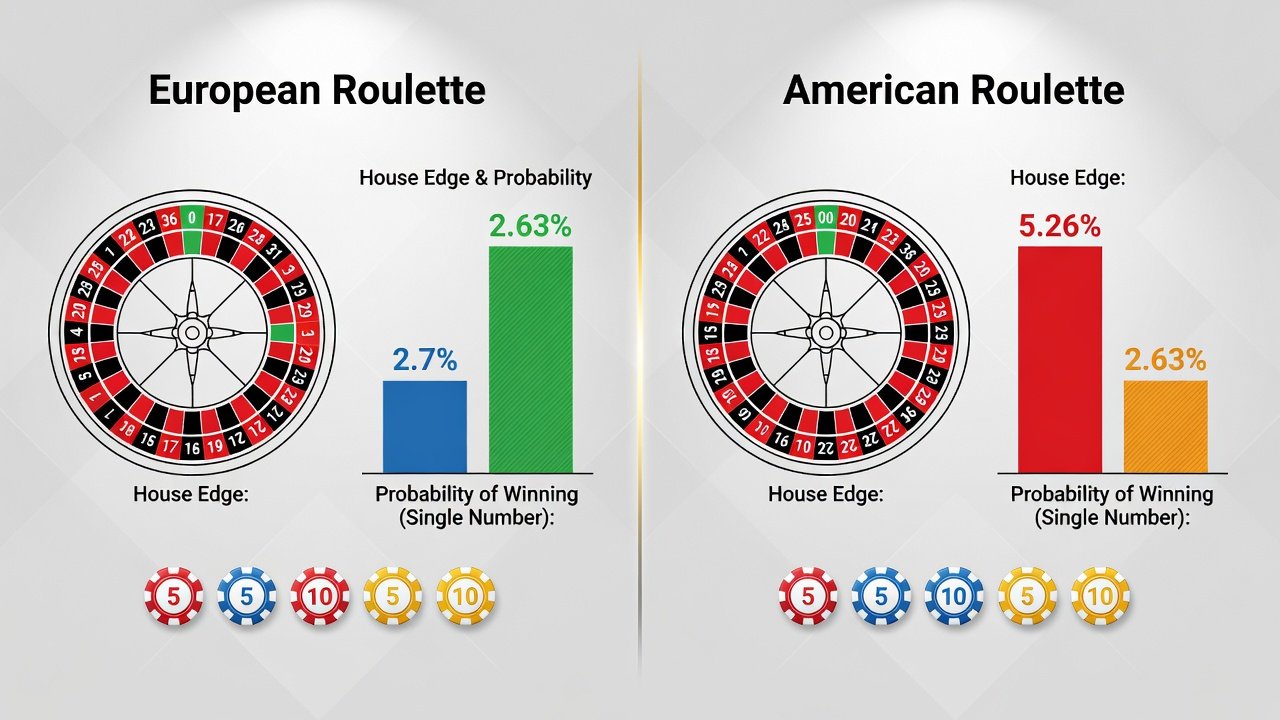
The European wheel contains 37 pockets consisting of numbers 1-36 and one zero. The American wheel expands to 38 pockets by adding the double zero. This extra pocket directly elevates the house edge from 2.70 percent on European wheels to 5.26 percent on American wheels. For even-money bets such as red or black, the payout remains 1:1 on both variants, yet the probability of success shifts measurably.
Calculating outcomes reveals clear implications. On a European wheel the probability of landing on a specific number equals 1 in 37, whereas the American wheel reduces this to 1 in 38. Over extended sessions these percentages compound, producing noticeably different bankroll trajectories. French roulette, a close relative of the European game, sometimes includes the "en prison" or "la partage" rules that can lower the house edge further to 1.35 percent on even-money wagers when the zero appears.
Learn more about roulette wheel mechanics from established references. Players benefit from reviewing these fundamentals before committing to any progression system.
Adapting Core Betting Systems
Martingale System Adjustments
The Martingale progression doubles the stake after every loss to recover prior deficits with a single win. On European wheels this system performs more efficiently because the lower house edge allows longer sequences before table maximums intervene. Consider a starting bet of 10 units on black: after four consecutive losses the next wager reaches 160 units. A win at this stage restores the entire deficit plus the original 10-unit profit.
American wheels demand larger reserves. The double zero increases the frequency of unfavorable outcomes, requiring approximately 20-25 percent more starting capital to withstand identical loss streaks. Session length typically shortens because the higher edge accelerates drawdowns. Experienced players often cap Martingale runs at five or six doublings on American tables to avoid rapid depletion.
Fibonacci Sequence Application
The Fibonacci system advances bets according to the sequence where each number equals the sum of the two preceding numbers. This creates a milder progression than Martingale. On European tables a 500-unit bankroll comfortably supports 15-18 steps before limits become restrictive. An example sequence beginning at 10 units might progress as 10, 10, 20, 30, 50, and so forth after losses.
American play compresses this timeline. The same 500-unit bankroll may only sustain 12 steps before risk thresholds are reached. Players frequently modify the system by resetting to the start after three wins rather than continuing indefinitely, preserving capital across both wheel types.
Additional Systems for Comparison
The D'Alembert method, which increases bets by one unit after losses and decreases after wins, offers a more conservative alternative. It pairs well with European wheels where variance remains lower. Labouchere, involving canceling numbers from a predetermined line after wins, requires careful tracking and benefits from the European layout's improved odds when constructing longer sequences.
Bankroll Scenarios and Practical Examples
Realistic planning begins with session simulations. A 1,000-unit bankroll over 150 spins using flat betting produces an expected loss of roughly 40.5 units on a European wheel compared with 79 units on an American wheel. When applying Martingale, the European scenario allows recovery within six doublings in most short streaks, while American play often requires pausing after four doublings to protect remaining funds.
Another scenario involves a 2,500-unit bankroll split across three sessions. Allocating 60 percent to European tables and 40 percent to American tables balances risk while permitting experimentation. Tracking results after each session reveals that European-focused play extends total playing time by nearly one-third before the stop-loss limit activates.
Players should establish clear win goals at 25 percent of the session bankroll and enforce them strictly. This prevents overextension regardless of wheel variant.
Selecting Tables in Online and Land-Based Casinos
- Verify wheel type in the game information panel or table signage before placing bets.
- Prioritize European or French variants featuring en prison rules for even-money bets.
- Online filters should target single-zero tables with current RNG certification from recognized testing agencies.
- Land-based visitors can observe wheel behavior during practice rounds to detect any mechanical biases.
- Compare table minimums and maximums to ensure they accommodate chosen progression lengths without premature termination.
Review regulatory standards for fair play from official bodies. Additional guidance on safe play appears at begambleaware resources.
Common Mistakes to Avoid
Many participants treat both variants identically and neglect the zero-pocket impact on probability. Others escalate bets without adjusting for the American wheel's steeper odds, leading to premature bankroll exhaustion. Failing to confirm wheel configuration before starting a session represents another frequent oversight. Always cross-reference the displayed wheel layout and set loss limits at 30 percent of available funds to maintain discipline.
Conclusion
European roulette delivers superior mathematical conditions and greater adaptability for most betting systems in 2026. American roulette introduces higher volatility that appeals to certain risk profiles but necessitates tighter controls and shorter progressions. Selecting the appropriate variant based on these documented differences supports more sustainable and strategic play over time.
FAQ
Is European roulette always better for strategy?
Yes, the single-zero configuration maintains a lower house edge, improving the performance of nearly every progression system.
When should I switch from American to European tables?
Switch when your bankroll falls below the level required to complete at least 12-15 progression steps safely on the higher-edge wheel.
Do betting systems work equally on both variants?
Systems operate on both wheels but demand larger reserves and earlier resets on American tables to remain effective.
Can I combine European and American play in one session?
Yes, many players allocate separate bankroll portions to each variant while applying the same core system with adjusted step limits.
How important is table selection for long-term results?
Table selection directly influences house edge exposure and progression viability, making verification of wheel type essential before every session.


No comments yet. Be the first!