 GambleLore

Introduction to Heads-Up Domination in Texas Hold'em Tournaments
Heads-up play represents the ultimate test of skill in Texas Hold'em tournaments. As fields narrow to the final two players in 2026 events, the dynamics shift dramatically from multi-way pots to a pure duel. Success requires precise adjustments to preflop ranges, heightened postflop aggression, and an understanding of Independent Chip Model (ICM) pressure. This guide delivers practical frameworks drawn from recent tournament trends, helping online players gain an edge in high-stakes situations.
Whether transitioning from cash games or refining late-stage tournament strategy, mastering heads-up demands both mathematical awareness and psychological insight. Players who adapt quickly often convert marginal situations into decisive advantages. Throughout 2026 online series, heads-up specialists have demonstrated that small edges in range construction and bet sizing compound rapidly when only two players remain. The following sections break down each critical element with concrete examples and decision trees you can apply immediately.
Adapting Preflop Ranges for Heads-Up Play
In heads-up situations, the button player acts first preflop but gains positional advantage postflop. Standard opening ranges expand significantly compared to full-ring play. A solid heads-up opening range from the button often includes any two cards with potential, typically 70-80% of hands. This includes all pairs, suited aces, suited connectors down to 54s, and many offsuit broadway combinations.
From the big blind, defend aggressively against raises. Three-bet frequencies increase, with many professionals mixing in suited connectors and small pairs for balance. Real-hand examples from 2026 WSOP Circuit events show top players widening their button opens to include hands like 7-2 suited when stacks are deep. For instance, at 50 big blinds effective, a strong player might open 82o from the button to apply immediate pressure, expecting the big blind to fold 40% of the time or defend weakly postflop.
Position and Stack Depth Considerations
Stack depth dictates range construction. With 30 big blinds or less, push-fold charts become essential. Deeper stacks allow for more speculative hands and postflop maneuvering. Always consider the opponent's tendencies before committing. When effective stacks drop below 20 big blinds, simplified push-fold strategies replace nuanced raising, and you should memorize approximate Nash ranges for both positions to avoid costly mistakes.
Postflop Aggression and Bet Sizing Strategies
Aggression defines winning heads-up play. Continuation betting frequencies rise to 60-70% on most boards when in position. Bet sizing should vary: smaller sizes (25-40% pot) on dry boards to maintain range advantage, larger sizes on wet boards to extract value from draws. On monotone boards, increase sizing to 55-70% pot to deny equity to flush draws while protecting your value hands.
Check-raising becomes a powerful weapon from the big blind. Use it selectively against over-aggressive c-bettors. 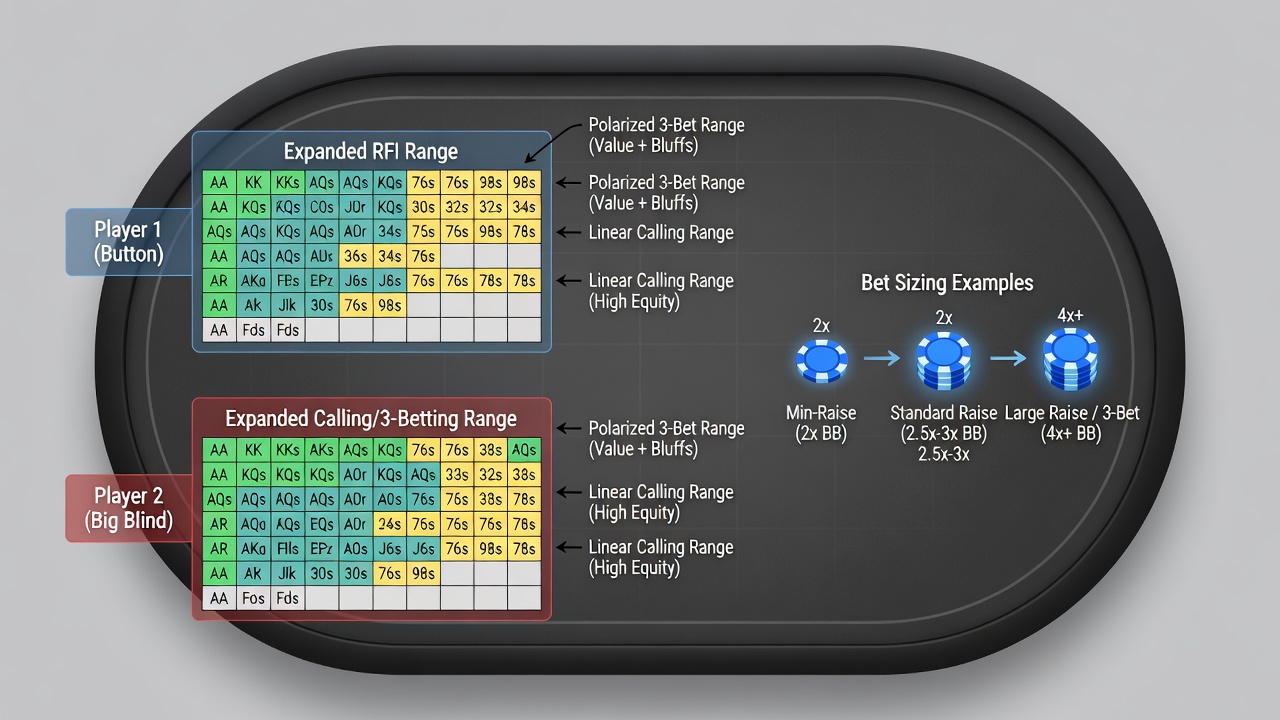
Step-by-Step Decision Frameworks for Key Spots
Develop repeatable frameworks for recurring heads-up decisions. First, assess board texture and your range advantage. Second, evaluate opponent stack depth and recent aggression. Third, calculate pot odds and implied odds before choosing bet size. In a 2026 online final table example, holding A9 on a K-7-2 rainbow flop against a loose opponent, the framework leads to a 35% pot continuation bet to fold out weaker kings and draws while keeping weaker pairs in.
Reading Opponent Patterns and Exploiting Tendencies
Pattern recognition separates elite players from the field. Track bet sizing tells, timing tells, and frequency of showdowns. In online 2026 tournaments, HUD software provides valuable data on VPIP and aggression factors. Adjust by tightening against nits and widening against loose-aggressive foes. Pay special attention to river bet sizing: players who suddenly overbet rivers often hold nuts, while smaller sizing frequently indicates bluffs or medium strength.
Common leaks include over-folding to three-bets and failing to bluff-catch on river. Counter these by mixing in more bluffs on coordinated boards and reviewing your own frequencies weekly.
Exploiting ICM Pressure in Late Tournament Stages
ICM dramatically alters heads-up decision-making when pay jumps are significant. With large pay differences, the shorter stack can apply pressure through all-ins, knowing the opponent may fold marginal hands. Review payout structures before final tables to calibrate risk tolerance. In one 2026 online series final, the short stack shoved 18 big blinds with KJo into the big blind's 35bb stack, correctly exploiting ICM pressure that forced a fold with a hand that would normally call.
Resources like official tournament rules from WSOP provide context for ICM calculations in major events.
Live vs Online Heads-Up Adjustments
Online play allows faster decisions and HUD tracking, while live games emphasize physical tells and table talk. Online players benefit from multi-tabling practice, whereas live requires stronger emotional control. Hybrid players should practice both formats to build versatility. Online adjustments include using timing tells from bet speed, while live players focus on breathing patterns and chip handling during heads-up.
Quick-Reference Aggression Checklist
- Expand button opens to 75%+ of hands in heads-up.
- Three-bet 12-15% from the big blind against button opens.
- Continuation bet 65% on average flops.
- Vary bet sizes based on board texture and stack depth.
- Exploit ICM by increasing shove frequency near pay jumps.
- Review hand histories after each session for leaks.
- Balance delayed continuation bets on later streets.
- Adjust three-bet sizing dynamically with stack depth.
Common Heads-Up Leaks and How to Avoid Them
Many players tighten too much preflop or become overly passive postflop. Avoid these by maintaining aggression and reviewing sessions with tracking software. Another frequent mistake is ignoring opponent adjustments—always evolve your strategy mid-match. Additional leaks include failing to barrel enough rivers with missed draws and overvaluing top pair in deep-stack confrontations. Fix these through deliberate practice on heads-up sit-and-gos before entering larger tournaments.
Frequently Asked Questions
How wide should I defend the big blind heads-up?
Defend at least 50% of hands against a button open, expanding to 60-65% when the opponent opens very wide. Focus on suited hands and connected cards that play well postflop.
What is the best bet size on dry flops?
Use 25-35% pot sizing on dry boards to keep the opponent's entire range in and maximize fold equity over multiple streets.
How does ICM change shove ranges?
ICM makes the short stack shove wider because the big blind's calling range tightens dramatically near pay jumps, allowing more profitable all-ins with marginal holdings.
Conclusion
Heads-up Texas Hold'em mastery in 2026 tournaments combines range awareness, aggression, and ICM savvy. Apply these frameworks consistently, study recent events, and refine through practice. Players who dominate heads-up consistently reach final tables and secure larger payouts. For further reading, explore strategy resources at PokerNews.


No comments yet. Be the first!