 GambleLore
Introduction
Tennis betting continues to grow in popularity throughout 2026, with major tournaments like the Australian Open, French Open, Wimbledon, and US Open drawing millions of wagers worldwide. For new and intermediate bettors, the appeal of quick profits can lead to repeated costly errors that erode bankrolls over time. Understanding these pitfalls is essential for improving retention and achieving better long-term results. This comprehensive guide explores the top five mistakes when using 2026 odds, supported by real-world examples from recent major events, and delivers actionable fixes to help you make smarter decisions.
Whether you are betting on clay, grass, or hard courts, success depends on thorough preparation rather than gut feelings. Many bettors overlook key variables such as surface performance, player schedules, and true value in the odds. By addressing these issues head-on, you can build a more sustainable approach that protects your capital and increases your edge.
Mistake 1: Ignoring Surface-Specific Stats
One of the most frequent errors involves failing to account for how different playing surfaces influence match outcomes. Clay courts reward endurance and consistent baseline play, while grass favors explosive serves and short points. Hard courts sit somewhere in between but still produce distinct patterns. In the 2026 Australian Open, several bettors lost heavily by backing players with strong overall records but poor hard-court win rates against specialists. Reviewing filtered head-to-head data and recent surface-specific form is critical before committing funds.
Practical research includes examining win percentages on each surface over the past 12 to 24 months. For example, a player who excels on clay may struggle when transitioning to grass in the same calendar year. Bettors who skipped this step during the 2026 clay swing often saw their ROI drop significantly. Always cross-reference multiple seasons of data rather than relying on a single tournament result.
Mistake 2: Chasing Overnight Odds Shifts
Odds movement can indicate sharp action, yet reacting impulsively to late changes without context frequently leads to losses. During the 2026 French Open, overnight line adjustments on several underdogs attracted heavy public money, only for the original favorites to prevail in straight sets. The key is understanding the reason behind any shift—whether it stems from injury news, weather, or simply bookmaker adjustments—rather than assuming the new number represents better value.
Instead of chasing movement, monitor lines for at least 24 hours using reputable sources and compare them against your own probability models. ATP Tour official site supplies detailed player statistics and schedules that help explain why odds fluctuate. Patience in this area often separates profitable bettors from those who repeatedly burn through their bankrolls.
Mistake 3: Mismanaging Stake Sizes Across Matches
Applying the same stake to every wager ignores varying levels of confidence and edge. In events such as the 2026 Indian Wells Masters, bettors who maintained fixed stakes across both high-confidence and speculative picks experienced faster drawdowns during variance swings. Effective bankroll management requires scaling stakes proportionally to your assessed value and overall risk tolerance, typically using a percentage model that never exceeds 2-5% of total capital on a single match.
Develop a clear staking plan before the tournament begins. For instance, allocate smaller percentages to matches with limited data and larger ones when multiple confirming factors align. This disciplined approach proved far more sustainable for bettors who navigated the grueling 2026 hard-court season successfully.
Mistake 4: Overlooking Player Fatigue and Schedule
Modern tennis calendars are demanding, with players frequently traveling between continents and playing consecutive weeks. Fatigue becomes especially relevant in best-of-five-set formats or during humid conditions. The 2026 Wimbledon fortnight provided clear examples where players who competed in long matches the previous week underperformed in later rounds. Bettors who ignored recovery time and recent match volume often backed tired favorites at unfavorable odds.
Build a simple tracking sheet that notes days between matches, travel distance, and any reported physical issues. Combining this information with surface demands helps identify hidden value on fresher opponents. Ignoring these details repeatedly reduces overall ROI across an entire season.
Mistake 5: Betting Without Assessing True Value
Many bettors focus solely on picking winners instead of identifying situations where the odds undervalue a player’s true chances. At the 2026 US Open, several mid-tier competitors offered genuine value against higher-ranked opponents on specific surfaces, yet casual bettors overlooked them in favor of short-priced favorites. Calculating your own probability estimate and comparing it to the implied probability from the odds is the foundation of long-term profitability.
Value exists when your researched chance exceeds the bookmaker’s margin-adjusted probability by a meaningful amount. WTA official site provides rankings, schedules, and historical data that support more accurate assessments. Consistently seeking these discrepancies rather than chasing popular picks is what separates successful bettors in 2026.
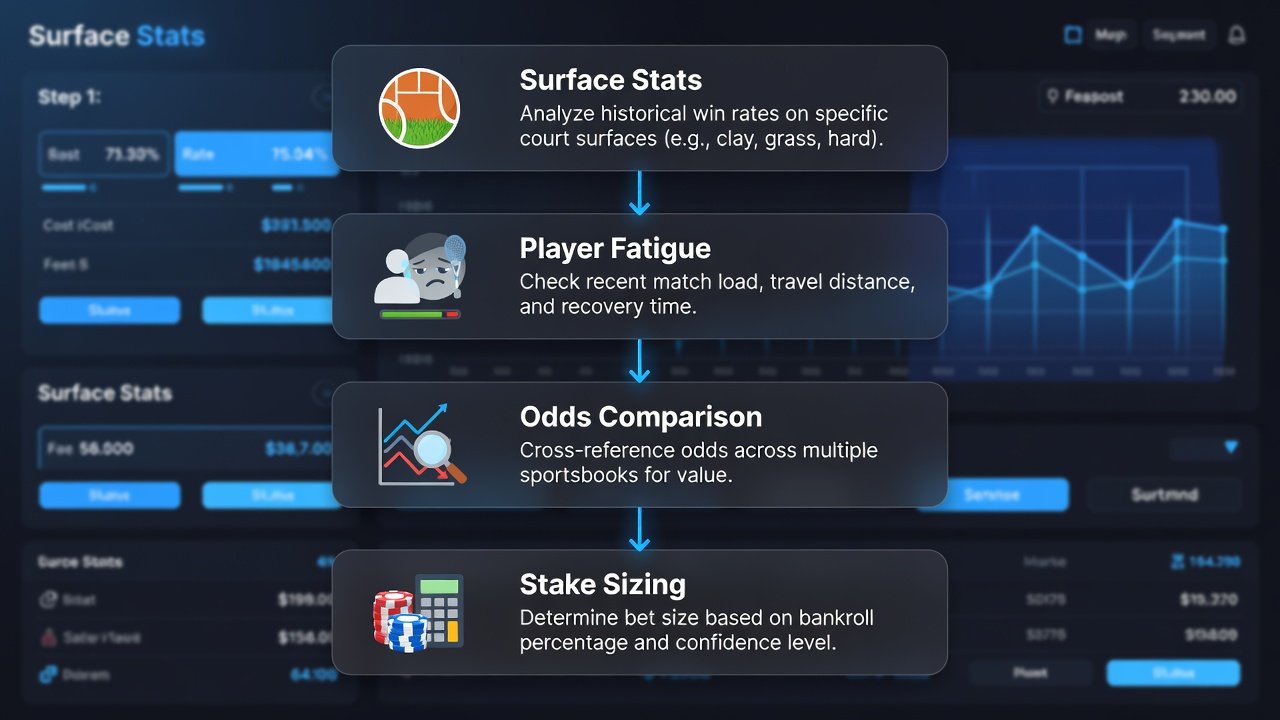
Step-by-Step Pre-Bet Research Checklist
- Filter all statistics by surface type and recent performance on that exact court speed.
- Review head-to-head records with attention to tournament round, best-of format, and weather conditions.
- Evaluate player fitness, days since last match, travel demands, and any reported injuries or illnesses.
- Build your own probability estimate for each outcome using multiple data points.
- Compare your estimate against current odds to confirm positive expected value.
- Determine stake size as a fixed percentage of your total bankroll scaled to edge size.
- Track line movement for 24 hours but avoid chasing without supporting new information.
- Document your reasoning and expected outcome for later review and adjustment.
FAQ: Spotting Value in Tennis Betting Odds
How do I calculate implied probability from decimal odds?
Divide one by the decimal odds to obtain the implied probability percentage. For example, odds of 2.50 imply a 40% chance. If your research suggests a higher likelihood, value may be present.
What separates true value from simply betting underdogs?
Value occurs whenever your estimated probability exceeds the odds-implied probability after accounting for the bookmaker margin. This can apply to favorites or underdogs depending on the specific matchup and surface.
How important is sample size when analyzing 2026 tennis form?
Small sample sizes can mislead. Prioritize at least 10-15 matches on the relevant surface and consider multiple seasons for more reliable patterns.
Should I adjust stakes after a losing streak?
Maintain your staking plan regardless of recent results. Increasing stakes to recover losses often compounds errors and accelerates bankroll depletion.
Conclusion
Avoiding these five mistakes requires consistent discipline and a structured research process. By focusing on surface-specific data, resisting impulsive odds chasing, managing stakes intelligently, monitoring fatigue, and hunting genuine value, you can improve your results throughout the 2026 tennis season. Apply the detailed checklist before every wager, review your outcomes regularly, and refine your approach based on what the data reveals. This methodical mindset transforms betting from a gamble into a skill-based activity with far better retention and profitability potential.
No comments yet. Be the first!