 GambleLore

Introduction to Custom Sports Betting Models
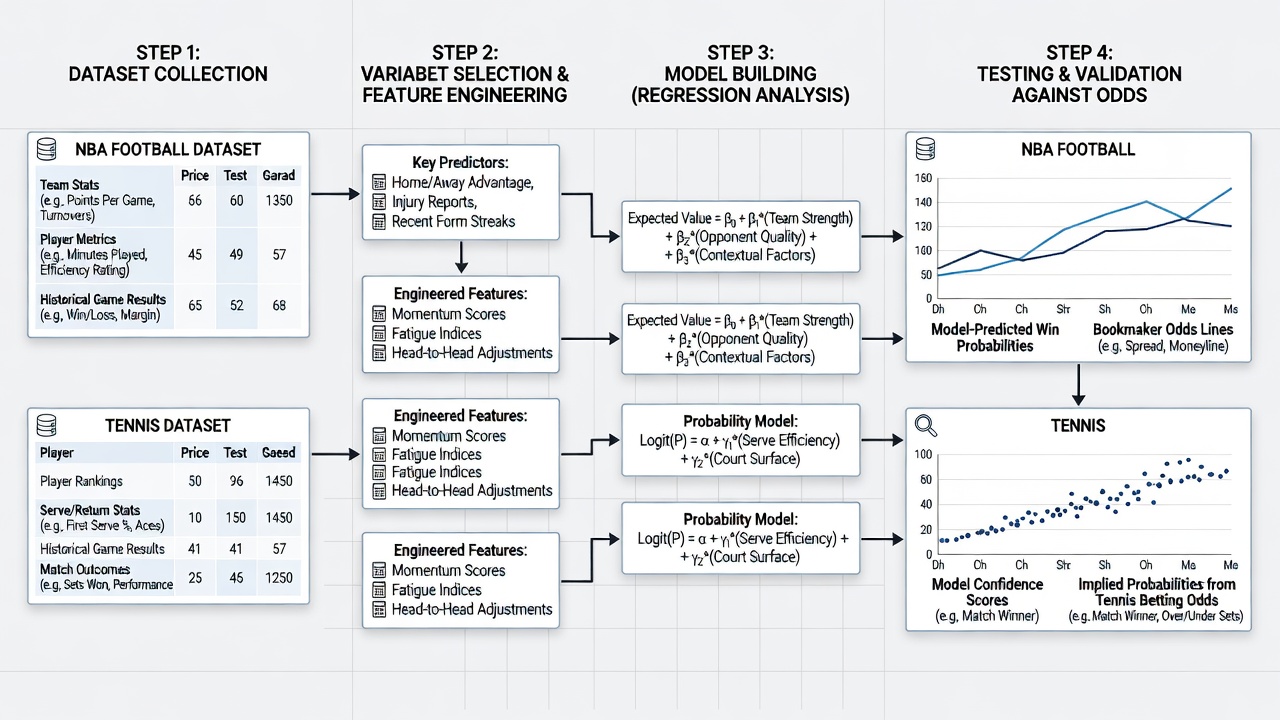
Creating your own betting model for football, NBA, and tennis allows intermediate bettors to move beyond generic tips and develop data-driven strategies tailored to 2026 markets. These models analyze historical trends, player performance, and odds movements to identify value bets. By building one yourself, you gain control over variables like team form and injury impacts, improving long-term profitability across major sports. Success depends on reliable data and rigorous testing. This guide walks through sourcing datasets, selecting variables, constructing models with accessible tools, and refining them against live 2026 betting odds. Intermediate bettors often start with simple spreadsheets before advancing to programming languages, ensuring the model evolves with new seasons and rule changes in each sport.
Sourcing Reliable Datasets for Football, NBA, and Tennis
High-quality data forms the foundation of any model. Start with official league sources and established statistics providers. For football, access match results, goal statistics, and player metrics from FIFA. NBA data includes player efficiency ratings, team standings, and advanced metrics available via NBA.com. Tennis requires detailed match histories, surface-specific performance, and ranking points from ATP Tour. Supplement with historical odds archives from reputable aggregators to track line movements. Ensure datasets cover at least five seasons for statistical robustness. Clean the data by removing duplicates and standardizing formats before import into your chosen tool. For example, download CSV files from league sites and use Excel's Power Query to merge player stats with match outcomes. Consider free public repositories for initial testing, then upgrade to premium feeds for granular details like shot locations in NBA or serve percentages in tennis. Always verify data freshness, as 2026 schedules introduce new teams and player transfers that can skew older models.
Selecting Key Variables for Accurate Predictions
Focus on variables that correlate strongly with outcomes. Core inputs include recent player or team form (last 5-10 matches), head-to-head records, home/away performance, and injury reports. For NBA models, incorporate pace and defensive ratings. Tennis models benefit from surface-specific win rates and fatigue indicators from travel schedules. Integrate historical odds movements to detect sharp action or public bias. Weight variables dynamically—player form might carry 40% influence in tennis while team chemistry dominates football calculations. Break this down by sport: In football, prioritize expected goals and possession metrics; in NBA, track usage rates and plus-minus scores; in tennis, emphasize break-point conversion and set-specific endurance. Create a variable importance chart during development to refine weights based on correlation analysis. Avoid redundant variables like raw points scored without context, as they dilute predictive power.
Step-by-Step Model Construction Using Accessible Tools
Use spreadsheet software like Excel or Google Sheets for beginners, or Python with libraries such as Pandas and Scikit-learn for more advanced users. Begin by importing cleaned datasets into a central table. Follow these detailed steps for a robust build:
- Define your target outcome, such as match winner or over/under totals, and label each row accordingly.
- Calculate derived metrics like expected goals for football or player efficiency differentials for NBA using formulas or scripts.
- Build a regression or logistic model to estimate probabilities, testing linear versus non-linear approaches.
- Incorporate odds data to compute implied probabilities and identify discrepancies between your projections and market lines.
- Run initial simulations on historical matches to calibrate parameters before full deployment.
For a concrete example, in Excel create columns for each variable, then use the Data Analysis ToolPak for regression. In Python, load data with Pandas, fit a logistic regression model, and output probability scores. Iterate by adding interaction terms, such as combining form with weather for outdoor football matches. This process typically takes 20-40 hours for a first viable version across the three sports.
Practical Examples of Testing Models Against 2026 Betting Odds
Apply your model to upcoming fixtures by pulling current odds from sportsbooks. Compare predicted probabilities against implied odds to spot value. For instance, if your football model projects a 65% win chance for a favored team priced at 55% implied probability, that represents a potential edge. Run backtests on 2025-2026 seasons first, then validate forward on fresh matches. Adjust coefficients based on performance discrepancies observed in real-time lines. Another example: For an NBA game, input recent pace stats and defensive ratings to forecast total points; if the model predicts 228 points against a line of 222.5, calculate the expected value and bet size accordingly. In tennis, test on clay versus hard courts separately to account for surface bias. Document every test result in a dedicated log to track improvements over dozens of matches.
Common Pitfalls to Avoid When Building Betting Models
Many models fail due to overfitting historical data without accounting for variance. Avoid ignoring sample size—small datasets lead to unreliable conclusions. Do not overlook external factors like weather in football or travel fatigue in tennis and NBA road games. Steer clear of confirmation bias by testing multiple scenarios. Regularly audit for data leakage where future information inadvertently influences past predictions. Additional pitfalls include failing to update for rule changes, such as new substitution rules in football, or neglecting bankroll management when scaling bets based on model outputs. Always separate training data from validation data to prevent inflated accuracy claims.
Validation Techniques and Live Adjustments
Validate using cross-validation methods, splitting data into training and test sets. Track metrics such as accuracy, ROI, and calibration of probability estimates. Monitor model performance over rolling windows to detect degradation. For live adjustments, integrate real-time feeds for injuries or lineups. Update probability outputs dynamically and recalibrate odds comparisons before placing bets. This keeps models responsive to 2026 market shifts. Use techniques like k-fold cross-validation for robustness and backtesting across multiple seasons. Implement a dashboard that flags when live data deviates more than 10% from model assumptions, prompting manual review.
Comparing Model Performance Across Sports
Football models often emphasize team-level aggregates due to lower scoring variance, while NBA models thrive on individual player tracking data. Tennis models require granular point-by-point analysis because of the sport's structure. Compare results by running parallel backtests: a football model might achieve 58% accuracy on over/under markets, whereas an NBA totals model could reach 62% with pace adjustments. Adjust feature engineering accordingly and consider ensemble methods that blend outputs from all three sports for diversified betting portfolios.
Short FAQ on Model Accuracy and Legal Considerations
How accurate can these models become?
Well-constructed models typically achieve 55-65% accuracy on major markets when properly validated, though results vary by sport and market efficiency.
Are sports betting models legal everywhere?
Legality depends on your jurisdiction. Always comply with local regulations and ensure responsible gambling practices before using any model for real stakes.
What data sources provide the most current 2026 updates?
Official league websites and established analytics platforms deliver the freshest statistics; cross-reference multiple sources to minimize errors.
How often should models be recalibrated?
Recalibrate at least monthly during active seasons or after significant roster changes to maintain edge.
Conclusion
Building a custom betting model for football, NBA, and tennis in 2026 empowers bettors with analytical tools that adapt to evolving markets. By sourcing quality data, selecting impactful variables, and rigorously testing and validating, you create a sustainable edge. Start small, iterate based on results, and maintain discipline to maximize long-term success. Remember that no model guarantees profits, so combine quantitative outputs with qualitative judgment for optimal results.

No comments yet. Be the first!